 Back
BackPhotosynthesis: Phototrophic Energy Metabolism and Carbon Fixation
Study Guide - Smart Notes
 Tailored notes based on your materials, expanded with key definitions, examples, and context.
Photosynthesis: An Overview
Introduction to Phototrophs
Phototrophs are organisms that convert solar energy into chemical energy, primarily in the form of ATP and NADPH. They are classified based on their carbon source and energy conversion mechanisms.
Photoautotrophs: Use solar energy and CO2 to synthesize energy-rich organic molecules.
Photoheterotrophs: Require organic sources for carbon but use light for energy.
General Steps of Photosynthesis
Photosynthesis consists of two main stages:
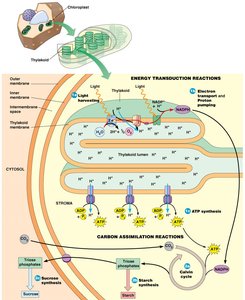
Energy Transduction: Light energy is converted to ATP and NADPH; water is oxidized to O2.
Carbon Fixation: Carbohydrates are formed from CO2 and H2O.
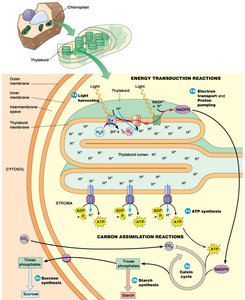
Chloroplast Structure and Function
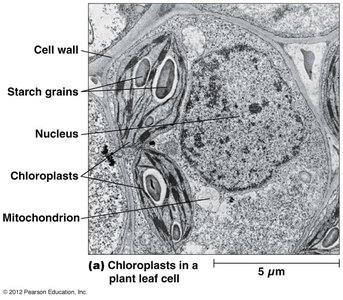
Chloroplasts in Plant Cells
Chloroplasts are the organelles where photosynthesis occurs. They contain internal membrane structures called thylakoids, which are organized into stacks (grana) and surrounded by stroma.
Starch grains: Temporary storage of glucose produced during photosynthesis.
Mitochondria: Present for cellular respiration.
Nucleus: Contains genetic material.
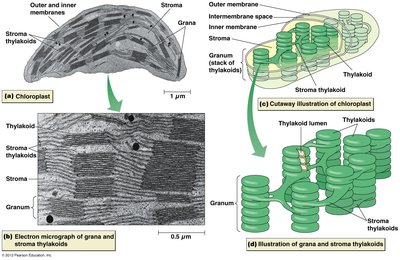
Chloroplast Ultrastructure
The chloroplast has a double membrane, internal thylakoid membranes, and stroma. Thylakoids are the site of light-dependent reactions, while the stroma is where the Calvin cycle occurs.
Grana: Stacks of thylakoids.
Stroma thylakoids: Connect grana stacks.
Light and Photosynthetic Pigments
Electromagnetic Radiation and Energy
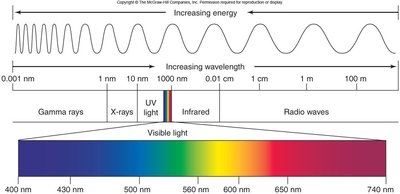
Light is a form of electromagnetic radiation with both wavelike and particle-like properties. The energy of a photon is inversely proportional to its wavelength: shorter wavelengths have higher energy.
Visible light: The range absorbed by photosynthetic pigments (400–740 nm).
Absorption Spectra of Photosynthetic Pigments
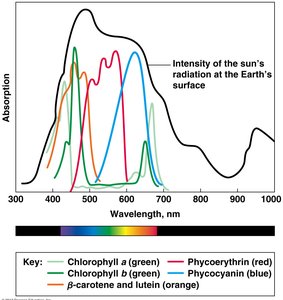
Photosynthetic pigments absorb specific wavelengths of light. Chlorophylls, carotenoids, and phycobilins each have unique absorption spectra, allowing plants to utilize a broad range of sunlight.
Chlorophyll a: Main pigment, absorbs blue and red light.
Accessory pigments: Expand the range of absorbed light.
Structure of Chlorophyll
Chlorophyll molecules have a porphyrin ring with a central magnesium ion and a hydrophobic phytol tail, enabling their integration into thylakoid membranes. 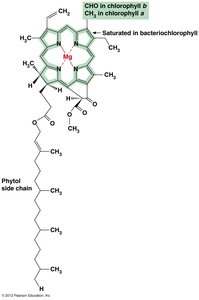
Photosystems and Light Harvesting
Organization of Photosynthetic Pigments
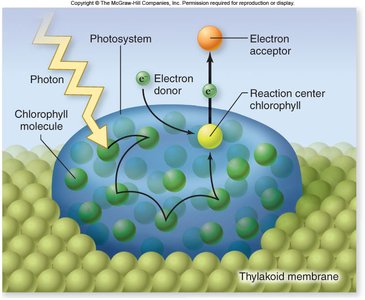
Pigments are organized into photosystems, which consist of a light-harvesting complex and a reaction center.
Antenna pigments: Collect and transfer energy to the reaction center.
Reaction center: Site where electromagnetic energy is converted to chemical energy via electron transfer.
Redox Reactions in Photosystems
When light excites chlorophyll, electrons are transferred to an electron acceptor, initiating a redox reaction. 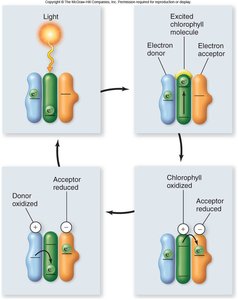
Energy Transduction: The Z-Scheme
Noncyclic Electron Flow
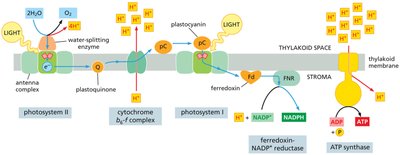
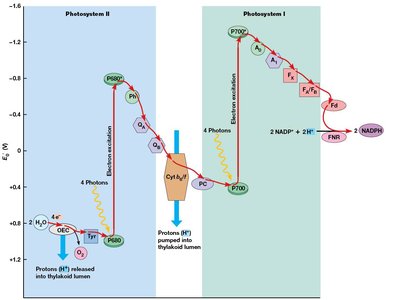
The Z-scheme describes the flow of electrons from water through photosystem II (PSII), cytochrome b6/f complex, photosystem I (PSI), and finally to NADP+, forming NADPH.
Photosystem II: Removes electrons from water, releases O2, and passes electrons to plastoquinone.
Cytochrome b6/f complex: Transfers electrons to PSI and pumps protons into the thylakoid lumen.
Photosystem I: Transfers electrons to ferredoxin, which reduces NADP+ to NADPH.
ATP Synthesis: Photophosphorylation
The proton gradient generated by electron transport drives ATP synthesis via ATP synthase.
Photophosphorylation: The process of ATP formation using light energy.
Stoichiometry: 14 H+ are required for synthesis of 3 ATP molecules.
Cyclic Electron Flow
Cyclic electron flow occurs when NADPH consumption is low or additional ATP is needed. Electrons from ferredoxin are cycled back to the cytochrome b6/f complex, increasing ATP production without generating NADPH. 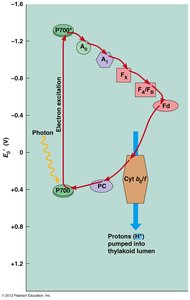
Carbon Fixation: The Calvin Cycle
Phases of the Calvin Cycle
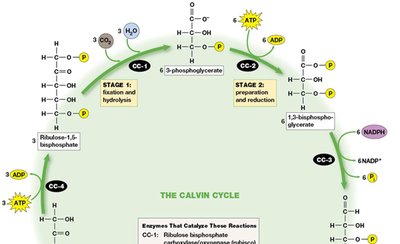
The Calvin cycle, occurring in the stroma, fixes carbon dioxide into organic molecules. It consists of three phases:
Fixation: CO2 reacts with ribulose-1,5-bisphosphate (RuBP) to form two 3-phosphoglycerate molecules.
Reduction: 3-phosphoglycerate is phosphorylated by ATP and reduced by NADPH to produce glyceraldehyde 3-phosphate (G3P).
Regeneration: Most G3P is used to regenerate RuBP; one out of six G3P molecules exits the cycle.
Fate of Sugar Produced by Photosynthesis
G3P produced by the Calvin cycle is used to synthesize glucose and fructose, which combine to form sucrose. Excess glucose is stored as starch in the chloroplast and later mobilized for transport.
Phosphate translocator (TPT): Important for transporting triose phosphates between stroma and cytosol.
Photorespiration and Its Avoidance
Photorespiration: The Glycolate Pathway
Rubisco, the enzyme responsible for carbon fixation, can also react with O2, leading to photorespiration. This process reduces photosynthetic efficiency by producing phosphoglycolate, which is recycled through the glycolate pathway involving chloroplasts, peroxisomes, and mitochondria.
Photorespiration: Returns ~75% of reduced carbon to the Calvin cycle but releases CO2 and consumes ATP.
Strategies to Avoid Photorespiration
C3 plants: No specific strategy; susceptible to photorespiration.
C4 plants: Confine rubisco to cells with high CO2 concentration using the Hatch-Slack cycle.
CAM plants: Minimize photorespiration and water loss by taking in CO2 at night.
Summary Table: Photosynthetic Pathways
Plant Type | Photorespiration Avoidance | Key Feature |
|---|---|---|
C3 | None | Direct Calvin cycle |
C4 | High CO2 in bundle sheath cells | Hatch-Slack cycle |
CAM | CO2 uptake at night | Temporal separation |
Key Equations
Energy of a Photon
where E is energy, h is Planck's constant, c is speed of light, and \lambda is wavelength.
Calvin Cycle Fixation Reaction
Photorespiration Reaction
Conclusion
Photosynthesis is a complex process involving light-dependent energy transduction and carbon fixation. The efficiency of carbon fixation is influenced by environmental conditions and the plant's strategy to avoid photorespiration. Understanding these mechanisms is fundamental to cell biology and plant physiology.
