 Back
BackCh 11 - Photosynthetic Energy Metabolism: Photosynthesis (Cell Biology Study Notes)
Study Guide - Smart Notes
 Tailored notes based on your materials, expanded with key definitions, examples, and context.
Chapter 11: Phototrophic Energy Metabolism – Photosynthesis
Learning Objectives
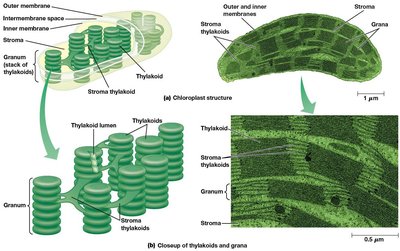
Explain the similarities and differences in the structure and function of mitochondria and chloroplasts as energy-generating organelles.
Describe the structure and function of photosystems.
Compare electron transport in mitochondria and chloroplasts.
Explain the regulation of the photosynthetic energy transduction pathway from light-harvesting to ATP and NADPH synthesis.
Illustrate cyclic electron flow through PSI and PSII.
Explain the regulation of the photosynthetic carbon assimilation pathway from the Calvin cycle to carbohydrate synthesis.
Describe the endosymbiotic theory for the evolution of mitochondria and chloroplasts.
Overview of Photosynthesis
Importance and Location
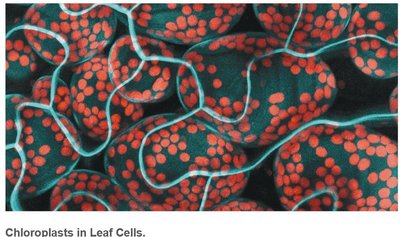
Photosynthesis is the primary metabolic process sustaining life on Earth, converting solar energy into chemical energy. In eukaryotic phototrophs, this process occurs in chloroplasts, which contain an internal membrane system called thylakoids. In cyanobacteria, similar processes occur in internal membranes and carboxysomes (protein complexes for carbon fixation).
Energy transduction reactions convert solar energy into NADPH and ATP.
Carbon assimilation reactions use this chemical energy to fix and reduce CO2 to carbohydrates.
Photosynthetic Energy Transduction I: Light Harvesting
Absorption of Light and Excitation of Electrons
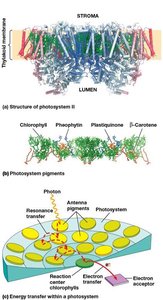
Light energy is absorbed by chlorophyll and accessory pigments in the thylakoid membranes. This energy is transferred to a special pair of chlorophyll molecules at the reaction center of a photosystem, where it excites and ejects an electron, initiating charge separation. In oxygenic phototrophs, the lost electron is replaced by one from water, generating oxygen as a byproduct.
Photosystem II (PSII) and Photosystem I (PSI) are the two main photosystems involved.
Accessory pigments expand the range of light absorption.
Photosynthetic Energy Transduction II: NADPH Synthesis
Electron Transport Chain and Proton Gradient
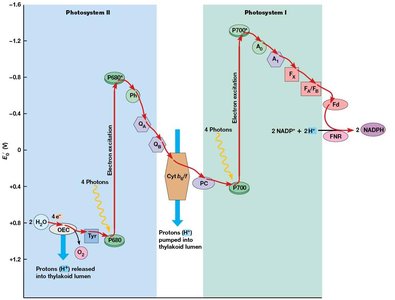
Electrons flow from water to NADP+ via two photosystems acting in series. PSII oxidizes water, while PSI reduces NADP+ to NADPH in the stroma. The electron transport chain includes a cytochrome complex that pumps protons into the thylakoid lumen, creating a proton gradient that stores solar energy.
Electron flow: Water → PSII → Cytochrome complex → PSI → NADP+
Proton gradient drives ATP synthesis.
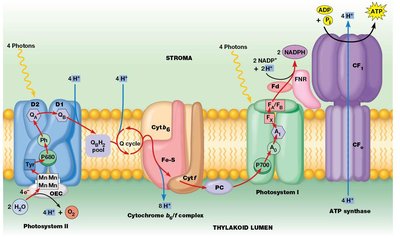
Photosynthetic Energy Transduction III: ATP Synthesis
ATP Synthase and Chemiosmosis
The proton motive force across the thylakoid membrane is used by the CF0CF1 ATP synthase complex to synthesize ATP as protons flow back into the stroma. This process is analogous to ATP synthesis in mitochondria but occurs in the chloroplast thylakoid membrane.
ATP synthase structure: CF0 (membrane channel) and CF1 (catalytic head in stroma).
ATP is produced as ADP and inorganic phosphate (Pi) are combined.
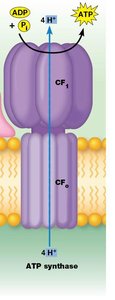
Photosynthetic Carbon Assimilation I: The Calvin Cycle
Stages and Enzymes of the Calvin Cycle
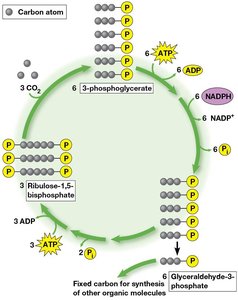
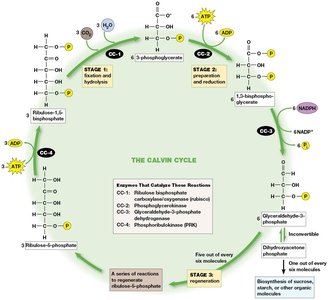
In the stroma, ATP and NADPH are used to fix and reduce CO2 into organic molecules via the Calvin cycle. The cycle consists of three main stages:
Carboxylation: CO2 is fixed by rubisco to form 3-phosphoglycerate (3-PGA).
Reduction: 3-PGA is reduced to glyceraldehyde-3-phosphate (G3P).
Regeneration: Ribulose-1,5-bisphosphate (RuBP) is regenerated to continue the cycle.
The net synthesis of one triose phosphate (G3P) requires fixation of three CO2 molecules, using nine ATP and six NADPH molecules.
Input | Output |
|---|---|
3 CO2 | 1 G3P |
9 ATP | 9 ADP + 8 Pi |
6 NADPH | 6 NADP+ |
Regulation of the Calvin Cycle
Enzyme Regulation and Light Activation
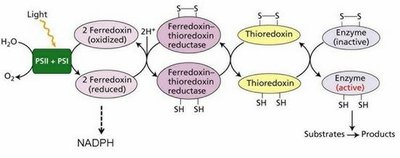
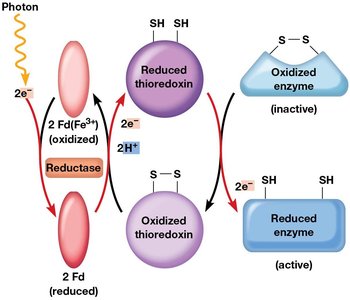
Key enzymes of the Calvin cycle are regulated to maximize efficiency. They are synthesized only in photosynthetic tissues exposed to light and are activated by high stromal pH and magnesium concentrations. Additional regulation involves thioredoxin (which senses the redox state) and rubisco activase (which removes inhibitors from rubisco in the light).
Light-dependent activation ensures Calvin cycle operates only when ATP and NADPH are available.
Thioredoxin-mediated reduction activates Calvin cycle enzymes.
Photosynthetic Carbon Assimilation II: Carbohydrate Synthesis
Fate of G3P and Biosynthesis Pathways
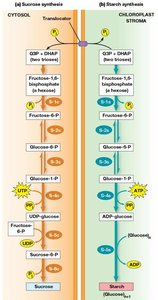
The initial product of CO2 fixation, glyceraldehyde-3-phosphate (G3P), is interconvertible with dihydroxyacetone phosphate (DHAP). These triose phosphates are used for the synthesis of complex carbohydrates (glucose, sucrose, starch, glycogen) and as precursors for other metabolic pathways. ATP produced in the chloroplast is also used for fatty acid, chlorophyll synthesis, and nitrogen/sulfur assimilation.
Rubisco’s Oxygenase Activity and Photorespiration
Photorespiration and Its Consequences
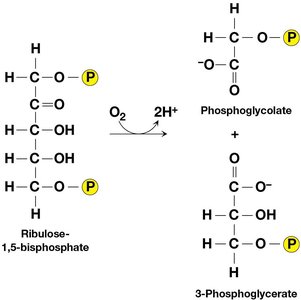
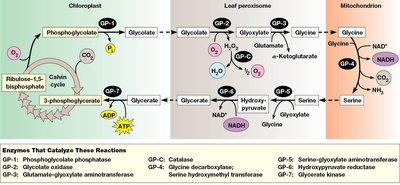
Rubisco can catalyze the reaction of O2 with RuBP, producing phosphoglycolate, which cannot be used in the Calvin cycle. The glycolate pathway (photorespiration) recycles phosphoglycolate but results in the loss of fixed carbon and energy. This process involves the chloroplast, peroxisome, and mitochondrion, and is called photorespiration because it consumes O2 and releases CO2 in the light.
Adaptations to Reduce Photorespiration: C4 and CAM Pathways
C4 and CAM Plant Strategies
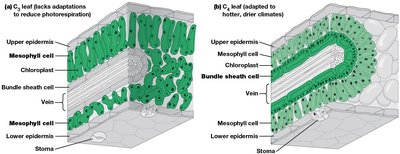
C4 and CAM plants have evolved mechanisms to minimize photorespiration. In these plants, CO2 is initially fixed by a carboxylation reaction that does not involve rubisco, and is later released in conditions favoring rubisco’s carboxylase activity (low O2, high CO2). In C4 plants, this occurs in different cell types; in CAM plants, it occurs at different times of day.
C4 pathway: Spatial separation of initial CO2 fixation and the Calvin cycle.
CAM pathway: Temporal separation (night vs. day) of CO2 fixation and Calvin cycle.
Summary Table: Comparison of Photosynthetic Pathways
Pathway | CO2 Fixation | Main Adaptation | Photorespiration |
|---|---|---|---|
C3 | Directly by rubisco | None | High |
C4 | PEP carboxylase (mesophyll), then rubisco (bundle sheath) | Spatial separation | Low |
CAM | PEP carboxylase (night), then rubisco (day) | Temporal separation | Low |
Additional info: The endosymbiotic theory explains the origin of chloroplasts and mitochondria as descendants of free-living prokaryotes engulfed by ancestral eukaryotic cells. Both organelles retain their own DNA and double membranes, supporting this evolutionary relationship.
