 Back
BackProtein Targeting and Sorting: Mechanisms of Cellular Compartmentalization
Study Guide - Smart Notes
 Tailored notes based on your materials, expanded with key definitions, examples, and context.
Protein Targeting and Sorting
Overview of Protein Targeting
Protein targeting and sorting are essential cellular processes that ensure proteins reach their correct destinations within the cell. Proteins are synthesized in the cytosol and must be directed to organelles such as the nucleus, mitochondria, chloroplasts, peroxisomes, or the endomembrane system. This targeting is achieved through specific signal sequences and transport mechanisms.
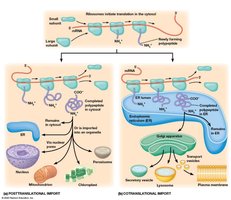
Cotranslational import: Protein import occurs simultaneously with translation, typically into the endoplasmic reticulum (ER).
Posttranslational import: Protein import occurs after translation is complete, targeting organelles such as the nucleus, mitochondria, chloroplasts, and peroxisomes.
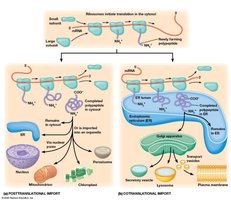
Posttranslational Import
Target Organelles
Proteins destined for the nucleus, mitochondria, chloroplasts, and peroxisomes are typically imported posttranslationally. Each organelle has unique import requirements and mechanisms.
Nucleus: Import through nuclear pores, regulated by nuclear localization signals (NLS).
Mitochondria: Import via TOM/TIM complexes, requiring transit sequences and chaperones.
Chloroplasts: Import via TOC/TIC complexes, with specific targeting sequences.
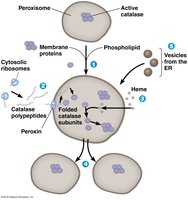
Peroxisomes: Import via peroxins, using peroxisomal targeting signals.
Requirements for Protein Import
Tag/Signal Sequence: A stretch of amino acids that directs the protein to its destination.
Translocator Complexes: Protein complexes that facilitate translocation across membranes (e.g., TOM/TIM, TOC/TIC).
Chaperones: Proteins that maintain the unfolded state of the protein during transport and assist in refolding upon entry.
Structure of the Nucleus
Nuclear Envelope and Pores
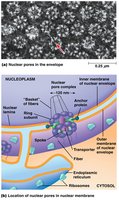
The nucleus is surrounded by a double membrane called the nuclear envelope, which contains nuclear pores for regulated exchange of materials between the nucleus and cytoplasm.
Outer membrane: Continuous with the endoplasmic reticulum.
Inner membrane: Lined by the nuclear lamina, providing structural support.
Nuclear pores: Large protein complexes that control molecular traffic.
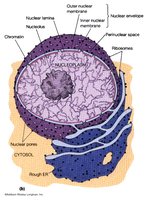
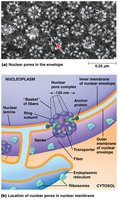
Nuclear Lamina
The nuclear lamina is a dense fibrillar network inside the nucleus, providing mechanical support and regulating important nuclear events.
Supports the shape of the nuclear envelope.
Regulates nuclear envelope formation and degeneration during mitosis.
Stabilizes the positions of nuclear pores and binds interphase chromatin.
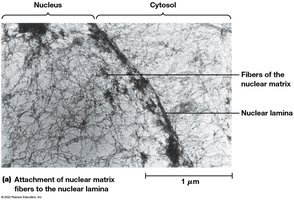
Nucleoplasm and Nucleolus
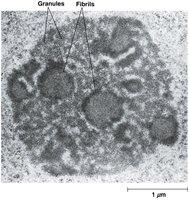
The nucleoplasm is the semi-fluid matrix inside the nucleus, containing chromatin and the nucleolus. The nucleolus is the site of ribosomal RNA synthesis and ribosome assembly.
Granular component: Bulk of the nucleolus, containing ribosomal subunits.
Fibrillar centers: Loosely packed fibrils, sites of rRNA gene transcription.
Dense fibrillar component: Tightly packed fibrils, containing nucleolin and fibrillarin.
Nuclear Pores and Transport
Function of Nuclear Pores
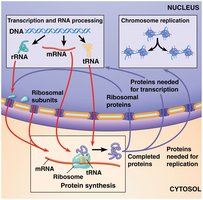
Nuclear pores serve as selective gateways for the movement of molecules between the nucleus and cytoplasm, facilitating both import and export processes.
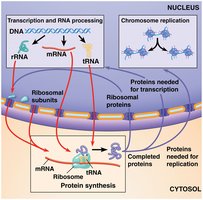
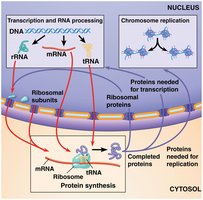
Export: Mature tRNA, mRNA, and ribosomal subunits are exported from the nucleus.
Import: Nuclear proteins, histones, nucleic acid polymerases, gene regulatory proteins, and RNA processing proteins are imported into the nucleus.
Carrier-Mediated Transport
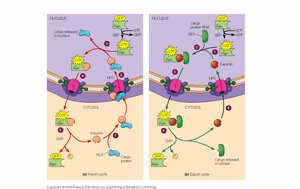
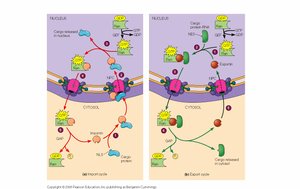
Transport through nuclear pores is mediated by carrier proteins such as importins and exportins, which recognize specific signal sequences on cargo molecules.
Import and Export Mechanisms
Import: Importin binds to cargo with a nuclear localization signal (NLS), transports it into the nucleus, and releases it upon binding Ran-GTP.
Export: Exportin binds to cargo with a nuclear export signal (NES) and Ran-GTP, transports it out, and releases it upon GTP hydrolysis.
Protein Import into Mitochondria and Chloroplasts
General Mechanism
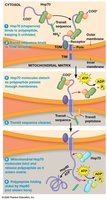
Proteins destined for mitochondria and chloroplasts are synthesized in the cytosol and imported posttranslationally. Chaperones keep proteins unfolded, and specific transit sequences direct them to the correct organelle.
Unfolded protein binds to receptor on the outer membrane.
Protein is translocated through TOM/TIM (mitochondria) or TOC/TIC (chloroplasts) complexes.
Signal sequence is cleaved, and chaperones assist in folding the protein inside the organelle.
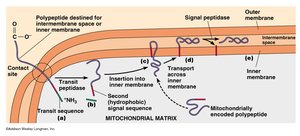
Chloroplast Targeting Specifics
Stroma: Single signal sequence directs import.
Thylakoid membrane: Initial signal for stroma import is removed, and a second hydrophobic signal directs insertion into the membrane.
Thylakoid lumen: Multiple signals are required for targeting.
Peroxisomal Protein Import
Proteins are imported into peroxisomes posttranslationally from free ribosomes in the cytosol. Specialized transporters called peroxins mediate this process.
Posttranslational Import into the Endoplasmic Reticulum (ER)
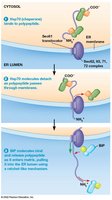
Some proteins are imported into the ER after translation, with the help of the chaperone BiP, which pulls the protein into the ER lumen through a translocator complex.
Cotranslational Import
Endomembrane System Targeting
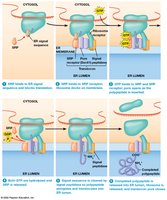
Cotranslational import is the process by which proteins are imported into the ER during their synthesis. This is the primary pathway for proteins destined for the ER, Golgi complex, lysosomes, secretory vesicles, or the plasma membrane.
Types of Proteins Synthesized in the RER
Water-soluble proteins: Released into the ER lumen, may remain or be packaged for secretion or delivery to other organelles.
Transmembrane proteins: Embedded in the ER membrane, destined for membranes of the endomembrane system or plasma membrane.
Mechanism of Cotranslational Import
ER targeting sequence emerges from the ribosome and is recognized by the signal recognition particle (SRP).
SRP binds to its receptor on the RER membrane.
Protein translocator facilitates entry of the growing polypeptide into the ER lumen.
Signal peptidase cleaves the targeting sequence.
Cotranslation of Transmembrane Proteins
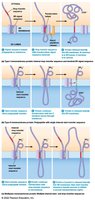
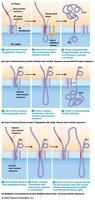
Transmembrane proteins are inserted into the ER membrane during synthesis. The number and arrangement of start and stop transfer sequences determine the protein's orientation and topology in the membrane.
Summary Table: Protein Targeting Pathways
Destination | Import Mechanism | Key Signals/Complexes | Chaperones |
|---|---|---|---|
Nucleus | Posttranslational | NLS, Nuclear pore complex, Importin/Exportin | No (protein folded) |
Mitochondria | Posttranslational | Transit sequence, TOM/TIM | Yes (unfolded state) |
Chloroplast | Posttranslational | Transit sequence, TOC/TIC | Yes (unfolded state) |
Peroxisome | Posttranslational | Peroxisomal targeting signal, Peroxins | No (protein folded) |
ER (lumen/membrane) | Cotranslational/Posttranslational | Signal sequence, SRP, Translocon | Yes (BiP for posttranslational) |
