 Back
BackSmall-Molecule Transport and Electrical Properties of Membranes
Study Guide - Smart Notes
 Tailored notes based on your materials, expanded with key definitions, examples, and context.
Small-Molecule Transport and Electrical Properties of Membranes
Overview of Membrane Transport
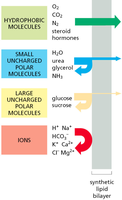
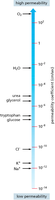
Cell membranes regulate the movement of small molecules and ions, maintaining distinct internal and external environments. The lipid bilayer is selectively permeable, allowing certain molecules to pass while restricting others, and specialized proteins facilitate transport across the membrane.
Key Point 1: The lipid bilayer is impermeable to most ions and polar molecules, but permeable to hydrophobic molecules.
Key Point 2: Membrane transport proteins enable the movement of substances that cannot freely cross the bilayer.
Example: Oxygen (O2) and carbon dioxide (CO2) diffuse freely, while ions like Na+ and K+ require transport proteins.
Inorganic Ion Concentrations Inside and Outside Cells
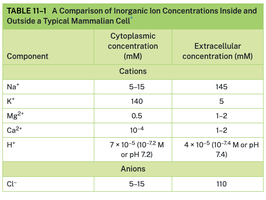
The concentration of inorganic ions differs significantly between the cytoplasm and extracellular fluid, which is essential for cell function and electrical properties.
Key Point 1: Sodium (Na+) is high outside cells, potassium (K+) is high inside.
Key Point 2: These gradients are maintained by active transport mechanisms and are critical for processes like nerve impulse transmission.
Example: The Na+/K+ pump maintains these gradients by moving Na+ out and K+ in.
Component | Cytoplasmic concentration (mM) | Extracellular concentration (mM) |
|---|---|---|
Na+ | 5–15 | 145 |
K+ | 140 | 5 |
Mg2+ | 0.5 | 1–2 |
Ca2+ | 10–4 | 1–2 |
H+ | 7 × 10⁻⁵ (pH 7.2) | 4 × 10⁻⁵ (pH 7.4) |
Cl– | 5–15 | 110 |
Main Classes of Membrane Transport Proteins
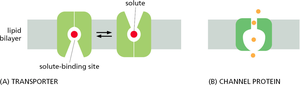
Membrane transport proteins are classified into channels and transporters, each with distinct mechanisms for moving molecules across the membrane.
Key Point 1: Channel proteins form pores that allow specific ions or water molecules to pass rapidly.
Key Point 2: Transporter proteins bind solutes and undergo conformational changes to move them across the membrane.
Example: Aquaporins are channel proteins for water; glucose transporters are transporter proteins.
Types of Membrane Transport
Transport across membranes can be passive or active, depending on whether energy is required and the direction relative to concentration gradients.
Key Point 1: Passive transport includes simple diffusion, channel-mediated, and transporter-mediated diffusion, moving substances down their concentration gradient.
Key Point 2: Active transport moves substances against their gradient, requiring energy input (e.g., ATP, light, or coupled transport).
Example: The Na+/K+ pump uses ATP to move ions against their gradients.
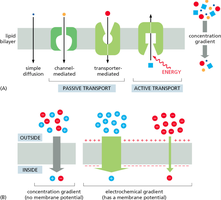
Transporter Conformational Changes and Kinetics
Transporters undergo conformational changes to move solutes, and their kinetics differ from simple diffusion.
Key Point 1: Transporter-mediated diffusion shows saturation kinetics, with a maximum rate (Vmax).
Key Point 2: Simple diffusion and channel-mediated transport increase linearly with concentration difference.
Example: Glucose transporters exhibit Michaelis-Menten kinetics.
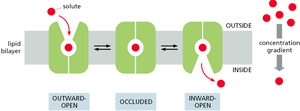
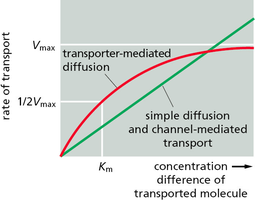
Mechanisms of Active Transport
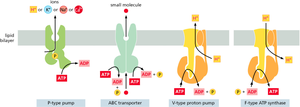
Active transport is driven by three main mechanisms: coupled transporters, ATP-driven pumps, and light-driven pumps.
Key Point 1: Coupled transporters use the energy from one molecule moving down its gradient to drive another molecule against its gradient.
Key Point 2: ATP-driven pumps hydrolyze ATP to provide energy for transport.
Key Point 3: Light-driven pumps use light energy to move molecules.
Example: The Na+/K+ pump is an ATP-driven pump.
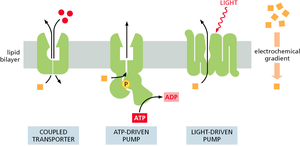
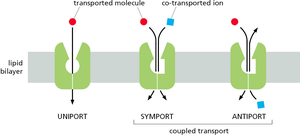
Types of Coupled Transport
Coupled transporters are classified as uniport, symport, or antiport, depending on the direction and number of molecules transported.
Key Point 1: Uniport moves a single type of molecule.
Key Point 2: Symport moves two molecules in the same direction.
Key Point 3: Antiport moves two molecules in opposite directions.
Example: The Na+/glucose symporter transports both Na+ and glucose into the cell.
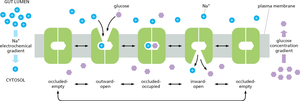
Glucose Transport Facilitated by Na+ Gradient
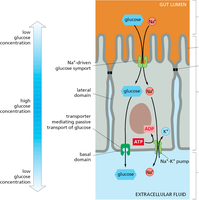
Glucose uptake in cells is often coupled to the Na+ gradient, allowing efficient transport even against glucose's concentration gradient.
Key Point 1: The Na+/glucose symporter uses the energy stored in the Na+ gradient to import glucose.
Key Point 2: This mechanism is essential in intestinal epithelial cells for nutrient absorption.
Example: Glucose is absorbed from the gut lumen into epithelial cells via Na+-driven symport.
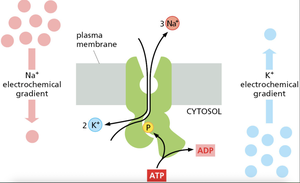
ATP-Driven Pumps and the Na+-K+ Pump
ATP-driven pumps are critical for maintaining ion gradients. The Na+-K+ pump is a primary example, moving Na+ out and K+ into the cell.
Key Point 1: The Na+-K+ pump hydrolyzes ATP to transport 3 Na+ out and 2 K+ in per cycle.
Key Point 2: This pump maintains membrane potential and cellular osmotic balance.
Example: The pump is essential for nerve and muscle function.
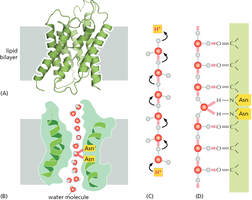
Selectivity of Aquaporins
Aquaporins are channel proteins that selectively allow water molecules to pass while blocking ions and protons.
Key Point 1: Aquaporins have a narrow pore and specific amino acid residues that prevent passage of ions.
Key Point 2: This selectivity is crucial for maintaining osmotic balance without disrupting ion gradients.
Example: Aquaporins are abundant in kidney tubules, facilitating water reabsorption.
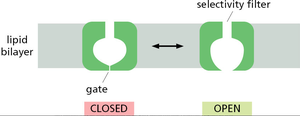
Ion Channels and Gating
Ion channels fluctuate between open and closed states, regulated by various gating mechanisms such as voltage, ligand binding, or mechanical force.
Key Point 1: Gating controls the flow of ions, enabling rapid changes in membrane potential.
Key Point 2: Selectivity filters ensure only specific ions pass through each channel.
Example: Voltage-gated Na+ channels are essential for action potential propagation in neurons.
Membrane Potential and Action Potentials
The difference in ion concentrations across the membrane creates a membrane potential, which is fundamental for electrical signaling in cells.
Key Point 1: The membrane potential is established by ion gradients and selective permeability.
Key Point 2: Action potentials are rapid changes in membrane potential, propagated by voltage-gated ion channels.
Example: Neurons use action potentials to transmit signals over long distances.
Equation for Membrane Potential (Nernst Equation):
Summary Table: Types of Membrane Transport
Transport Type | Energy Requirement | Direction | Example |
|---|---|---|---|
Simple Diffusion | No | Down gradient | O2, CO2 |
Channel-mediated | No | Down gradient | Ion channels |
Transporter-mediated | No/Yes | Down/against gradient | Glucose transporter, Na+/K+ pump |
ATP-driven pump | Yes (ATP) | Against gradient | Na+/K+ pump |
Coupled transporter | Yes (gradient) | Against gradient | Na+/glucose symporter |
Light-driven pump | Yes (light) | Against gradient | Bacterial rhodopsin |
Additional info: The notes expand on brief points with academic context, definitions, and examples to ensure completeness and clarity for cell-biology students.
