 Back
BackThe Chemical Context of Life: Foundations for Cell Biology
Study Guide - Smart Notes
 Tailored notes based on your materials, expanded with key definitions, examples, and context.
The Chemical Context of Life
Introduction to Life and Chemistry
All living organisms are governed by the fundamental laws of chemistry and physics. The movement and interaction of atoms and subatomic particles, the formation and breaking of chemical bonds, and the flow of energy are central to biological processes. Understanding these principles is essential for studying cell biology.
Matter: Anything that has mass and occupies space.
Elements: Pure substances that cannot be broken down by ordinary chemical reactions. Each element is defined by its number of protons.
Chemical Bonds: Forces that hold atoms together, including ionic, covalent, and hydrogen bonds.
Laws of Thermodynamics: Govern energy transformations in biological systems.
Chemical Components of Cells
Atoms, Elements, and Molecules
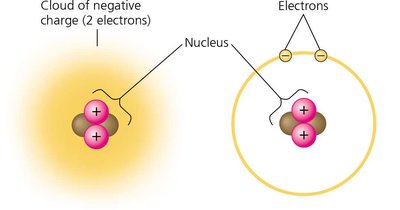
Atoms are the smallest units of matter that retain the properties of an element. They are composed of protons, neutrons, and electrons. Elements combine to form molecules, which can be simple (diatomic) or complex (compounds).
Protons: Positively charged particles in the nucleus.
Neutrons: Neutral particles in the nucleus.
Electrons: Negatively charged particles in orbitals around the nucleus.
Isotopes: Atoms of the same element with different numbers of neutrons.
Ions: Atoms with unequal numbers of protons and electrons, resulting in a charge.
Elements Essential for Life
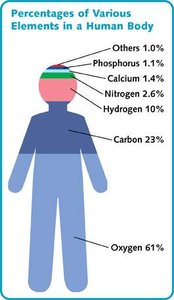
Living organisms are primarily composed of a few key elements, including oxygen, carbon, hydrogen, nitrogen, calcium, and phosphorus. These elements are obtained from the environment through food and air.
Compounds and Mixtures
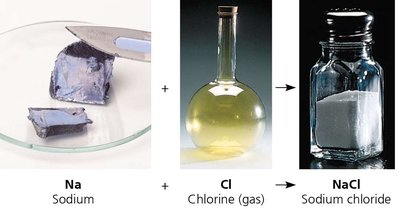
Compounds are substances formed from two or more elements chemically bonded together, exhibiting emergent properties distinct from their constituent elements. Mixtures are physical combinations of substances that are not chemically bonded.
Example: Sodium (Na) and chlorine (Cl) combine to form sodium chloride (NaCl), a compound with properties different from its elements.
Atomic Structure and the Periodic Table
Atomic Number, Mass Number, and Isotopes
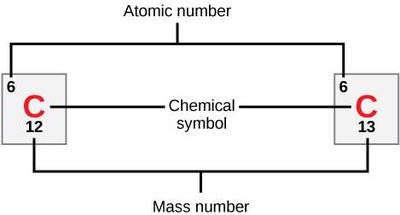
The atomic number is the number of protons in an atom, defining the element. The mass number is the sum of protons and neutrons. Isotopes have the same atomic number but different mass numbers.
Radioisotopes and Radioactive Decay
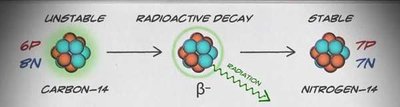
Some isotopes are unstable (radioisotopes) and undergo radioactive decay, emitting particles to achieve stability. This process is important in biological dating techniques and medical applications.
Example: Carbon-14 decays to nitrogen-14 through beta emission.
Electron Orbitals and Energy Levels
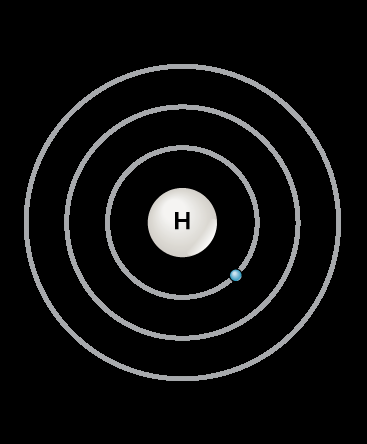
Electrons occupy orbitals, which are regions around the nucleus where electrons are likely to be found. The arrangement of electrons determines an atom's chemical reactivity. The outermost shell, or valence shell, is most important for chemical bonding.
First shell: up to 2 electrons
Second shell: up to 8 electrons
Third shell: up to 18 electrons (but often stable at 8 in biological systems)
The Periodic Table
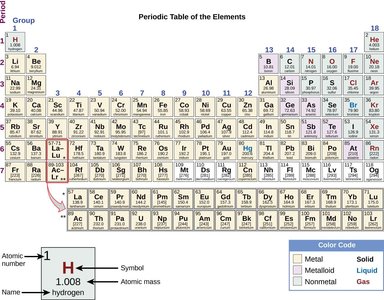
The periodic table organizes elements by increasing atomic number and similar chemical properties. Groups (columns) share similar valence electron configurations, influencing their reactivity.
Chemical Bonds and Interactions
Ionic Bonds
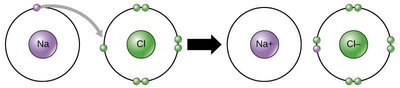
Ionic bonds form when electrons are transferred from one atom to another, resulting in oppositely charged ions that attract each other. These bonds are common in salts.
Example: Sodium donates an electron to chlorine, forming Na+ and Cl-.
Covalent Bonds
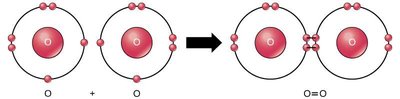
Covalent bonds involve the sharing of electron pairs between atoms. They can be single, double, or triple bonds, depending on the number of shared electron pairs.
Polar Covalent Bonds: Electrons are shared unequally, creating partial charges (e.g., in water).
Nonpolar Covalent Bonds: Electrons are shared equally (e.g., in O2 or CH4).
Hydrogen Bonds and van der Waals Interactions
Hydrogen bonds are weak attractions between a hydrogen atom covalently bonded to an electronegative atom (like oxygen or nitrogen) and another electronegative atom. van der Waals interactions are transient attractions due to temporary shifts in electron density.
Biological Importance: Hydrogen bonds stabilize DNA structure and contribute to protein folding.
Summary Table: Types of Chemical Bonds
Type of Bond | Properties | Example |
|---|---|---|
Triple Covalent | Sharing 3 pairs of electrons | N2 |
Double Covalent | Sharing 2 pairs of electrons | O2 |
Single Covalent | Sharing 1 pair of electrons | H2 |
Ionic | Electrostatic attraction between ions | NaCl |
Hydrogen | Attraction between partial charges | Between water molecules |
van der Waals | Transient attractions | Between nonpolar molecules |
Properties of Water
Structure and Polarity
Water is a bent, polar molecule due to the high electronegativity of oxygen. This allows water molecules to form hydrogen bonds with each other, giving rise to unique properties essential for life.
Solvent Properties
Water is known as the universal solvent because its polarity allows it to dissolve ionic and polar substances, forming spheres of hydration around ions.
Example: Dissolving NaCl in water results in hydration shells around Na+ and Cl- ions.
Cohesion, Adhesion, and Surface Tension
Hydrogen bonding causes water molecules to stick together (cohesion) and to other surfaces (adhesion). These properties contribute to surface tension and capillary action, which are vital for processes like water transport in plants.
Thermal Properties
Water has a high specific heat capacity and heat of vaporization, allowing it to moderate temperature changes in organisms and environments. This property is crucial for maintaining stable internal conditions in cells.
Example: Oceans and lakes moderate coastal climates due to water's high heat capacity.
Expansion Upon Freezing
Unlike most substances, water expands when it freezes due to the formation of a crystalline lattice. This makes ice less dense than liquid water, allowing it to float and insulate aquatic environments.
Water as a Medium for Life
Water exists in all three states (solid, liquid, gas) within Earth's temperature range, supporting a wide variety of biological processes, including evaporative cooling and transpiration in plants.
Acids, Bases, and pH
Dissociation of Water and pH Scale
Water can dissociate into hydrogen ions (H+) and hydroxide ions (OH-). The pH scale measures the concentration of H+ ions in a solution, with lower pH being acidic and higher pH being basic.
Acids: Increase H+ concentration (pH < 7).
Bases: Decrease H+ concentration (pH > 7).
Buffers: Solutions that resist changes in pH by absorbing excess H+ or OH-.
Example: The carbonic acid-bicarbonate buffer system helps maintain blood pH.
Energy and Thermodynamics in Biology
Laws of Thermodynamics
Biological systems obey the laws of thermodynamics:
First Law: Energy cannot be created or destroyed, only transformed.
Second Law: Every energy transfer increases the entropy (disorder) of the universe; no process is 100% efficient.
Gradients, or uneven distributions of substances or energy, drive many cellular processes, such as diffusion and active transport.
Additional info: This guide expands on the provided lecture notes with definitions, examples, and academic context to ensure a comprehensive understanding of the chemical foundations of cell biology.
