 Back
BackTransport Across Membranes: Mechanisms and Energetics
Study Guide - Smart Notes
 Tailored notes based on your materials, expanded with key definitions, examples, and context.
Transport Across Membranes: Overcoming the Permeability Barrier
Introduction to Membrane Transport
The selective transport of molecules and ions across cellular membranes is essential for maintaining cellular homeostasis and supporting vital biochemical processes. Membranes act as barriers, allowing only certain substances to pass through, either directly or via specialized transport proteins.
Key Point: Membrane transport ensures that necessary substances are moved into and out of cells and organelles at appropriate times and rates.
Key Point: Transport mechanisms include simple diffusion, facilitated diffusion, and active transport.
Types of Membrane Transport
Substances cross membranes by different mechanisms, depending on their chemical properties and the presence of transport proteins.
Simple Diffusion: Unassisted movement of small or nonpolar molecules down their concentration gradient.
Facilitated Diffusion: Protein-mediated movement of large, polar molecules or ions down their gradient.
Active Transport: Protein-mediated movement of molecules or ions against their gradient, requiring energy input.
Comparison of Transport Mechanisms
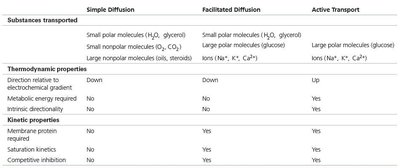
The following table summarizes the main differences between simple diffusion, facilitated diffusion, and active transport:
Simple Diffusion | Facilitated Diffusion | Active Transport | |
|---|---|---|---|
Substances transported | Small polar molecules (H2O, glycerol), small nonpolar molecules (O2, CO2), large nonpolar molecules (steroids) | Small polar molecules (H2O, glycerol), large polar molecules (glucose), ions (Na+, K+, Cl-) | Large polar molecules (glucose), ions (Na+, K+, Cl-) |
Direction relative to gradient | Down | Down | Up |
Metabolic energy required | No | No | Yes |
Membrane protein required | No | Yes | Yes |
Saturation kinetics | No | Yes | Yes |
Competitive inhibition | No | Yes | Yes |
Simple Diffusion: Unassisted Movement Down the Gradient
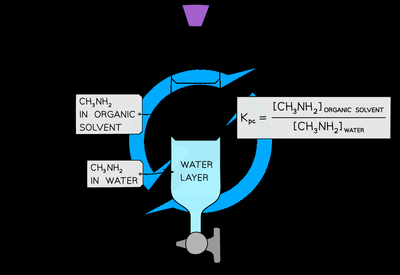
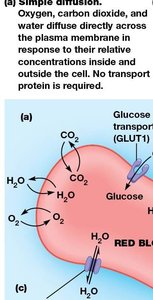
Simple diffusion allows small or nonpolar molecules such as O2, CO2, and lipids to cross the membrane without assistance. Water, though polar, is small enough to diffuse across membranes, though the mechanism is not fully understood.
Key Point: Membranes are permeable to lipids, which pass through the nonpolar interior of the lipid bilayer.
Key Point: Membrane permeability is proportional to the partition coefficient (relative solubility in oil vs. water).
Key Point: Diffusion direction is determined by the concentration gradient, always moving toward equilibrium.
Key Point: If the membrane is impermeable to a solute, water moves by osmosis from lower solute concentration to higher solute concentration.
Facilitated Diffusion: Protein-Mediated Movement Down the Gradient
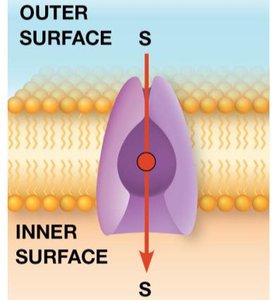
Facilitated diffusion is required for large, polar molecules and ions that cannot cross the membrane directly. Transport proteins, such as carrier proteins and channel proteins, mediate this process.
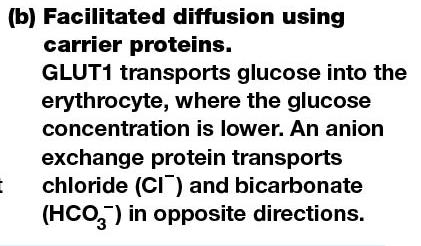
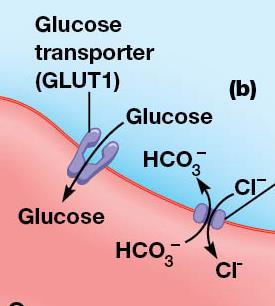
Key Point: Carrier proteins alternate between two conformational states to transport molecules (e.g., glucose transporter, anion exchange protein).
Key Point: Channel proteins form hydrophilic channels for ions and water (e.g., ion channels, porins, aquaporins).
Key Point: Transport can be uniport (single molecule), symport (two molecules in same direction), or antiport (two molecules in opposite directions).
Key Point: For ions, transport depends on both concentration and charge gradients (electrochemical potential).
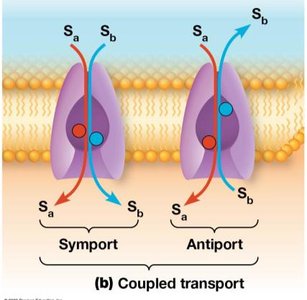
Facilitated Diffusion in Erythrocytes
GLUT1: Transports glucose into erythrocytes.
Anion Exchange Protein: Transports Cl- and HCO3- in opposite directions (antiport).
Aquaporins: Facilitate rapid water movement.
Active Transport: Protein-Mediated Movement Up the Gradient
Active transport moves molecules or ions against their concentration gradient, requiring energy input. This process is essential for maintaining ion gradients and cellular homeostasis.
Key Point: Energy sources include ATP hydrolysis, ion gradients, or light energy.
Key Point: Four major classes of ATP-powered transport proteins: P-type, V-type, F-type, and ABC-type ATPases.
Key Point: The Na+/K+ pump (P-type ATPase) maintains electrochemical potentials for sodium and potassium ions in animal cells.
Key Point: Active transport driven by ion gradients (e.g., Na+ or H+) is common in nutrient uptake.
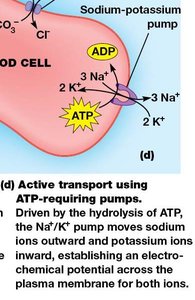
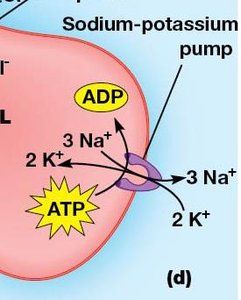
Examples of Active Transport
Na+/glucose symporter: Uses indirect active transport to move glucose into cells, driven by Na+ gradient.
Bacteriorhodopsin in Halobacterium: Uses light energy to pump protons across the membrane, generating ATP as protons flow back in.
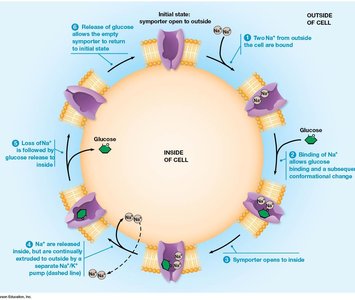
The Energetics of Transport
The free energy change (ΔG) for transport determines whether a process is spontaneous or requires energy input. For uncharged solutes, ΔG depends only on the concentration gradient; for charged solutes, both concentration and membrane potential are considered.
Key Point: If ΔG < 0, transport is spontaneous; if ΔG > 0, energy input is required; if ΔG = 0, no net movement occurs.
Key Point: For uncharged solutes:
Key Point: For charged solutes:
Key Point: R = gas constant (1.987 cal/mol-K), T = absolute temperature, z = charge, F = Faraday constant (23,062 cal/mol-V), Vm = membrane potential.
Summary
Membrane transport is vital for cellular function, involving simple diffusion, facilitated diffusion, and active transport.
Transport proteins provide specificity and regulation, enabling cells to maintain internal environments and respond to external changes.
Energetics of transport are governed by concentration gradients and membrane potentials, dictating the direction and necessity of energy input.
