 Back
BackTransport Across Membranes: Overcoming the Permeability Barrier
Study Guide - Smart Notes
 Tailored notes based on your materials, expanded with key definitions, examples, and context.
Transport Across Membranes: Overcoming the Permeability Barrier
Introduction
The cell membrane acts as a selective barrier, regulating the movement of substances into and out of the cell. This chapter explores the mechanisms by which cells overcome the permeability barrier, focusing on the types of membrane transport, their properties, and their physiological significance.
Types of Membrane Transport
Overview of Transport Mechanisms
Cells utilize three primary mechanisms to transport substances across membranes:
Simple Diffusion: Movement of molecules directly through the lipid bilayer without assistance.
Facilitated Diffusion: Movement of molecules via specific membrane proteins (channels or carriers).
Active Transport: Movement of molecules against their concentration gradient, requiring energy input.
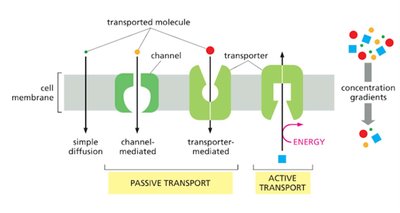
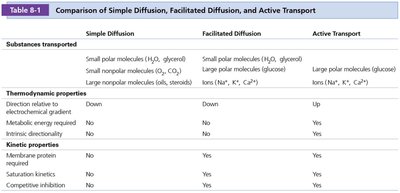
Comparison of Simple Diffusion, Facilitated Diffusion, and Active Transport
The following table summarizes the main differences between these transport mechanisms:
Property | Simple Diffusion | Facilitated Diffusion | Active Transport |
|---|---|---|---|
Substances Transported | Small polar/nonpolar molecules | Large polar molecules, ions | Large polar molecules, ions |
Directionality | Down gradient | Down gradient | Up gradient |
Energy Required | No | No | Yes |
Membrane Proteins Required | No | Yes | Yes |
Saturation Kinetics | No | Yes | Yes |
Competitive Inhibition | No | Yes | Yes |
Simple Diffusion
Principles of Simple Diffusion
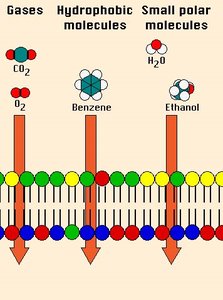
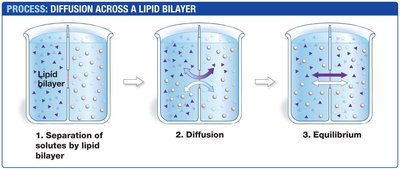
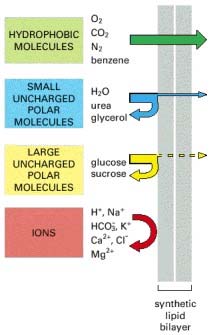
Simple diffusion is the unassisted movement of molecules from regions of high concentration to regions of low concentration, minimizing free energy. Only certain molecules can cross the lipid bilayer by this method:
Gases (e.g., O2, CO2)
Hydrophobic molecules (e.g., benzene)
Small polar molecules (e.g., H2O, ethanol)
Factors Affecting Diffusion Rate
Size: Smaller molecules diffuse faster.
Solubility: Nonpolar molecules diffuse more readily than polar molecules.
Osmosis: The Diffusion of Water
Definition and Mechanism
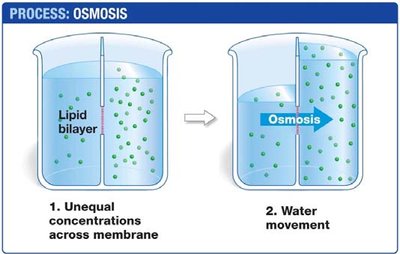
Osmosis is the diffusion of water across a selectively permeable membrane. Water moves from areas of low solute concentration to areas of high solute concentration.
Tonicity: The ability of an extracellular solution to cause water movement by osmosis.
Osmolarity: The total concentration of solute particles in a solution.
Effects of Tonicity on Cells
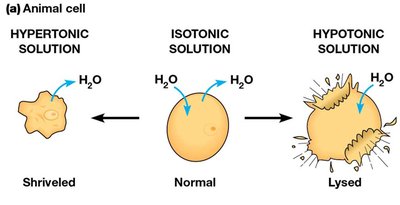
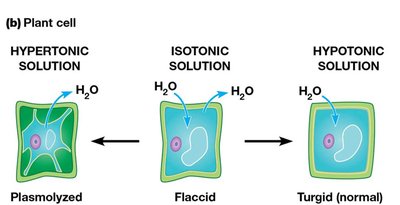
Cells respond differently to changes in tonicity:
Hypertonic solution: Water leaves the cell, causing it to shrink.
Isotonic solution: No net water movement; cell remains normal.
Hypotonic solution: Water enters the cell, causing it to swell or burst.
Facilitated Diffusion
Facilitated Diffusion through Channels
Facilitated diffusion allows ions and polar molecules to cross the membrane via specific proteins:
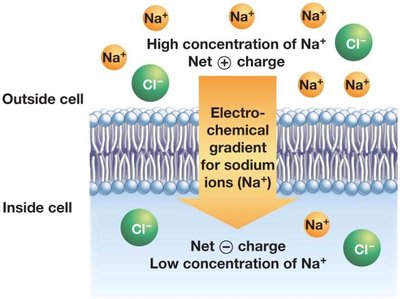
Ion channels: Permit passage of ions (e.g., Na+, K+).
Porins: Allow passage of larger molecules.
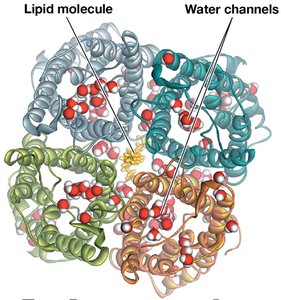
Aquaporins: Specialized for water transport.
Gated Channels
Channels may be regulated (gated) by:
Mechanical forces
Voltage changes
Ligand binding
Facilitated Diffusion through Carriers
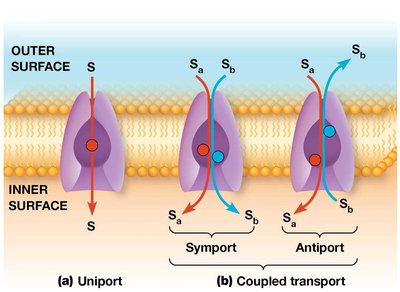
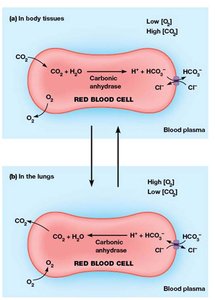
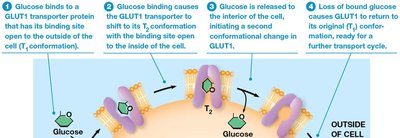
Carrier proteins bind specific solutes and undergo conformational changes to transport them across the membrane. Examples include glucose transporters and anion exchangers.

Properties of Facilitated Diffusion
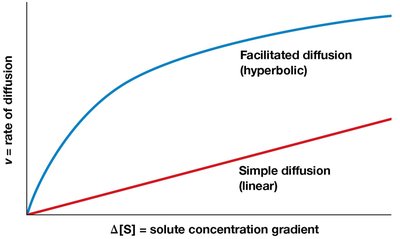
Highly specific for the transported solute
Can be regulated
Carrier proteins can become saturated
Transport rate is faster through channels than carriers
Example: Glucose Transport
Glucose transporters (GLUT) facilitate the movement of glucose across the membrane by binding glucose, undergoing conformational changes, and releasing it inside the cell.
Active Transport
Principles of Active Transport
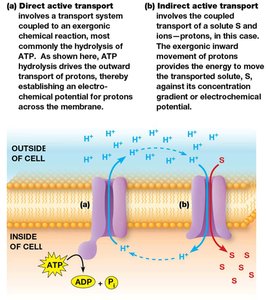
Active transport moves solutes against their concentration gradient, requiring energy (usually from ATP hydrolysis). It is essential for:
Uptake of essential nutrients
Removal of wastes
Maintenance of nonequilibrium ion concentrations
Primary vs Secondary Active Transport
Primary (Direct) Active Transport: Directly uses ATP to transport solutes.
Secondary (Indirect) Active Transport: Uses the energy from an existing gradient (often established by primary transport) to drive the transport of other solutes.
Main Types of Transport ATPases (Pumps)
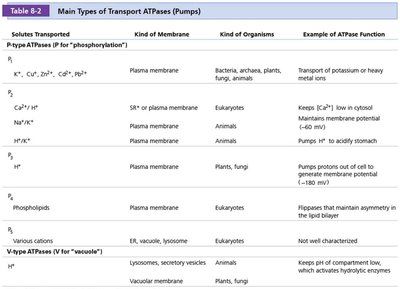
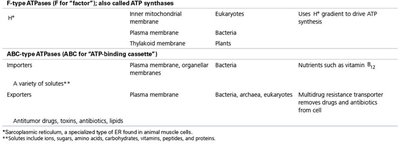
ATPases are specialized proteins that use ATP to transport ions and other solutes across membranes. The following table summarizes their types and functions:
Solutes Transported | Kind of Membrane | Kind of Organisms | Example of ATPase Function |
|---|---|---|---|
K+, Cu2+, Zn2+, Cd2+, Pb2+ | Plasma membrane | Bacteria, archaea, plants, fungi, animals | Transport of potassium or heavy metal ions |
Ca2+ | SR or plasma membrane | Eukaryotes | Keeps Ca2+ low in cytosol |
Na+/K+ | Plasma membrane | Animals | Maintains membrane potential |
H+ | Plasma membrane | Plants, fungi | Pumps H+ to acidify stomach |
Phospholipids | Plasma membrane | Eukaryotes | Flippases maintain asymmetry |
Various cations | ER, vacuole, lysosome | Eukaryotes | Not well characterized |
H+ | Lysosomes, secretory vesicles | Animals | Keeps pH of compartment low |
H+ | Vacuolar membrane | Plants, fungi | Activates hydrolytic enzymes |
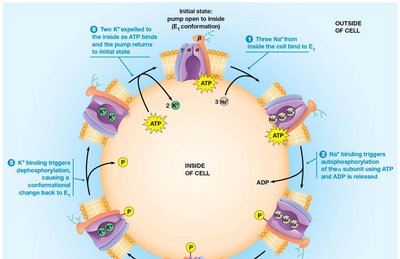
Mechanism of Na+/K+ Pump
The Na+/K+ pump is a primary active transporter that maintains the electrochemical gradient across the plasma membrane by pumping Na+ out and K+ in.

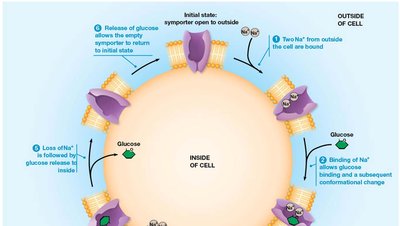
Secondary Active Transport: Sodium-Glucose Co-Transport
Secondary active transport uses the Na+ gradient established by the Na+/K+ pump to drive the uptake of glucose and amino acids via symporters.

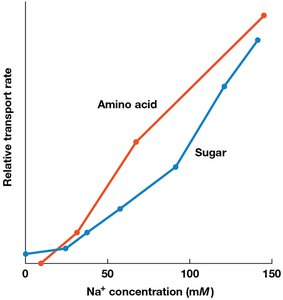
Effect of Na+ Concentration on Transport Rate
As extracellular Na+ concentration increases, the rate of nutrient (e.g., amino acid, sugar) transport into the cell increases proportionately, demonstrating the dependence of secondary active transport on the Na+ gradient.
Summary
Membrane transport is essential for cellular function, enabling the uptake of nutrients, removal of wastes, and maintenance of ion gradients. The cell utilizes simple diffusion, facilitated diffusion, and active transport, each with distinct properties and mechanisms. Understanding these processes is fundamental to cell biology.
