In Exercises 19–28, solve each system by the addition method. {x2+y2=13x2−y2=5
Verified step by step guidance
1
Identify the given system of equations: \\ \(x^2 + y^2 = 13\) and \(x^2 - y^2 = 5\).
Add the two equations together to eliminate \(y^2\(: \\ \)(x^2 + y^2) + (x^2 - y^2) = 13 + 5\).
Simplify the resulting equation: \\ \$2x^2 = 18$.
Solve for \(x^2\( by dividing both sides by 2: \\ \)x^2 = 9\).
Substitute \(x^2 = 9\) back into one of the original equations (for example, \(x^2 + y^2 = 13\)) to solve for \(y^2\), then find \(y\).
Verified video answer for a similar problem:
This video solution was recommended by our tutors as helpful for the problem above
Video duration:
4m
Play a video:
0 Comments
Key Concepts
Here are the essential concepts you must grasp in order to answer the question correctly.
Systems of Equations
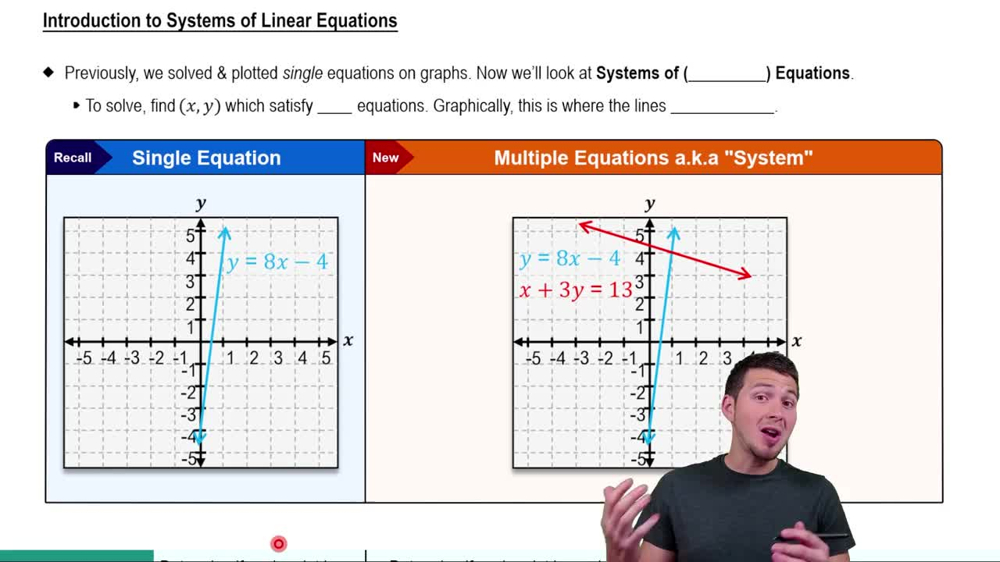
A system of equations consists of two or more equations with the same variables. The goal is to find values for the variables that satisfy all equations simultaneously. Understanding how to interpret and manipulate these systems is essential for finding their solutions.
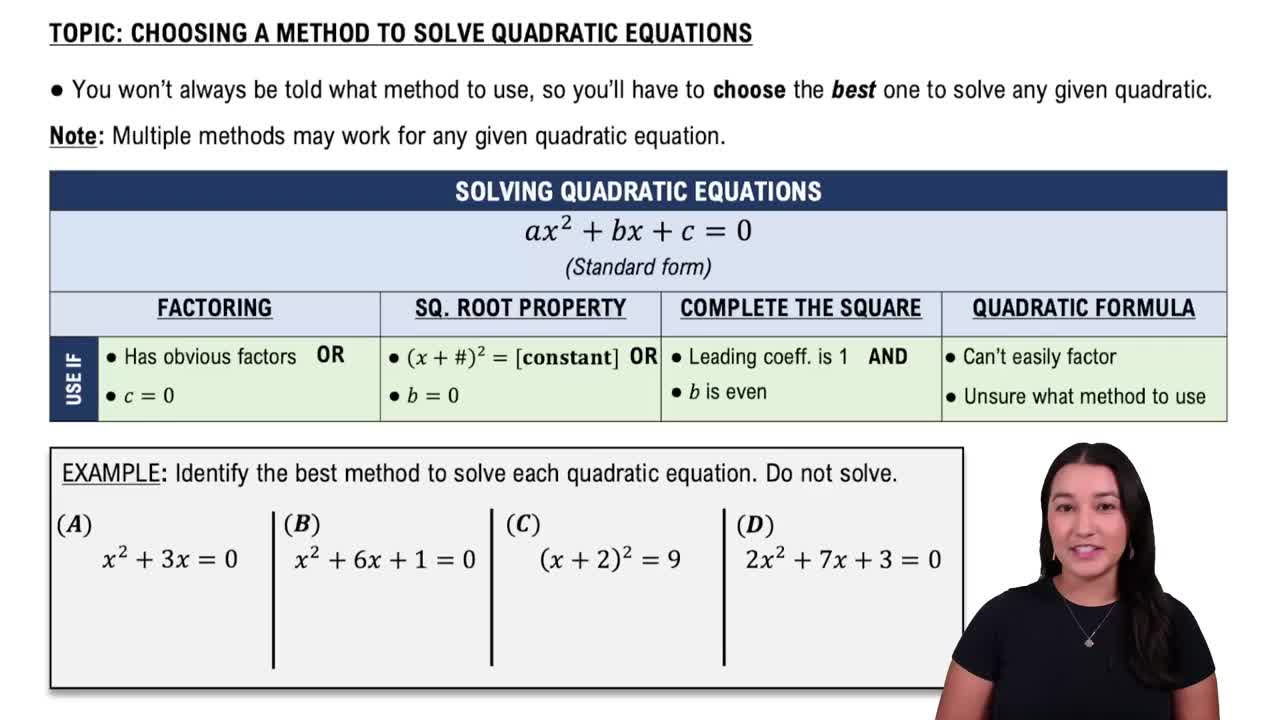
The addition method involves adding or subtracting equations to eliminate one variable, simplifying the system to a single equation with one variable. This technique is useful when the coefficients of a variable are opposites or can be made opposites by multiplication.
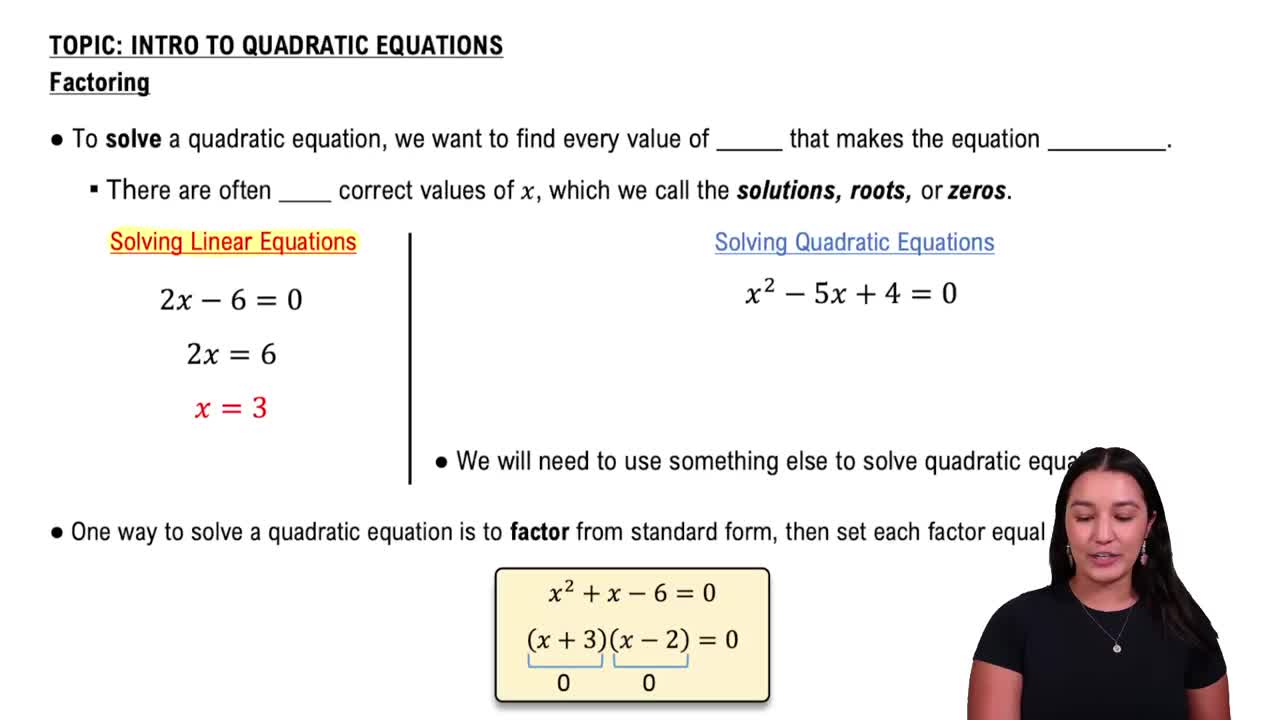
Quadratic equations involve variables raised to the second power. Solving them may require factoring, using the quadratic formula, or simplifying expressions after elimination. Recognizing and solving quadratic forms is crucial when variables appear squared in systems.

 4:23 minutes
 Verified step by step guidance
 4:27
4:27