In Exercises 47–52, solve each system by the method of your choice. {−4x+y=12y=x3+3x2
Verified step by step guidance
1
Start with the given system of equations:
\(-4x + y = 12\)
and
\(y = x^3 + 3x^2\).
Since both equations are equal to \(y\), set the right-hand sides equal to each other to eliminate \(y\):
\(-4x + y = 12\) implies \(y = 4x + 12\) (by adding \$4x\( to both sides), so set
\)4x + 12 = x^3 + 3x^2$.
Rewrite the equation to bring all terms to one side, forming a polynomial equation:
\(x^3 + 3x^2 - 4x - 12 = 0\).
Solve the cubic equation \(x^3 + 3x^2 - 4x - 12 = 0\) by factoring or using methods such as the Rational Root Theorem to find possible roots for \(x\).
Once you find the values of \(x\), substitute each back into one of the original equations (for example, \(y = 4x + 12\)) to find the corresponding \(y\) values, giving you the solution pairs \((x, y)\).
Verified video answer for a similar problem:
This video solution was recommended by our tutors as helpful for the problem above
Video duration:
5m
Play a video:
0 Comments
Key Concepts
Here are the essential concepts you must grasp in order to answer the question correctly.
Systems of Equations
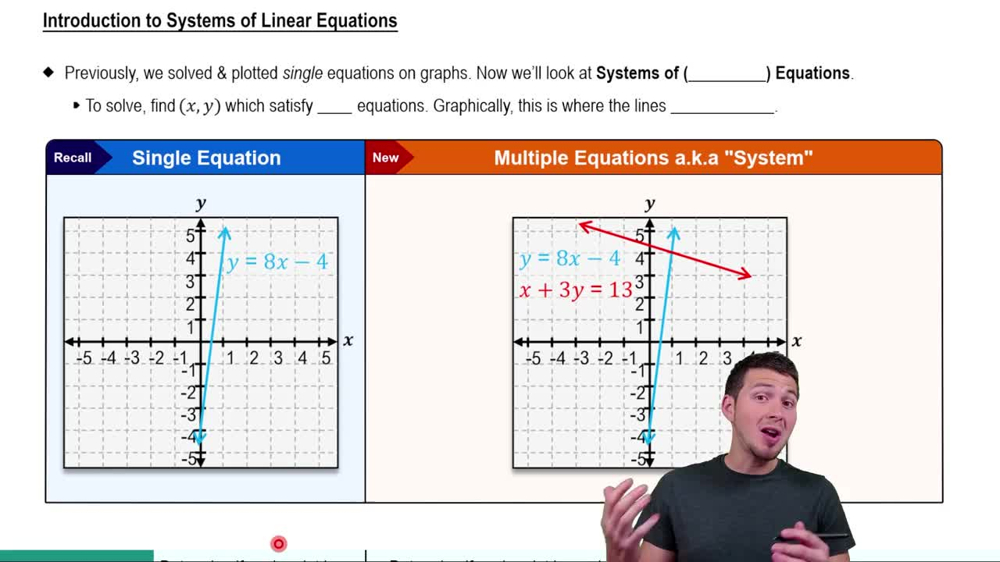
A system of equations consists of two or more equations with the same variables. The goal is to find values for the variables that satisfy all equations simultaneously. Solutions can be points where the graphs of the equations intersect.
The substitution method involves solving one equation for one variable and then substituting that expression into the other equation. This reduces the system to a single equation with one variable, making it easier to solve.
When a system includes nonlinear equations, such as cubic or quadratic terms, solving requires careful algebraic manipulation. After substitution, the resulting equation may be polynomial, requiring factoring or other methods to find roots.

 5:49 minutes
 Verified step by step guidance
 4:27
4:27