Find the domain of each function. h(x) = √(x −2)+ √(x +3)
Verified step by step guidance
1
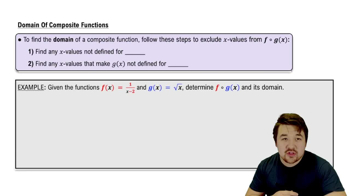
Step 1: Recall that the domain of a function is the set of all possible input values (x-values) for which the function is defined. For square root functions, the expression inside the square root must be greater than or equal to zero, because the square root of a negative number is undefined in the real number system.
Step 2: Analyze the first square root term, √(x − 2). To ensure this term is defined, the expression inside the square root must satisfy x − 2 ≥ 0. Solve this inequality: x − 2 ≥ 0 implies x ≥ 2.
Step 3: Analyze the second square root term, √(x + 3). Similarly, the expression inside this square root must satisfy x + 3 ≥ 0. Solve this inequality: x + 3 ≥ 0 implies x ≥ −3.
Step 4: Combine the results from Step 2 and Step 3. The domain of the function is the intersection of the two conditions: x ≥ 2 and x ≥ −3. The stricter condition (x ≥ 2) will determine the domain.
Step 5: Write the domain in interval notation. Since x must be greater than or equal to 2, the domain is [2, ∞).
Verified video answer for a similar problem:
This video solution was recommended by our tutors as helpful for the problem above
Video duration:
3m
Play a video:
0 Comments
Key Concepts
Here are the essential concepts you must grasp in order to answer the question correctly.
Domain of a Function
The domain of a function refers to the set of all possible input values (x-values) for which the function is defined. For functions involving square roots, the expression inside the root must be non-negative, as the square root of a negative number is not defined in the set of real numbers.
A square root function is defined as f(x) = √x, where x must be greater than or equal to zero. This means that for any expression under the square root, it must satisfy the condition that the expression is non-negative to ensure the function yields real number outputs.
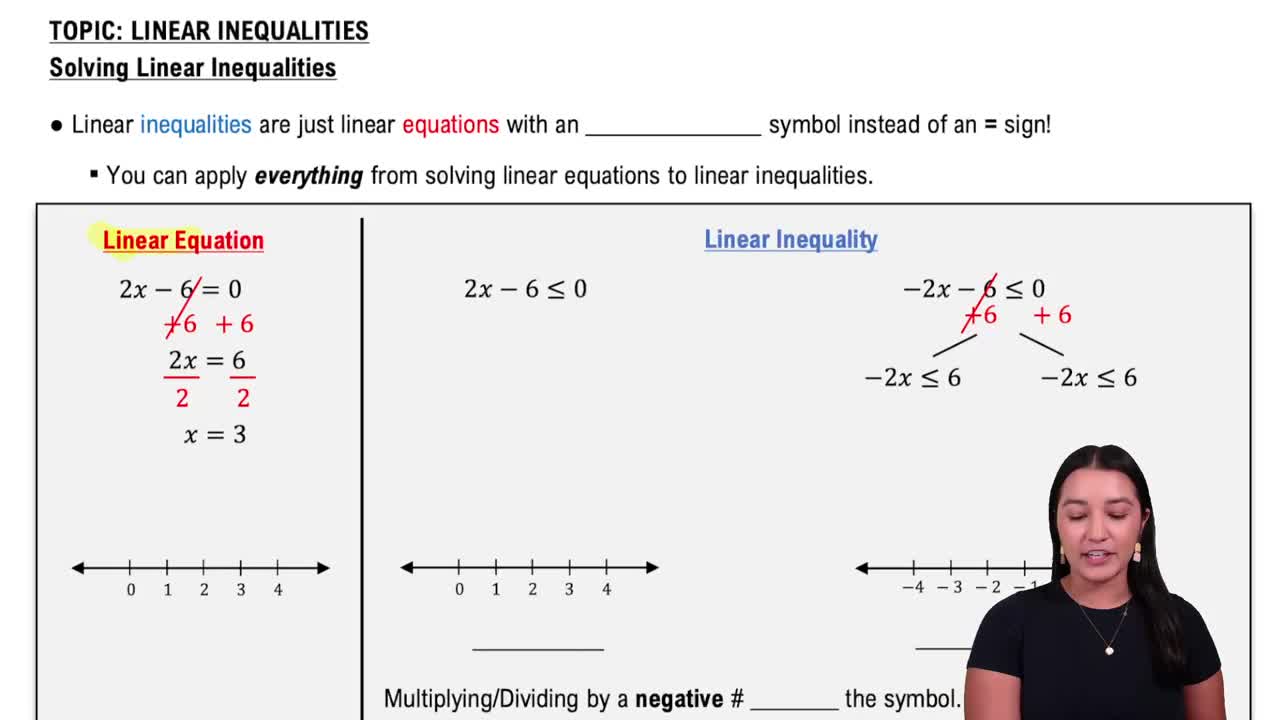
Inequalities are mathematical expressions that show the relationship between two values, indicating that one is greater than, less than, or equal to the other. In finding the domain of the function h(x), we will set up inequalities based on the conditions required for the square roots to be defined, allowing us to determine the valid range of x-values.