Find ƒ/g and determine the domain for each function. f(x) = 2x² − x − 3, g (x) = x + 1
Verified step by step guidance
1
Step 1: Understand the problem. We are tasked with finding the quotient of two functions, ƒ(x) and g(x), denoted as (ƒ/g)(x), and determining the domain of the resulting function.
Step 2: Write the expression for (ƒ/g)(x). This is defined as (ƒ/g)(x) = ƒ(x) / g(x). Substituting the given functions, we have (ƒ/g)(x) = (2x² − x − 3) / (x + 1).
Step 3: Analyze the domain of the function. The domain of a rational function is all real numbers except where the denominator equals zero. Set the denominator g(x) = x + 1 equal to zero and solve for x: x + 1 = 0, so x = -1.
Step 4: Exclude the value x = -1 from the domain. The domain of (ƒ/g)(x) is all real numbers except x = -1, because division by zero is undefined.
Step 5: Simplify the expression if possible. Check if the numerator (2x² − x − 3) can be factored and if any common factors exist with the denominator (x + 1). If there are common factors, simplify the expression by canceling them, but ensure to note any restrictions on the domain introduced by the cancellation.
Verified video answer for a similar problem:
This video solution was recommended by our tutors as helpful for the problem above
Video duration:
5m
Play a video:
0 Comments
Key Concepts
Here are the essential concepts you must grasp in order to answer the question correctly.
Function Division
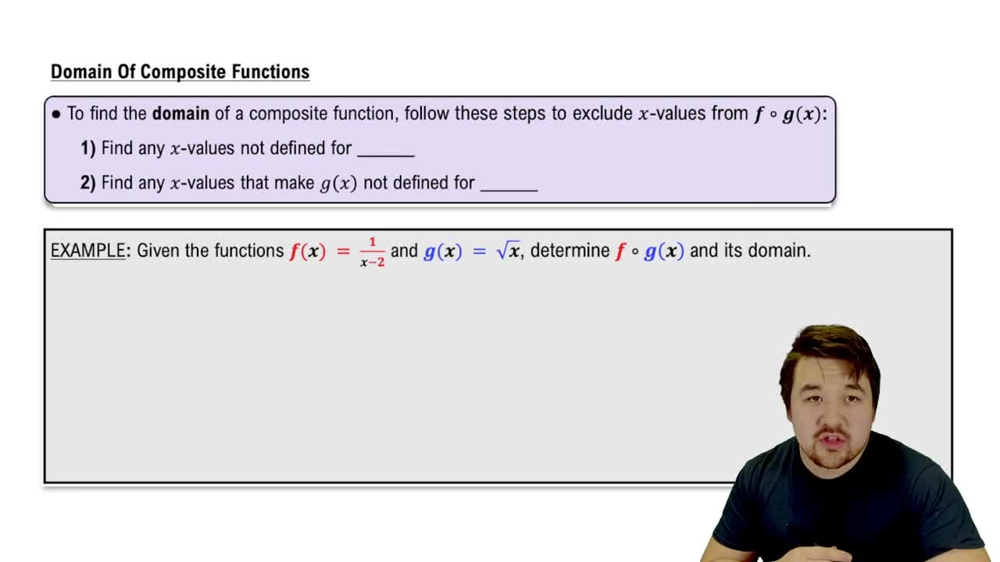
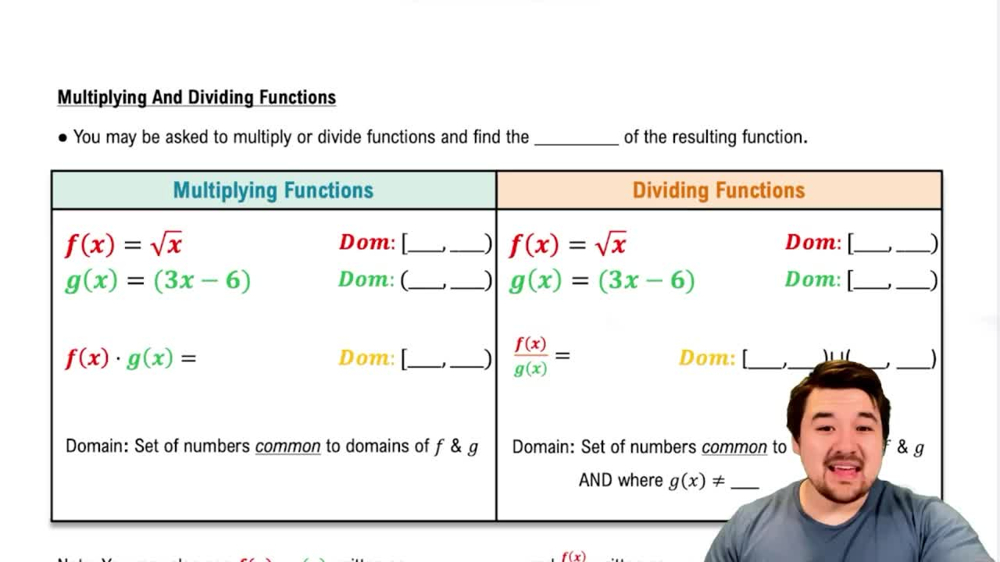
Function division involves dividing one function by another, resulting in a new function. In this case, we are finding ƒ/g, which means we will take the function f(x) = 2x² − x − 3 and divide it by g(x) = x + 1. This process requires algebraic manipulation to simplify the expression and identify any restrictions on the variable.
The domain of a function is the set of all possible input values (x-values) for which the function is defined. When dividing functions, the domain must exclude any values that make the denominator zero, as division by zero is undefined. For g(x) = x + 1, the domain restriction occurs when x = -1, which must be considered when determining the overall domain of the function ƒ/g.
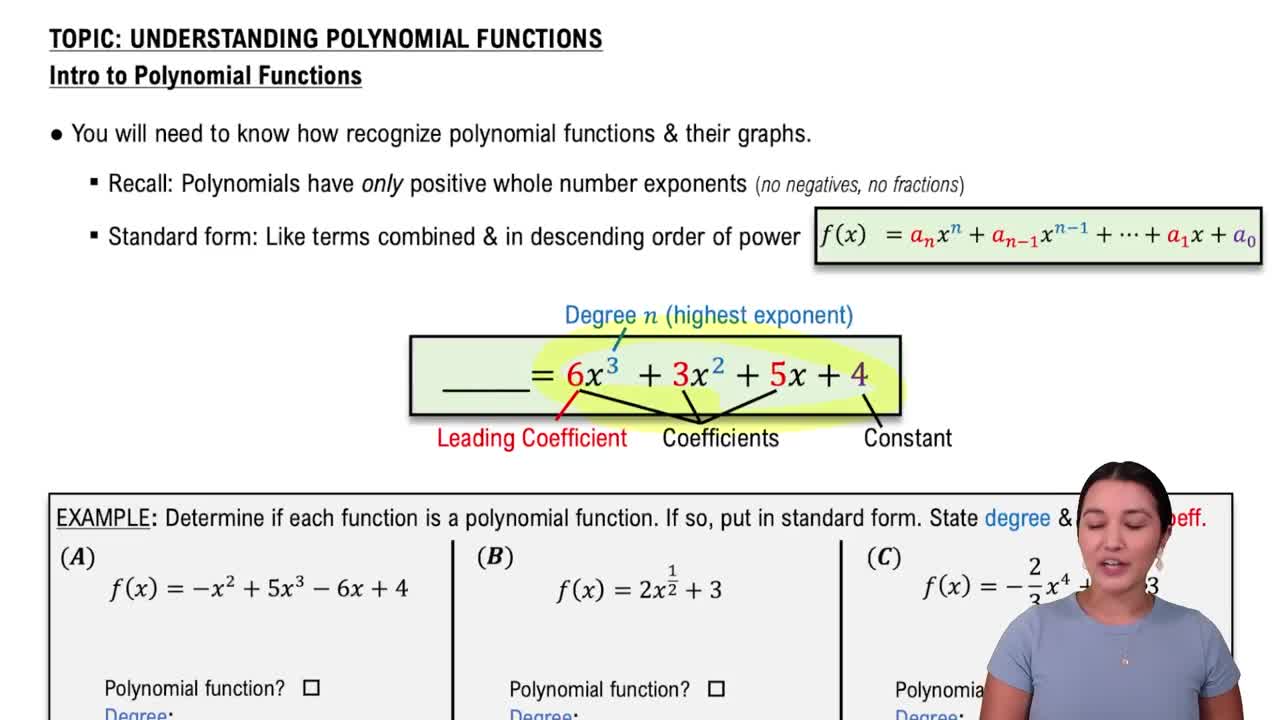
Polynomial functions are expressions that involve variables raised to whole number powers, combined using addition, subtraction, and multiplication. The function f(x) = 2x² − x − 3 is a quadratic polynomial, which can be analyzed for its roots and behavior. Understanding polynomial functions is essential for performing operations like division and for analyzing their graphs and domains.

 5:22 minutes
 Verified step by step guidance
 7:24
7:24