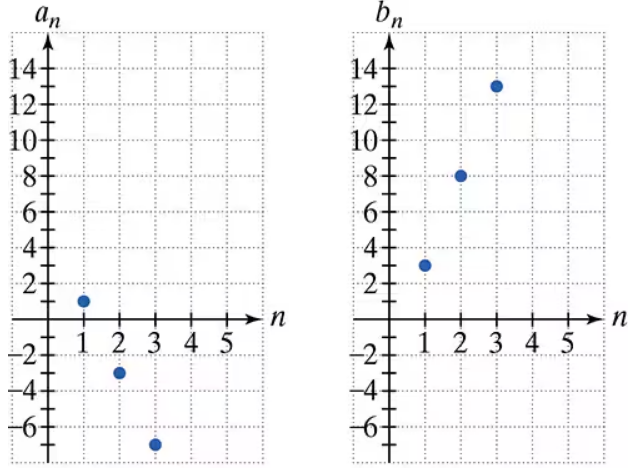
Use the graphs of the arithmetic sequences {a} and {b} to solve Exercises 51-58. If {an} is a finite sequence whose last term is -83, how many terms does {an} contain?
Verified step by step guidance
1
Identify the first term and the common difference of the arithmetic sequence from the given points. The first term \(a_1\) corresponds to the value when \(n=1\), which is 4. The common difference \(d\) can be found by subtracting consecutive terms, for example, \$7 - 4\( or \)10 - 7$.
Write the general formula for the \(n\)-th term of an arithmetic sequence: \(a_n = a_1 + (n - 1)d\).
Substitute the known values of \(a_1\) and \(d\) into the formula to express \(a_n\) in terms of \(n\).
Since the last term of the sequence is given as \(-83\), set \(a_n = -83\) and solve the equation \(-83 = 4 + (n - 1)d\) for \(n\).
Solve the resulting equation for \(n\) to find the number of terms in the sequence.
Verified video answer for a similar problem:
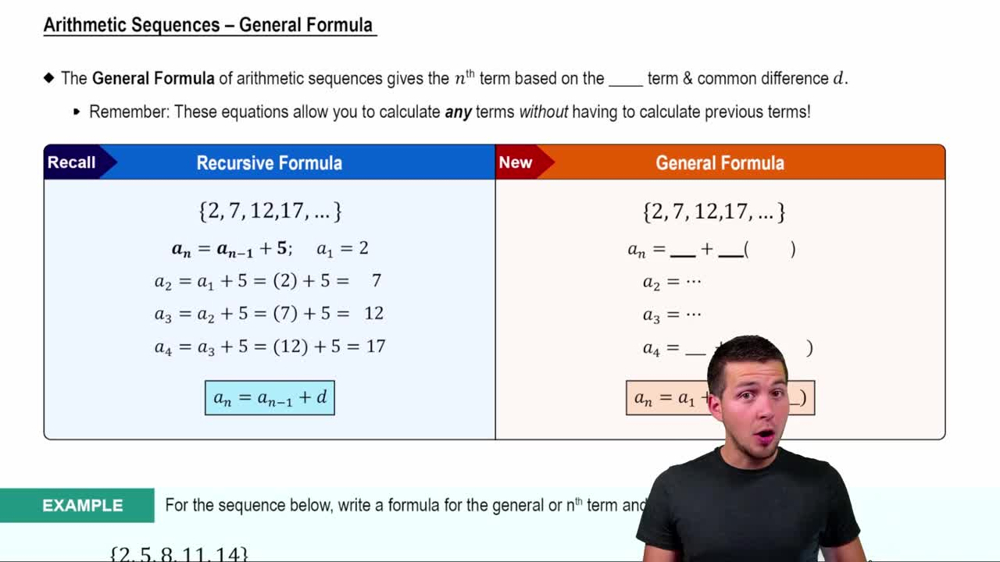
This video solution was recommended by our tutors as helpful for the problem above
Video duration:
6m
Play a video:
0 Comments
Key Concepts
Here are the essential concepts you must grasp in order to answer the question correctly.
Arithmetic Sequence
An arithmetic sequence is a list of numbers where each term after the first is found by adding a constant difference to the previous term. This difference is called the common difference. For example, the sequence 4, 7, 10 has a common difference of 3.
The nth term of an arithmetic sequence can be found using the formula a_n = a_1 + (n - 1)d, where a_1 is the first term, d is the common difference, and n is the term number. This formula helps find any term in the sequence without listing all terms.
To find how many terms a finite arithmetic sequence contains when the last term is known, set the nth term formula equal to the last term and solve for n. This involves algebraic manipulation to isolate n, giving the total number of terms in the sequence.