Show that the sum of the first n positive odd integers,1 +3 +5 + ··· + (2n − 1), ... is n².
Verified step by step guidance
1
Recognize the sequence given: the first n positive odd integers are 1, 3, 5, ..., (2n - 1). Each term can be expressed as the general term \(a_k = 2k - 1\) where \(k\) ranges from 1 to \(n\).
Write the sum of the first n odd integers as a summation: \(S = \sum_{k=1}^n (2k - 1)\).
Use the properties of summation to separate the sum into two parts: \(S = \sum_{k=1}^n 2k - \sum_{k=1}^n 1\).
Evaluate each summation separately: \(\sum_{k=1}^n 2k = 2 \sum_{k=1}^n k\) and \(\sum_{k=1}^n 1 = n\). Recall that \(\sum_{k=1}^n k = \frac{n(n+1)}{2}\).
Substitute the known formula into the expression and simplify: \(S = 2 \times \frac{n(n+1)}{2} - n = n(n+1) - n = n^2 + n - n = n^2\). This shows that the sum of the first n odd integers is \(n^2\).
Verified video answer for a similar problem:
This video solution was recommended by our tutors as helpful for the problem above
Video duration:
2m
Play a video:
0 Comments
Key Concepts
Here are the essential concepts you must grasp in order to answer the question correctly.
Arithmetic Series
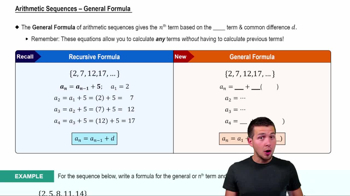
An arithmetic series is the sum of terms in an arithmetic sequence, where each term increases by a constant difference. In this problem, the sequence of odd integers (1, 3, 5, ...) has a common difference of 2, and understanding this helps in summing the terms.
Mathematical induction is a proof technique used to verify statements for all positive integers. It involves proving a base case and then showing that if the statement holds for an integer k, it also holds for k+1. This method is often used to prove formulas like the sum of odd integers equals n².
The sum of the first n positive odd integers is given by n². This formula can be derived or proven using induction or by recognizing that adding consecutive odd numbers forms perfect squares, which is a key insight in this problem.