Identify each equation without completing the square. 9x2+25y2−54x−200y+256=0
Verified step by step guidance
1
Recognize the general form of the equation: \( Ax^2 + By^2 + Cx + Dy + E = 0 \). This is a conic section equation.
Identify the coefficients of the squared terms: \( A = 9 \) and \( B = 25 \). Since both coefficients are positive, the equation represents an ellipse.
Check if the equation is centered at the origin by examining the linear terms \( Cx \) and \( Dy \). Here, \( C = -54 \) and \( D = -200 \), indicating the ellipse is not centered at the origin.
To find the center of the ellipse, use the formula \( x = -\frac{C}{2A} \) and \( y = -\frac{D}{2B} \). Substitute the values to find the coordinates of the center.
Verify the constant term \( E = 256 \) to ensure it fits the standard form of an ellipse equation. This term will be used to complete the square if needed, but here we are identifying the type of conic section without completing the square.
Verified video answer for a similar problem:
This video solution was recommended by our tutors as helpful for the problem above
Video duration:
2m
Play a video:
0 Comments
Key Concepts
Here are the essential concepts you must grasp in order to answer the question correctly.
Quadratic Equations
A quadratic equation is a polynomial equation of degree two, typically in the form ax^2 + bx + c = 0, where a, b, and c are constants. In the given equation, the presence of x^2 and y^2 terms indicates that it is a quadratic in two variables. Understanding the structure of quadratic equations is essential for identifying their properties and solutions.
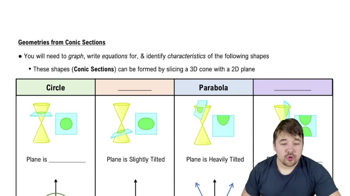
Conic sections are the curves obtained by intersecting a plane with a double-napped cone. The equation provided can represent different conic sections, such as ellipses or hyperbolas, depending on the coefficients and the discriminant. Recognizing the type of conic section is crucial for analyzing the geometric properties of the equation.
The standard form of conic sections provides a way to express the equations of conics in a recognizable format, such as (x-h)^2/a^2 + (y-k)^2/b^2 = 1 for ellipses. Transforming the given equation into standard form without completing the square involves rearranging and simplifying the terms, which is vital for understanding the graph and characteristics of the conic.