Identify each equation without completing the square. y2+8x+6y+25=0
Verified step by step guidance
1
Start by recognizing the general form of a conic section equation. The given equation is \( y^2 + 8x + 6y + 25 = 0 \). This resembles the general form of a parabola, \( Ax^2 + Bxy + Cy^2 + Dx + Ey + F = 0 \), where either \( A = 0 \) or \( C = 0 \).
In the given equation, notice that there is no \( x^2 \) term, which means \( A = 0 \). This suggests that the equation could represent a parabola that opens horizontally.
Next, identify the coefficients: \( A = 0 \), \( B = 0 \), \( C = 1 \), \( D = 8 \), \( E = 6 \), and \( F = 25 \). Since \( C \neq 0 \) and \( A = 0 \), this confirms that the equation is a parabola.
To further analyze the equation, rearrange it to isolate the \( y \) terms: \( y^2 + 6y = -8x - 25 \). This form helps in identifying the vertex and direction of the parabola.
Finally, recognize that the equation is in a form that can be transformed into the standard form of a parabola by completing the square on the \( y \) terms, but since the task is to identify without completing the square, we conclude that the equation represents a horizontally oriented parabola.
Verified video answer for a similar problem:
This video solution was recommended by our tutors as helpful for the problem above
Video duration:
2m
Play a video:
0 Comments
Key Concepts
Here are the essential concepts you must grasp in order to answer the question correctly.
Quadratic Equations
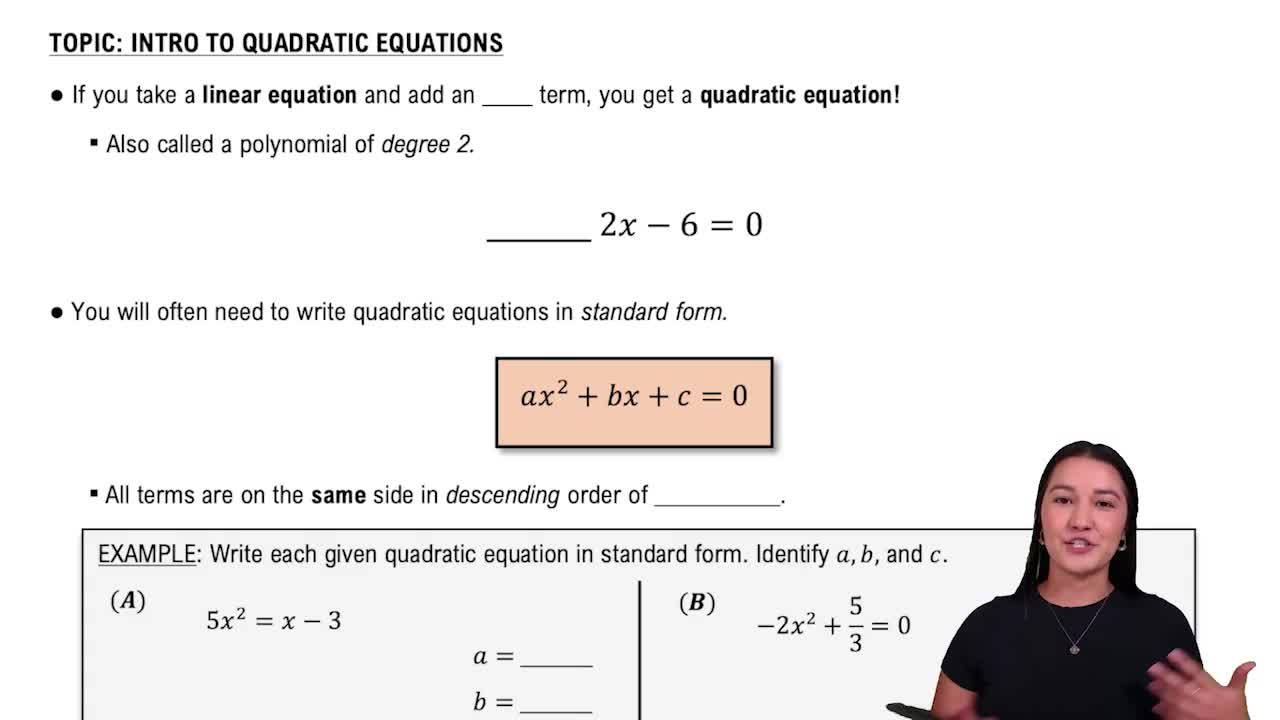
A quadratic equation is a polynomial equation of degree two, typically expressed in the standard form ax^2 + bx + c = 0. In the given equation, y^2 + 6y + 8x + 25 = 0, the presence of the y^2 term indicates that it is a quadratic in y. Understanding the structure of quadratic equations is essential for identifying their properties and solutions.
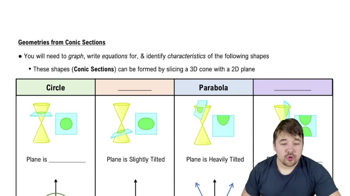
Conic sections are the curves obtained by intersecting a plane with a double-napped cone. The equation provided can represent different conic sections depending on its form. In this case, it can be rearranged to identify whether it represents a parabola, ellipse, or hyperbola, which is crucial for understanding the geometric implications of the equation.
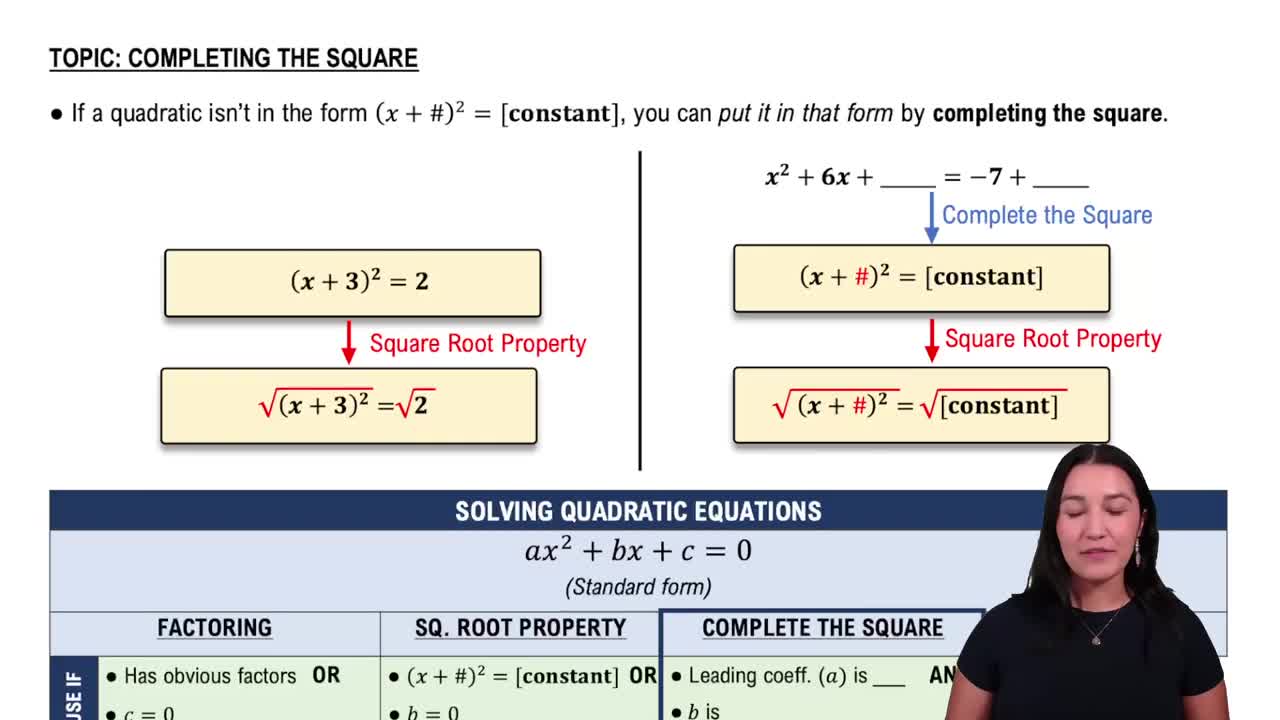
Completing the square is a method used to transform a quadratic equation into a perfect square trinomial, making it easier to solve or analyze. Although the question specifies not to complete the square, understanding this technique is vital for recognizing the vertex form of a quadratic and for solving quadratic equations efficiently.