Write a formula for the general term (the nth term) of each arithmetic sequence. Do not use a recursion formula. Then use the formula for an to find a20, the 20th term of the sequence. an = an-1 +3, a1 = 4
Table of contents
- 0. Review of Algebra4h 18m
- 1. Equations & Inequalities3h 18m
- 2. Graphs of Equations1h 43m
- 3. Functions2h 17m
- 4. Polynomial Functions1h 44m
- 5. Rational Functions1h 23m
- 6. Exponential & Logarithmic Functions2h 28m
- 7. Systems of Equations & Matrices4h 5m
- 8. Conic Sections2h 23m
- 9. Sequences, Series, & Induction1h 22m
- 10. Combinatorics & Probability1h 45m
9. Sequences, Series, & Induction
Arithmetic Sequences
Problem 39
Textbook Question
Find 1+2+3+4+...+ 100, the sum of the first 100 natural numbers.
Verified step by step guidance1
Recognize that the problem asks for the sum of the first 100 natural numbers, which is an arithmetic series where the first term \(a_1 = 1\) and the last term \(a_n = 100\).
Recall the formula for the sum of the first \(n\) natural numbers: \(S_n = \frac{n(n+1)}{2}\), where \(n\) is the number of terms.
Identify that in this problem, \(n = 100\) because we are summing from 1 to 100.
Substitute \(n = 100\) into the formula to set up the expression: \(S_{100} = \frac{100(100+1)}{2}\).
Simplify the expression step-by-step to find the sum, but do not calculate the final numeric value as per instructions.
Verified video answer for a similar problem:This video solution was recommended by our tutors as helpful for the problem above
Video duration:
3mPlay a video:
0 Comments
Key Concepts
Here are the essential concepts you must grasp in order to answer the question correctly.
Arithmetic Series
An arithmetic series is the sum of the terms of an arithmetic sequence, where each term increases by a constant difference. In this problem, the numbers 1, 2, 3, ..., 100 form an arithmetic sequence with a common difference of 1.
Recommended video:
Guided course
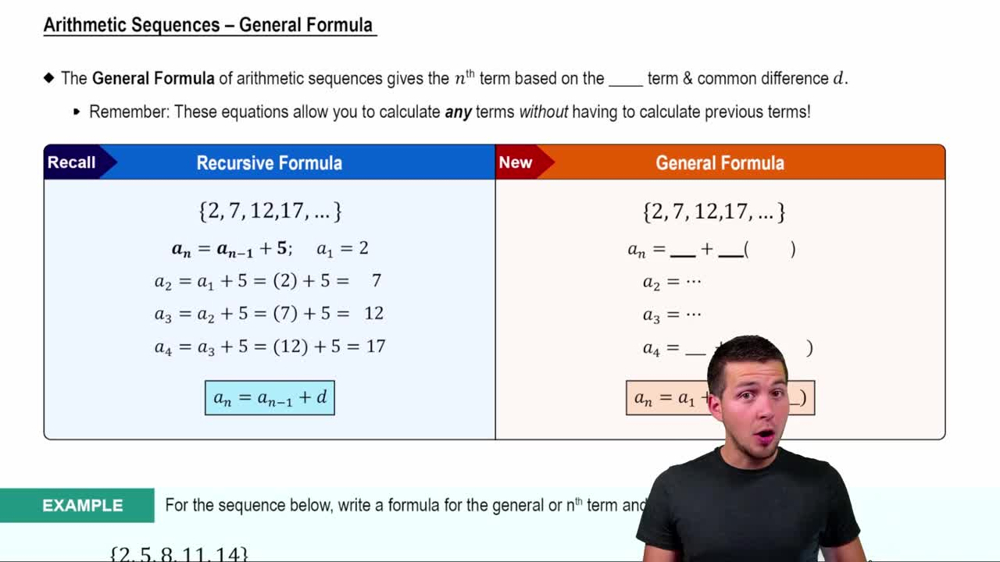
Arithmetic Sequences - General Formula
Formula for the Sum of the First n Natural Numbers
The sum of the first n natural numbers can be found using the formula S = n(n + 1)/2. This formula provides a quick way to calculate the sum without adding each number individually.
Recommended video:
Solving Quadratic Equations Using The Quadratic Formula
Natural Numbers
Natural numbers are the set of positive integers starting from 1 (1, 2, 3, ...). Understanding that the problem involves the first 100 natural numbers helps identify the sequence and apply the appropriate summation formula.
Recommended video:
The Natural Log
Related Videos
Related Practice
Textbook Question
761
views