Find the sum of the even integers between 21 and 45.
Verified step by step guidance
1
Identify the range of integers between 21 and 45, which means all integers greater than 21 and less than 45.
Determine the even integers within this range. The smallest even integer greater than 21 is 22, and the largest even integer less than 45 is 44.
List the even integers from 22 to 44: 22, 24, 26, ..., 44. Notice this is an arithmetic sequence where the first term \(a_1 = 22\), the last term \(a_n = 44\), and the common difference \(d = 2\).
Find the number of terms \(n\) in this arithmetic sequence using the formula \(a_n = a_1 + (n-1)d\). Rearrange to solve for \(n\): \(n = \frac{a_n - a_1}{d} + 1\).
Calculate the sum of the arithmetic sequence using the formula \(S_n = \frac{n}{2} (a_1 + a_n)\), where \(S_n\) is the sum of the \(n\) terms.
Verified video answer for a similar problem:
This video solution was recommended by our tutors as helpful for the problem above
Video duration:
4m
Play a video:
0 Comments
Key Concepts
Here are the essential concepts you must grasp in order to answer the question correctly.
Identifying Even Integers
Even integers are whole numbers divisible by 2 without a remainder. To find even integers between two numbers, determine the smallest even number greater than the lower bound and the largest even number less than the upper bound.
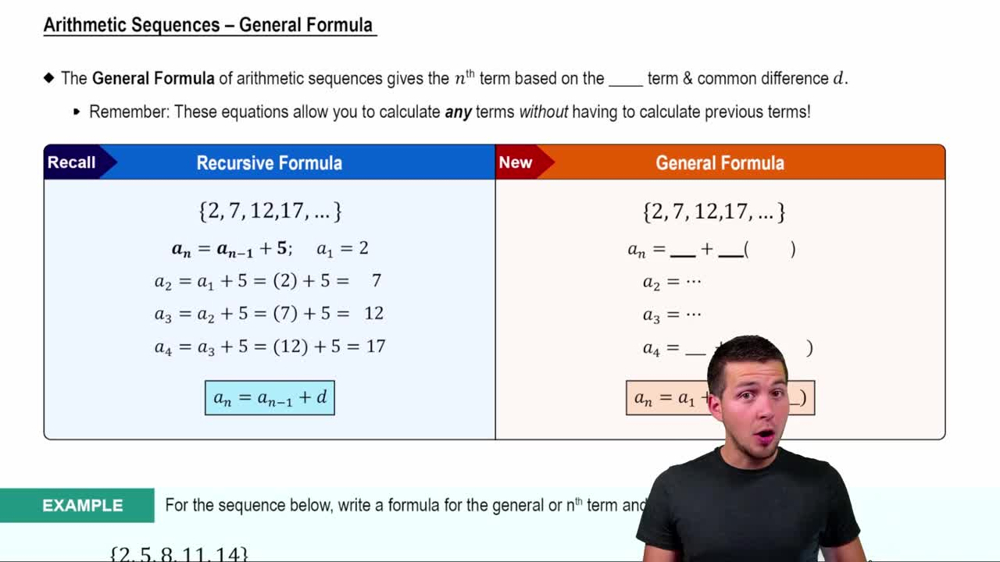
An arithmetic sequence is a list of numbers with a constant difference between consecutive terms. Even integers form an arithmetic sequence with a common difference of 2, which helps in systematically listing or summing them.
The sum of an arithmetic sequence can be found using the formula S = n/2 * (first term + last term), where n is the number of terms. This formula simplifies adding many terms without summing each individually.

 4:12 minutes
 Verified step by step guidance
 05:01
05:01