Use mathematical induction to prove that each statement is true for every positive integer n. 1 + 3 + 5 + ... + (2n - 1) = n2
Verified step by step guidance
1
Step 1: Understand the statement to prove by induction: For every positive integer \(n\), the sum of the first \(n\) odd numbers is equal to \(n^2\). In other words, prove that \(1 + 3 + 5 + \dots + (2n - 1) = n^2\).
Step 2: Base Case: Verify the statement for \(n=1\). Substitute \(n=1\) into the left side and right side of the equation to check if both sides are equal.
Step 3: Inductive Hypothesis: Assume the statement is true for some positive integer \(k\), that is, assume \(1 + 3 + 5 + \dots + (2k - 1) = k^2\) holds.
Step 4: Inductive Step: Using the inductive hypothesis, prove the statement is true for \(k+1\). Start with the sum up to \(k+1\) terms: \(1 + 3 + 5 + \dots + (2k - 1) + (2(k+1) - 1)\), and show this equals \((k+1)^2\).
Step 5: Simplify the expression from Step 4 by substituting the inductive hypothesis and algebraically manipulating the terms to demonstrate the equality holds, completing the induction proof.
Verified video answer for a similar problem:
This video solution was recommended by our tutors as helpful for the problem above
Video duration:
6m
Play a video:
0 Comments
Key Concepts
Here are the essential concepts you must grasp in order to answer the question correctly.
Mathematical Induction
Mathematical induction is a proof technique used to establish that a statement holds for all positive integers. It involves two steps: proving the base case (usually n=1) is true, and then proving that if the statement holds for an arbitrary integer k, it also holds for k+1.
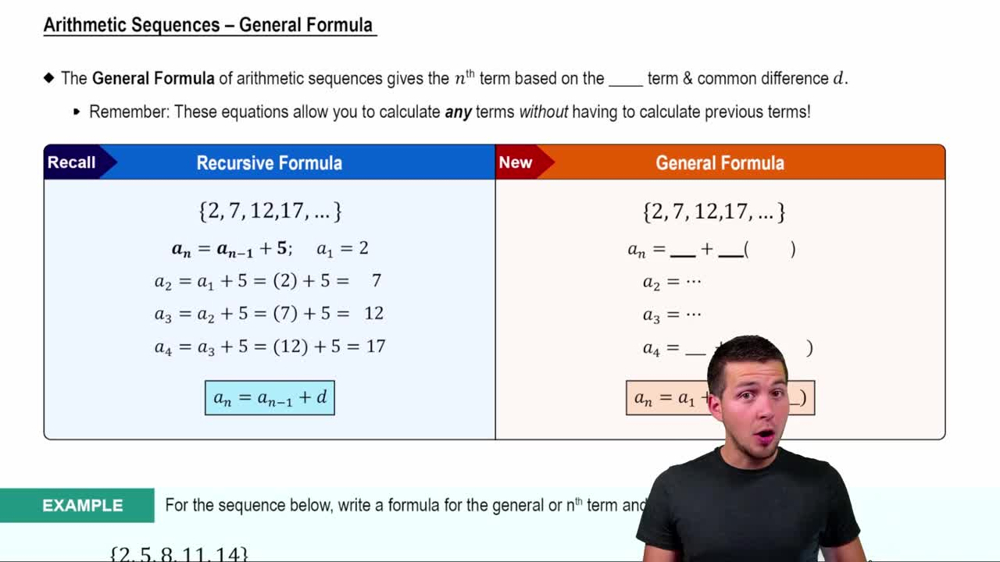
The sum 1 + 3 + 5 + ... + (2n - 1) is an arithmetic sequence with a common difference of 2. Understanding how to express and manipulate sums of arithmetic sequences helps in recognizing patterns and formulating the statement to be proved.
Algebraic manipulation involves simplifying expressions and substituting terms correctly. In this proof, it is essential to manipulate the inductive hypothesis and the next term to show that the sum equals n², ensuring the logical flow of the induction step.

 6:18 minutes
 Verified step by step guidance
 05:17
05:17