Recognize that the expression \((x + y)^2 + 6(x + y) + 9\) is a quadratic in terms of \(u = (x + y)\).
Rewrite the expression as \(u^2 + 6u + 9\).
Notice that this is a perfect square trinomial, which can be factored as \((u + 3)^2\).
Substitute back \(u = (x + y)\) into the factored form to get \((x + y + 3)^2\).
Verify the factorization by expanding \((x + y + 3)^2\) to ensure it matches the original expression.
Verified video answer for a similar problem:
This video solution was recommended by our tutors as helpful for the problem above
Video duration:
2m
Play a video:
0 Comments
Key Concepts
Here are the essential concepts you must grasp in order to answer the question correctly.
Factoring Quadratic Expressions
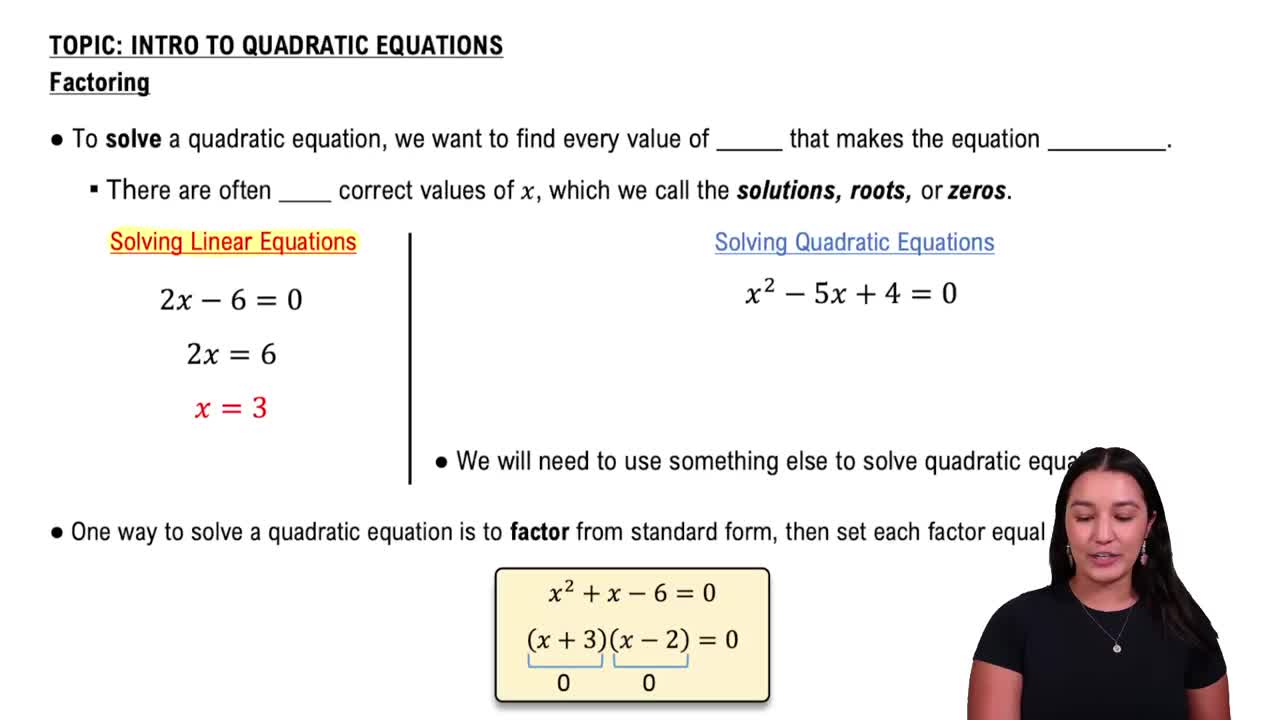
Factoring quadratic expressions involves rewriting them as a product of binomials. This process is essential for simplifying expressions and solving equations. The standard form of a quadratic is ax² + bx + c, and the goal is to express it in the form (px + q)(rx + s). Recognizing patterns, such as perfect squares or the difference of squares, can aid in this process.
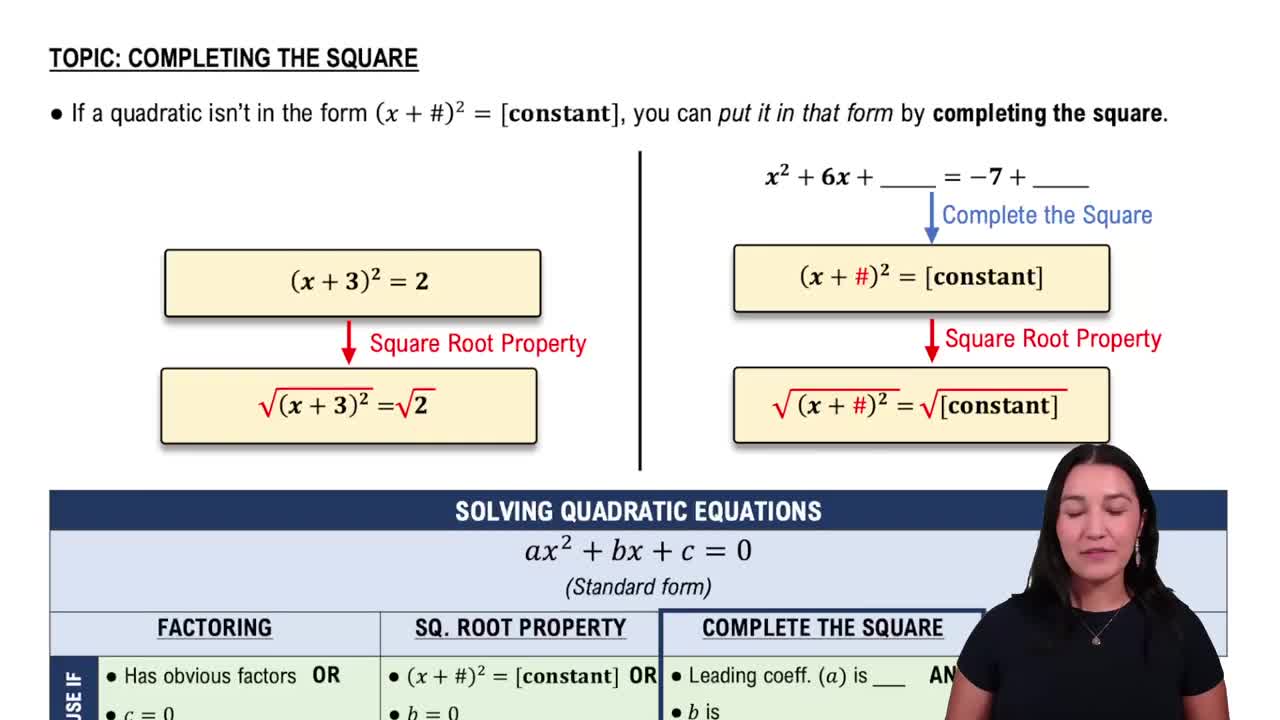
Completing the square is a method used to transform a quadratic expression into a perfect square trinomial. This technique involves manipulating the expression to create a squared term, which can simplify factoring. For example, in the expression (x + y)² + 6(x + y) + 9, recognizing that it can be rewritten as ((x + y) + 3)² helps in identifying the factors.
Solving Quadratic Equations by Completing the Square
Binomial Theorem
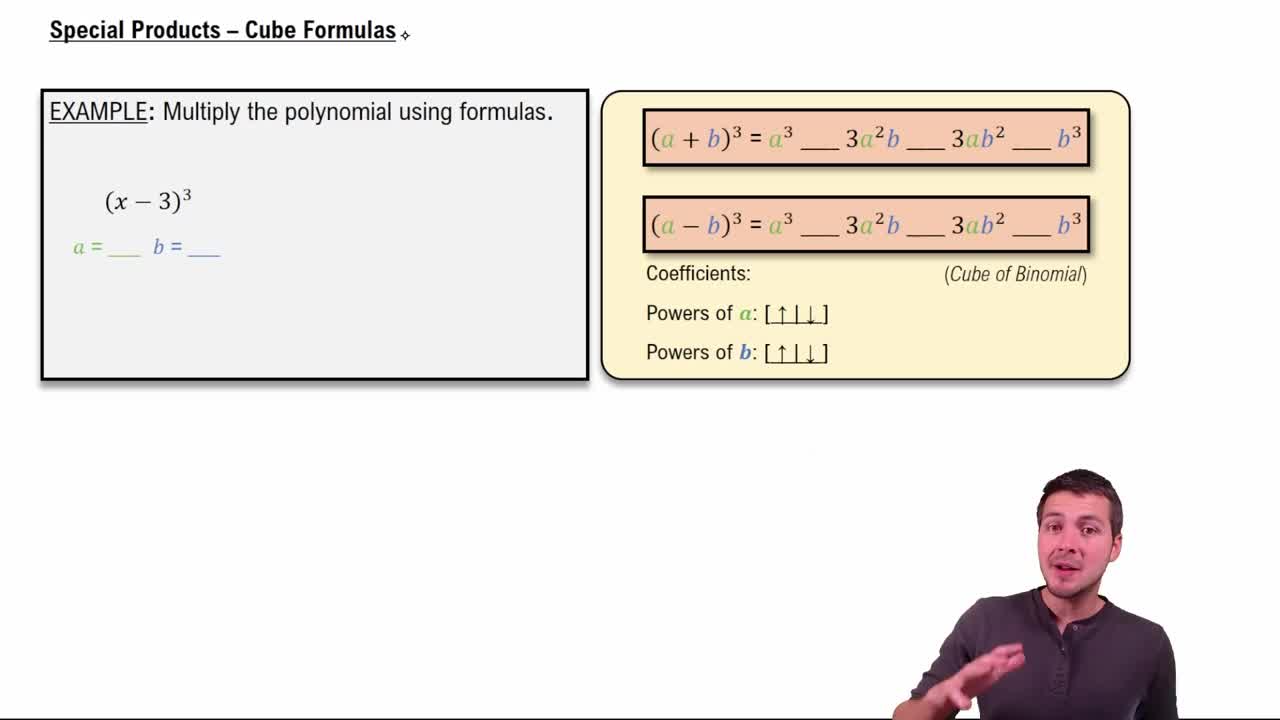
The Binomial Theorem provides a formula for expanding expressions raised to a power, specifically (a + b)ⁿ. In the context of factoring, it helps in recognizing patterns in polynomials. For instance, the expression (x + y)² can be expanded to x² + 2xy + y², which is useful for identifying and factoring quadratic expressions effectively.

 2:08 minutes
 Verified step by step guidance
 06:08
06:08