In Exercises 65–74, factor by grouping to obtain the difference of two squares. 9x^2 − 30x + 25 − 36x^4
Verified step by step guidance
1
insert step 1: Rearrange the terms in the expression to group them in a way that facilitates factoring. Start by writing the expression as: \(-36x^4 + 9x^2 - 30x + 25\).
insert step 2: Group the terms into two pairs: \((-36x^4 + 9x^2)\) and \((-30x + 25)\).
insert step 3: Factor out the greatest common factor from each group. For the first group, factor out \(-9x^2\), and for the second group, factor out \(-5\). This gives: \(-9x^2(4x^2 - 1) - 5(6x - 5)\).
insert step 4: Notice that \$4x^2 - 1\( is a difference of squares, which can be factored further as \)(2x - 1)(2x + 1)$.
insert step 5: Combine the factored terms to express the original expression as a product of factors, including the difference of squares.
Verified video answer for a similar problem:
This video solution was recommended by our tutors as helpful for the problem above
Video duration:
9m
Play a video:
0 Comments
Key Concepts
Here are the essential concepts you must grasp in order to answer the question correctly.
Factoring by Grouping
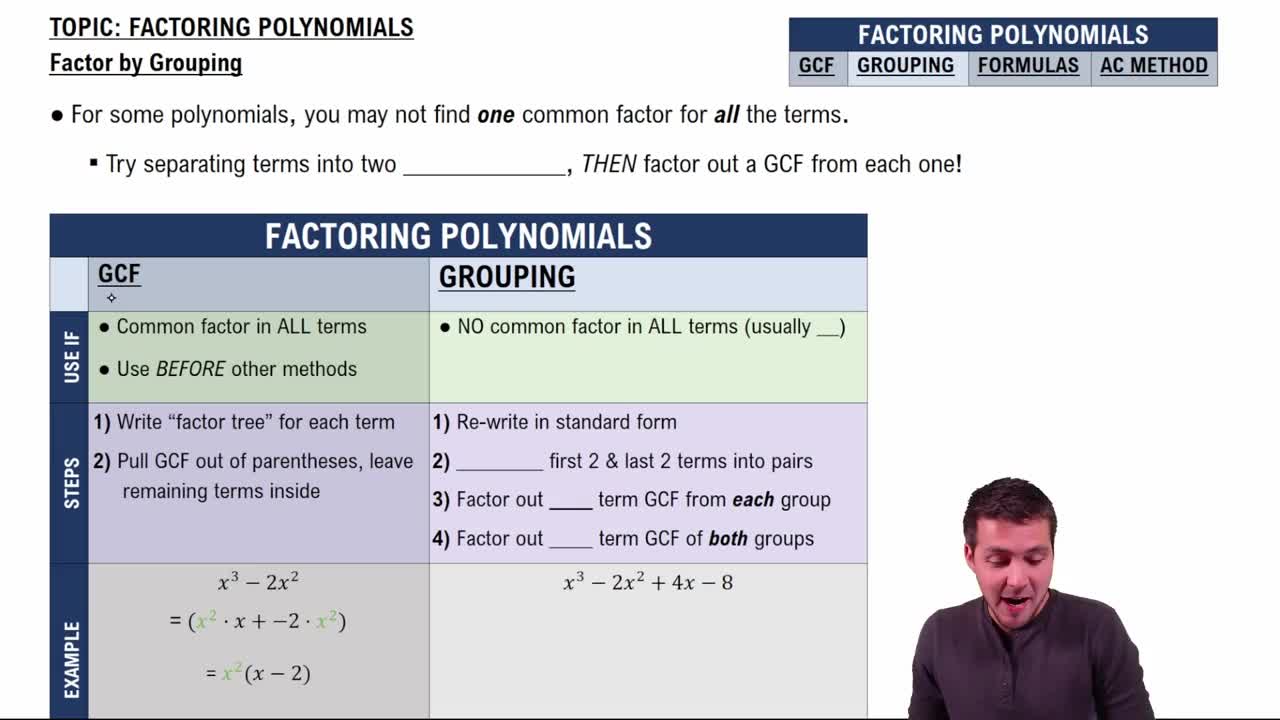
Factoring by grouping is a method used to factor polynomials by rearranging and grouping terms in pairs. This technique involves identifying common factors in each group, allowing for simplification. It is particularly useful when dealing with polynomials that do not have a straightforward factorization.
The difference of squares is a specific algebraic identity that states that the expression a^2 - b^2 can be factored into (a - b)(a + b). This concept is essential for recognizing and simplifying expressions that can be represented as the difference between two squared terms, facilitating easier calculations.
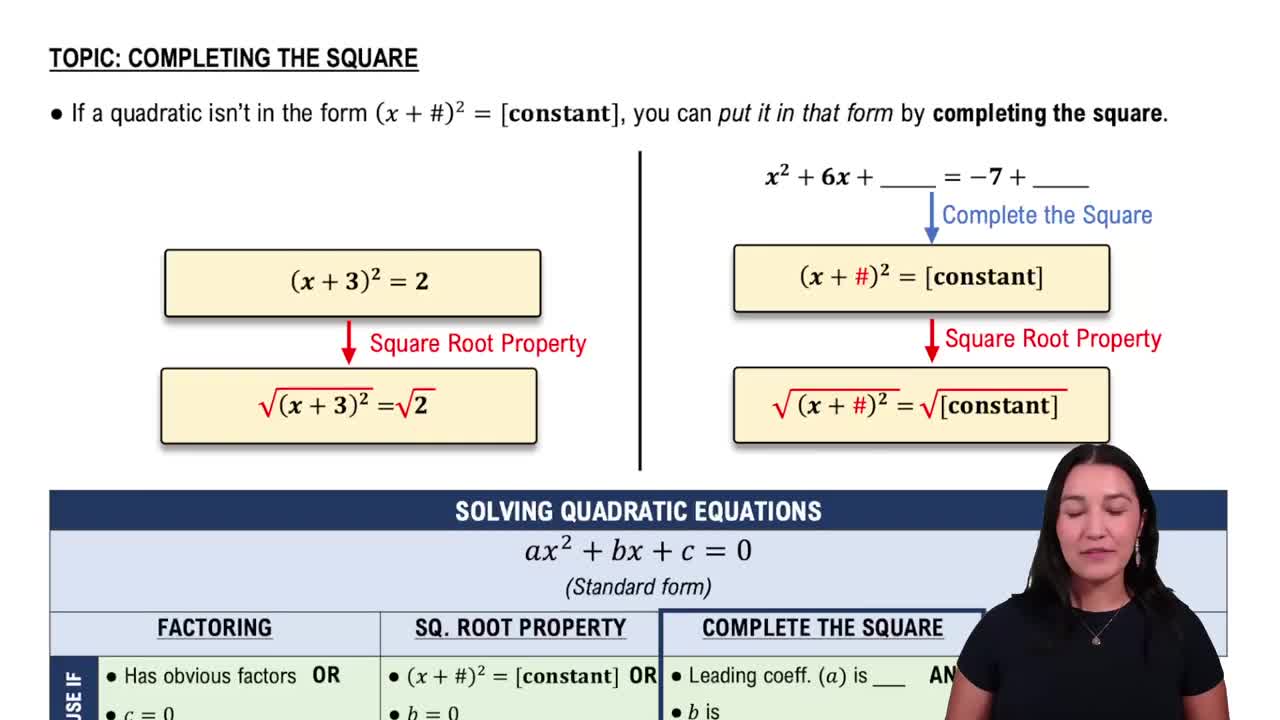
Solving Quadratic Equations by Completing the Square
Polynomial Expressions
Polynomial expressions are mathematical expressions that consist of variables raised to whole number powers and their coefficients. Understanding the structure of polynomials, including terms, degrees, and coefficients, is crucial for performing operations such as addition, subtraction, and factoring, which are foundational in algebra.

 9:02 minutes
 Verified step by step guidance
 04:36
04:36