Find f−g and determine the domain for each function. f(x) = 3 − x², g(x) = x² + 2x − 15
Verified step by step guidance
1
Step 1: Understand the problem. You are tasked with finding the difference of two functions, denoted as (f - g)(x), which is defined as f(x) - g(x). Additionally, you need to determine the domain of the resulting function.
Step 2: Write the expression for (f - g)(x). Substitute the given functions f(x) = 3 - x² and g(x) = x² + 2x - 16 into the formula: (f - g)(x) = f(x) - g(x). This becomes (f - g)(x) = (3 - x²) - (x² + 2x - 16).
Step 3: Simplify the expression. Distribute the negative sign across the terms in g(x): (f - g)(x) = 3 - x² - x² - 2x + 16. Combine like terms to simplify further: (f - g)(x) = 19 - 2x - 2x².
Step 4: Determine the domain of the resulting function. Since (f - g)(x) = 19 - 2x - 2x² is a polynomial, and polynomials are defined for all real numbers, the domain of (f - g)(x) is all real numbers, or (-∞, ∞).
Step 5: Summarize the results. The simplified expression for (f - g)(x) is 19 - 2x - 2x², and its domain is all real numbers (-∞, ∞).
Verified video answer for a similar problem:
This video solution was recommended by our tutors as helpful for the problem above
Video duration:
1m
Play a video:
0 Comments
Key Concepts
Here are the essential concepts you must grasp in order to answer the question correctly.
Function Operations
Function operations involve combining two or more functions to create new functions. In this case, finding f - g means subtracting the function g(x) from f(x). Understanding how to perform these operations is essential for manipulating and analyzing functions in algebra.
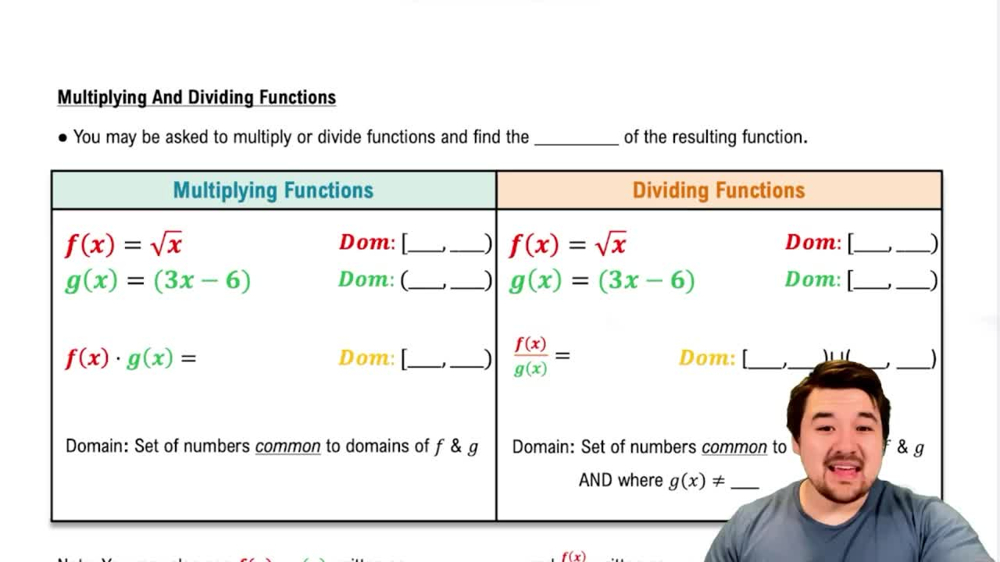
The domain of a function is the set of all possible input values (x-values) for which the function is defined. When performing operations like subtraction, it is crucial to determine the domain of the resulting function to ensure that all values are valid and do not lead to undefined expressions.
Quadratic functions are polynomial functions of degree two, typically expressed in the form f(x) = ax² + bx + c. In this problem, both f(x) and g(x) are quadratic functions, and understanding their properties, such as their graphs and behavior, is important for analyzing the results of their operations.

 1:51 minutes
 Verified step by step guidance
 7:24
7:24