Find ƒ+g, ƒ- g, ƒg and ƒ/g. Determine the domain for each function. f(x) = 3 − x², g(x) = x² + 2x − 15
Verified step by step guidance
1
Step 1: Understand the problem. We are tasked with finding the sum of two functions, ƒ(x) and g(x), denoted as (ƒ + g)(x). This means we need to add the two given functions together and simplify the resulting expression.
Step 2: Write the expressions for ƒ(x) and g(x). The given functions are ƒ(x) = 3 − x² and g(x) = x² + 2x − 15.
Step 3: Add the two functions. Combine ƒ(x) and g(x) by adding their expressions: (ƒ + g)(x) = ƒ(x) + g(x) = (3 − x²) + (x² + 2x − 15).
Step 5: Determine the domain of the resulting function. Since the resulting function (ƒ + g)(x) = 2x − 12 is a polynomial, it is defined for all real numbers. Therefore, the domain is all real numbers, which can be expressed as (-∞, ∞).
Verified video answer for a similar problem:
This video solution was recommended by our tutors as helpful for the problem above
Video duration:
1m
Play a video:
0 Comments
Key Concepts
Here are the essential concepts you must grasp in order to answer the question correctly.
Function Addition
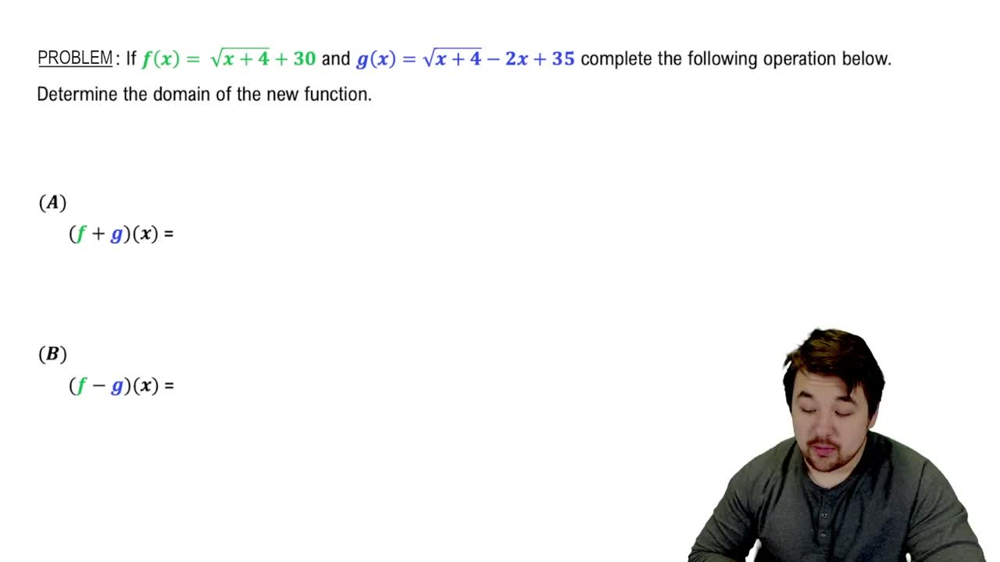
Function addition involves combining two functions by adding their outputs for each input. For functions f(x) and g(x), the sum is defined as (f + g)(x) = f(x) + g(x). This operation requires evaluating both functions at the same x-value and summing the results, which is essential for solving the given problem.
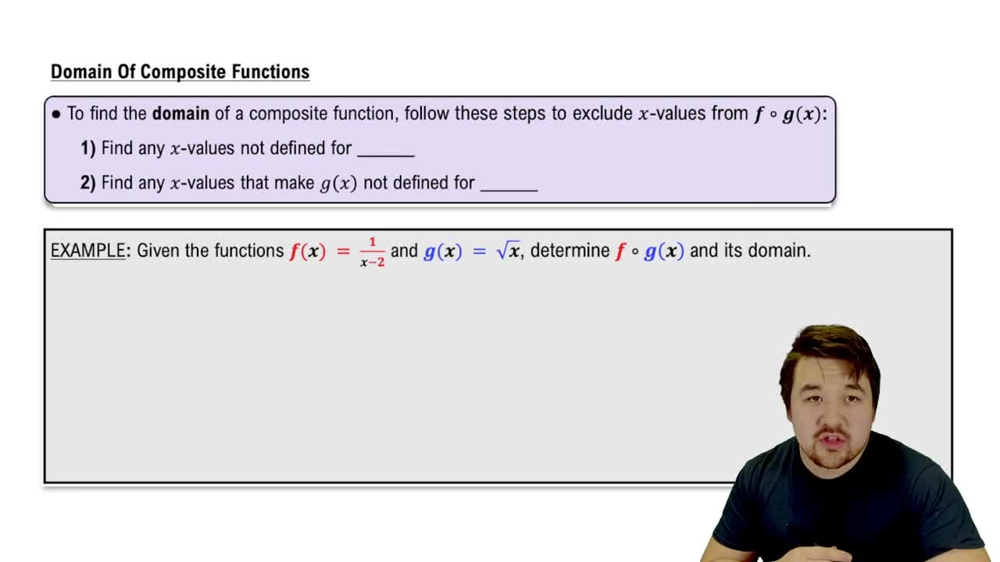
The domain of a function is the set of all possible input values (x-values) for which the function is defined. For polynomial functions like f(x) = 3 - x² and g(x) = x² + 2x - 15, the domain is typically all real numbers, as polynomials do not have restrictions such as division by zero or square roots of negative numbers.
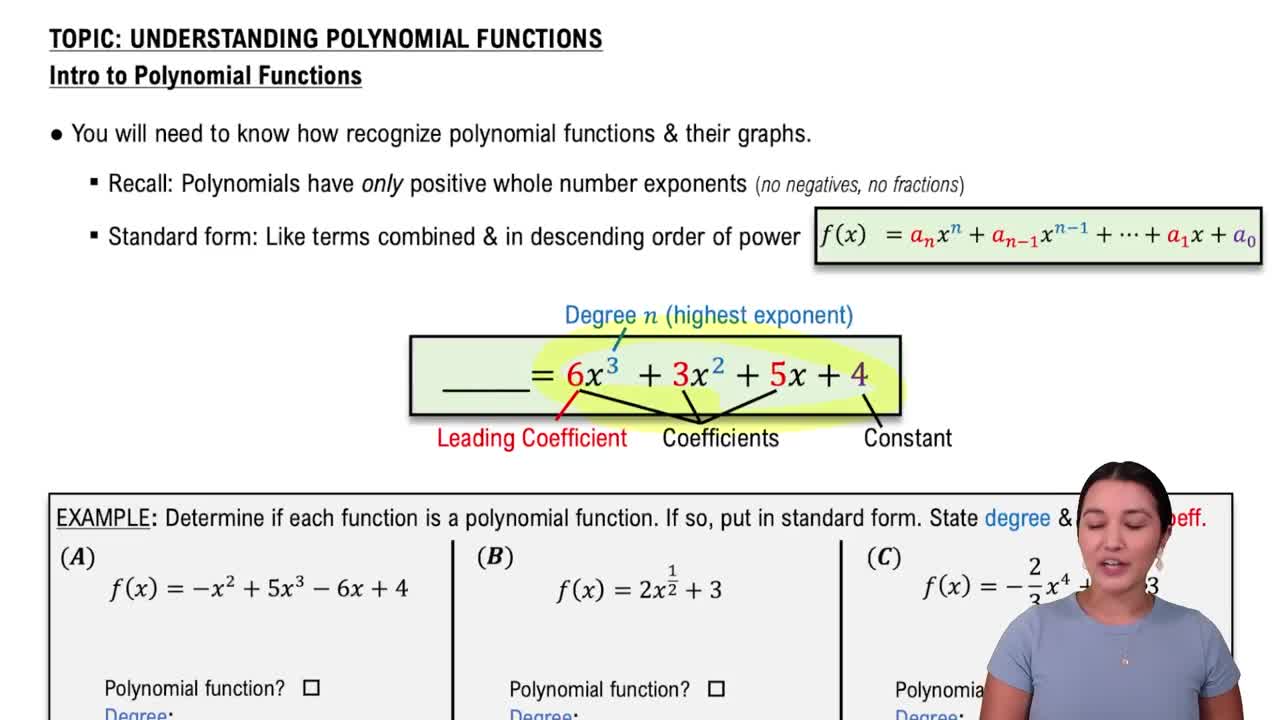
Polynomial functions are expressions that involve variables raised to whole number powers, combined using addition, subtraction, and multiplication. The functions f(x) and g(x) in the problem are both polynomials, which means they are continuous and smooth, making their behavior predictable across their domains. Understanding their structure is crucial for performing operations like addition.

 1:43 minutes
 Verified step by step guidance
 4:46
4:46