Begin by graphing the cube root function, f(x) = ∛x. Then use transformations of this graph to graph the given function. g(x) = ∛x+2
Verified step by step guidance
1
Start by understanding the parent function f(x) = ∛x. This is the cube root function, which has a characteristic shape. The graph passes through the origin (0, 0), increases to the right, and decreases to the left. It is symmetric about the origin, meaning it is an odd function.
Graph the parent function f(x) = ∛x. Plot key points such as (-8, -2), (-1, -1), (0, 0), (1, 1), and (8, 2). These points are derived from the cube root of x values.
Now, analyze the transformation applied to f(x) to obtain g(x) = ∛x + 2. The '+2' indicates a vertical shift upward by 2 units. This means every point on the graph of f(x) will move 2 units higher.
Apply the vertical shift to the key points of f(x). For example, the point (0, 0) on f(x) becomes (0, 2) on g(x), the point (1, 1) becomes (1, 3), and so on. Adjust all the plotted points accordingly.
Draw the graph of g(x) = ∛x + 2 by connecting the transformed points smoothly, maintaining the same shape as the parent function. Ensure the graph still reflects the cube root function's characteristic behavior, but shifted upward by 2 units.
Verified video answer for a similar problem:
This video solution was recommended by our tutors as helpful for the problem above
Video duration:
1m
Play a video:
0 Comments
Key Concepts
Here are the essential concepts you must grasp in order to answer the question correctly.
Cube Root Function
The cube root function, denoted as f(x) = ∛x, is a type of radical function that returns the number which, when cubed, gives the input x. This function is defined for all real numbers and has a characteristic S-shaped curve that passes through the origin (0,0). Understanding its basic shape and properties is essential for graphing transformations.
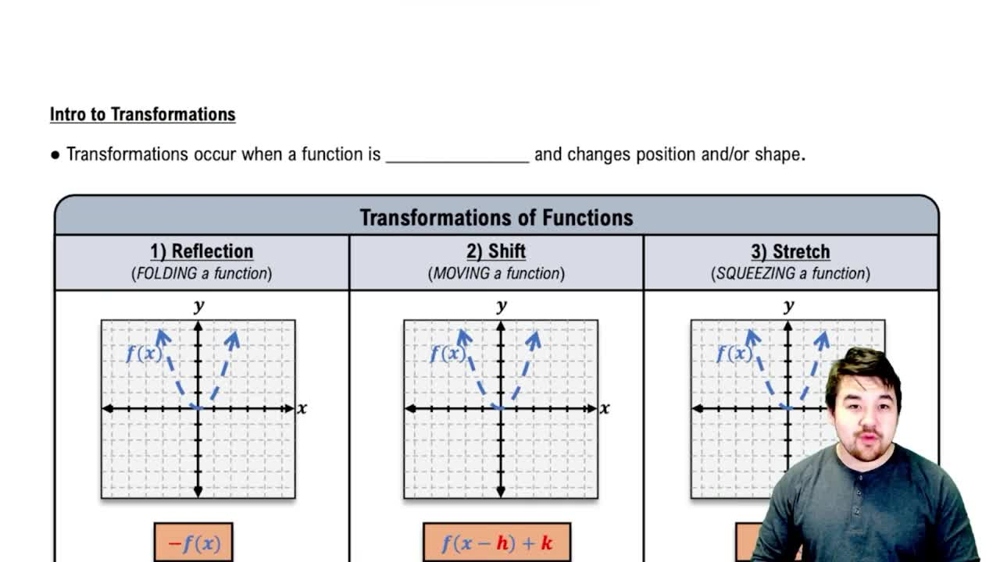
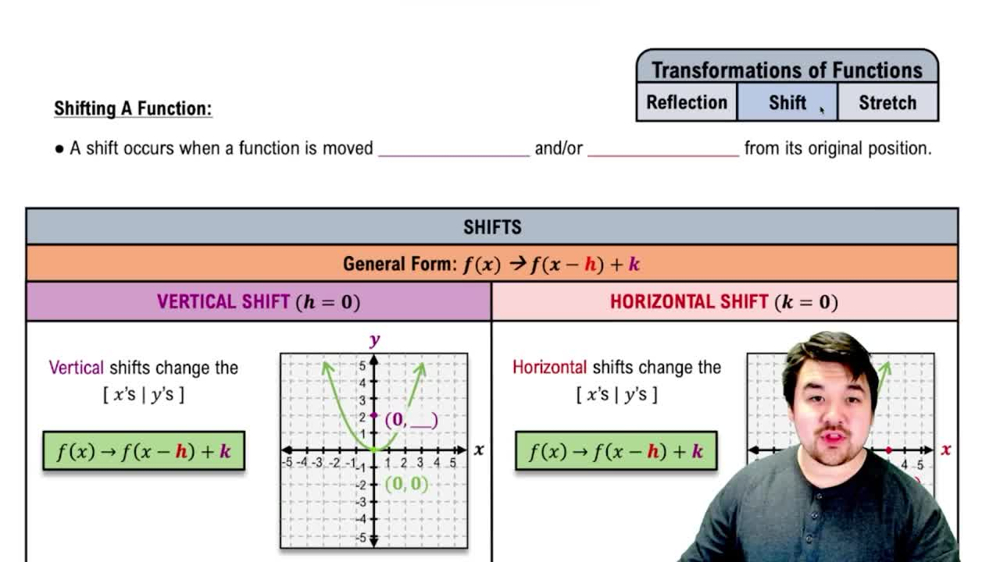
Graph transformations involve shifting, stretching, compressing, or reflecting the graph of a function. In this case, the transformation applied to the cube root function f(x) = ∛x to obtain g(x) = ∛x + 2 is a vertical shift upwards by 2 units. Recognizing how these transformations affect the graph is crucial for accurately sketching the new function.
A vertical shift occurs when a function is adjusted by adding or subtracting a constant from its output. For g(x) = ∛x + 2, the '+2' indicates that every point on the graph of f(x) = ∛x is moved up by 2 units. This concept is fundamental in understanding how the graph's position changes without altering its shape.