The graph of a function ƒ is shown in the figure. Sketch the graph of each function defined as follows. (d) y = |ƒ(x)|
Verified step by step guidance
1
Understand that the function y = |ƒ(x)| means taking the absolute value of the original function's output. This means all y-values will be non-negative (y ≥ 0).
Identify the parts of the original graph where ƒ(x) is positive or zero. For these parts, the graph of y = |ƒ(x)| will remain the same because the absolute value of a positive number or zero is the number itself.
Locate the parts of the graph where ƒ(x) is negative. For these parts, reflect the graph above the x-axis by taking the positive value of the y-coordinates. In other words, change the negative y-values to their positive counterparts.
Specifically, for the segment from (0, 0) to (8, -4), reflect the points below the x-axis to above it. For example, the point (8, -4) will become (8, 4) in the graph of y = |ƒ(x)|.
Sketch the new graph by keeping the positive parts unchanged and reflecting the negative parts above the x-axis, ensuring the graph never goes below the x-axis.
Verified video answer for a similar problem:
This video solution was recommended by our tutors as helpful for the problem above
Video duration:
1m
Play a video:
0 Comments
Key Concepts
Here are the essential concepts you must grasp in order to answer the question correctly.
Absolute Value of a Function
The absolute value of a function, denoted as |ƒ(x)|, transforms all negative output values of ƒ(x) into their positive counterparts. This means any part of the graph below the x-axis is reflected above it, while parts already above the x-axis remain unchanged.
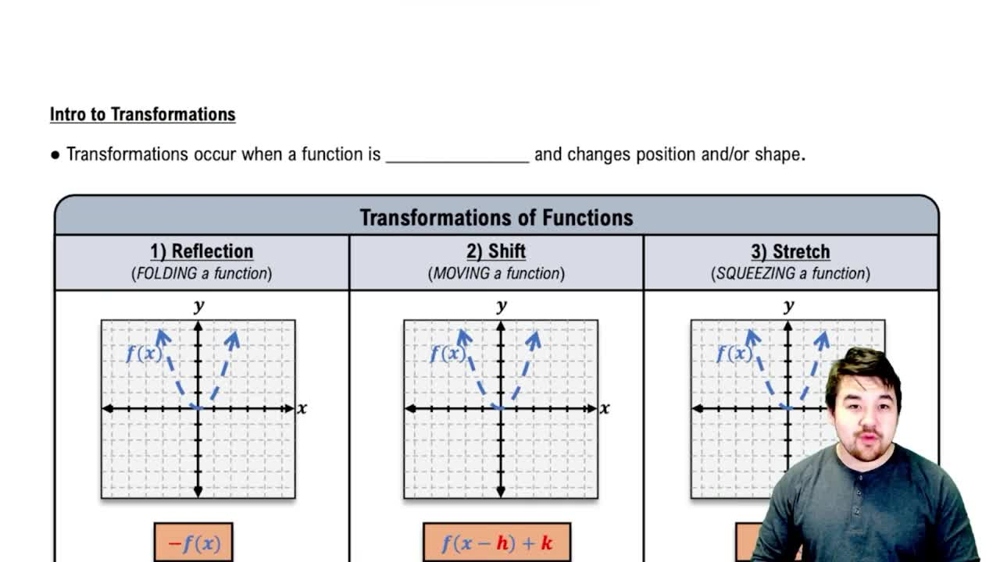
Graph transformations involve shifting, reflecting, stretching, or compressing the graph of a function. For y = |ƒ(x)|, the transformation reflects the portion of the graph where ƒ(x) < 0 across the x-axis, effectively flipping negative y-values to positive.
Key points such as intercepts and vertices help in accurately sketching transformed graphs. For y = |ƒ(x)|, points where ƒ(x) = 0 remain fixed, while points with negative y-values are reflected above the x-axis, aiding in precise graph construction.