Factor out the least power of the variable or variable expression. Assume all variables represent positive real numbers. See Example 8. 4t-2+8t-4
Verified step by step guidance
1
Identify the terms in the expression: \$4t^{-2} + 8t^{-4}$.
Determine the least power of the variable \(t\) in the terms. Here, the powers are \(-2\) and \(-4\), so the least power is \(-4\).
Factor out \(t^{-4}\) from each term. This means rewriting each term as a product involving \(t^{-4}\).
Express each term after factoring out \(t^{-4}\): \$4t^{-2} = 4t^{-4}t^{2}\( and \)8t^{-4} = 8t^{-4}t^{0}\( (since \)t^{0} = 1$).
Write the factored expression as \(t^{-4}(4t^{2} + 8)\).
Verified video answer for a similar problem:
This video solution was recommended by our tutors as helpful for the problem above
Video duration:
3m
Play a video:
0 Comments
Key Concepts
Here are the essential concepts you must grasp in order to answer the question correctly.
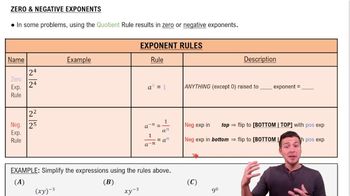
Negative Exponents
Negative exponents indicate the reciprocal of the base raised to the positive exponent. For example, t^-2 means 1 divided by t squared (1/t²). Understanding this helps in rewriting and factoring expressions involving negative powers.
Factoring out the least power means identifying the smallest exponent of the variable in all terms and factoring it out as a common factor. This simplifies the expression and makes further operations easier.
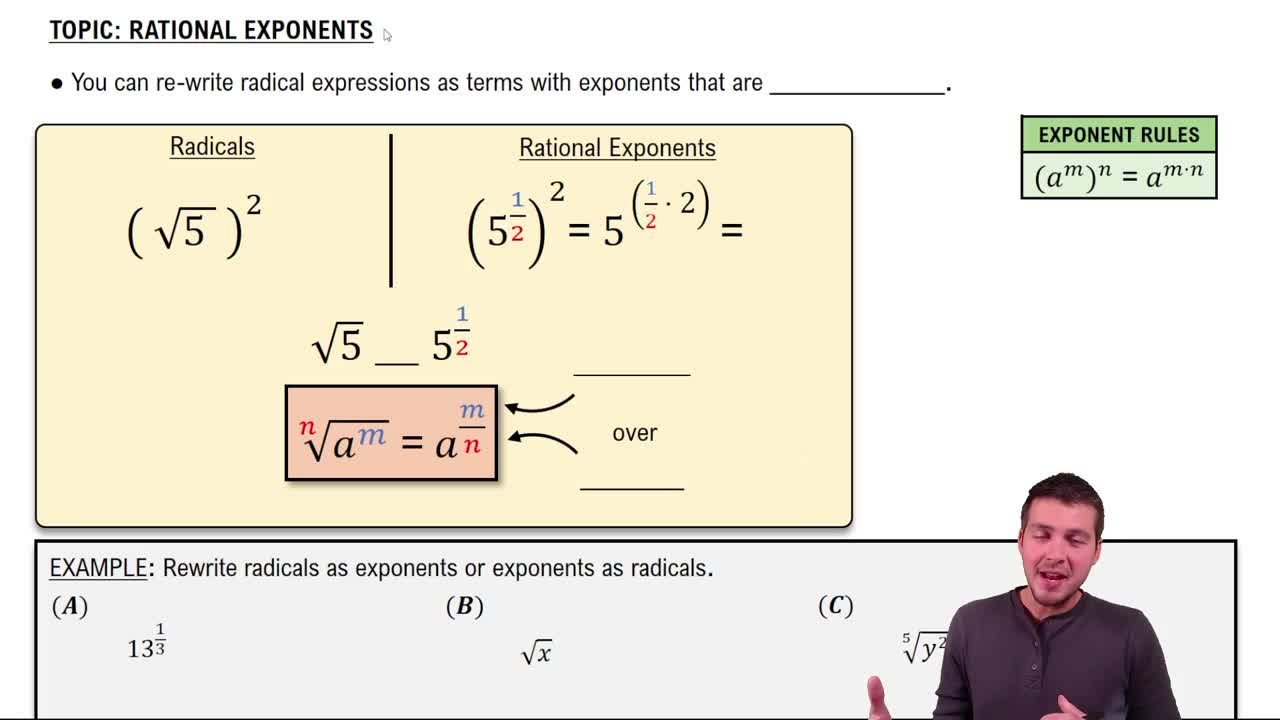
The properties of exponents, such as a^m * a^n = a^(m+n) and a^m / a^n = a^(m-n), are essential for manipulating and factoring expressions with variables raised to powers. These rules allow combining and simplifying terms effectively.