Identify the given linear equation: \$4x + 9 = 33$.
Isolate the term containing the variable \(x\) by subtracting 9 from both sides: \$4x + 9 - 9 = 33 - 9\(, which simplifies to \)4x = 24$.
Solve for \(x\) by dividing both sides of the equation by 4: \(\frac{4x}{4} = \frac{24}{4}\), which simplifies to \(x = 6\).
Check the solution by substituting \(x = 6\) back into the original equation: \$4(6) + 9$ and verify if it equals 33.
If the left side equals 33 after substitution, then \(x = 6\) is the correct solution.
Verified video answer for a similar problem:
This video solution was recommended by our tutors as helpful for the problem above
Video duration:
1m
Play a video:
0 Comments
Key Concepts
Here are the essential concepts you must grasp in order to answer the question correctly.
Linear Equations
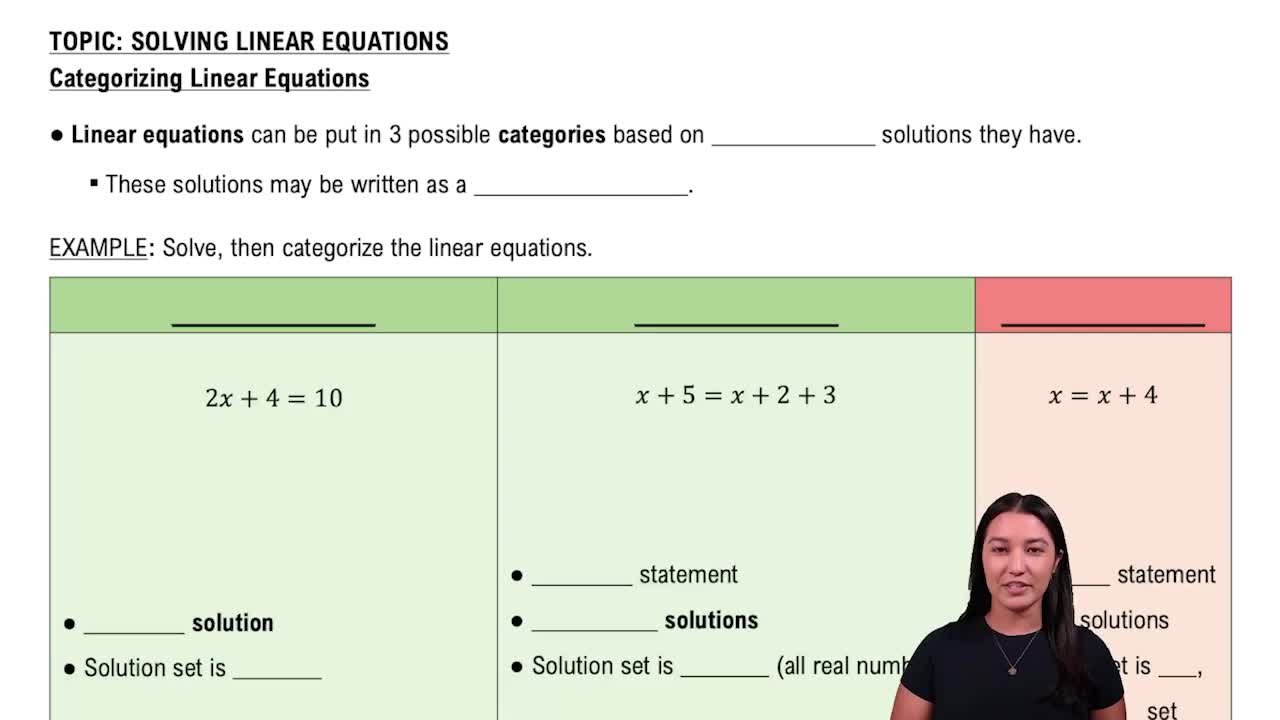
A linear equation is an algebraic equation in which each term is either a constant or the product of a constant and a single variable. It forms a straight line when graphed and typically has the form ax + b = c, where a, b, and c are constants. Solving linear equations involves finding the value of the variable that makes the equation true.
Isolating the variable means manipulating the equation to get the variable alone on one side. This is done using inverse operations such as addition, subtraction, multiplication, or division to both sides of the equation. For example, subtracting 9 from both sides and then dividing by 4 isolates x in the equation 4x + 9 = 33.
Checking the solution involves substituting the found value of the variable back into the original equation to verify it satisfies the equation. This step ensures no mistakes were made during solving. For instance, after finding x, plug it into 4x + 9 to confirm the result equals 33.