Solve each equation. A= 24f / B(p+1), for f (approximate annual interest rate)
Verified step by step guidance
1
Start with the given equation: \(A = \frac{24f}{B(p+1)}\).
To isolate \(f\), multiply both sides of the equation by the denominator \(B(p+1)\) to eliminate the fraction: \(A \times B(p+1) = 24f\).
Rewrite the equation as \(A B (p+1) = 24f\) to clearly show the product on the left side.
Divide both sides of the equation by 24 to solve for \(f\): \(f = \frac{A B (p+1)}{24}\).
Now, \(f\) is expressed in terms of \(A\), \(B\), and \(p\), which completes the isolation of \(f\).
Verified video answer for a similar problem:
This video solution was recommended by our tutors as helpful for the problem above
Video duration:
1m
Play a video:
0 Comments
Key Concepts
Here are the essential concepts you must grasp in order to answer the question correctly.
Solving for a Variable in an Equation
This involves isolating the desired variable on one side of the equation by performing algebraic operations such as multiplication, division, addition, or subtraction. The goal is to rewrite the equation so that the variable is expressed explicitly in terms of the other variables and constants.
Variables represent unknown or changeable quantities, while constants are fixed values. Recognizing which symbols are variables and which are constants helps in manipulating the equation correctly and understanding the relationships between different quantities.
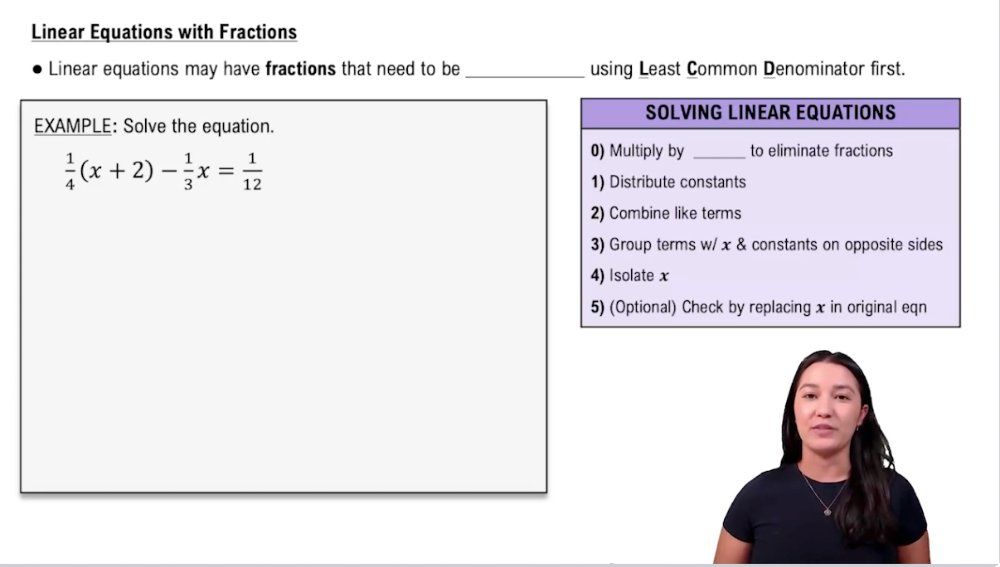
When variables appear in denominators or as part of fractions, cross-multiplication is a useful technique to eliminate fractions and simplify the equation. This involves multiplying both sides of the equation by the denominators to clear fractions and make solving for the variable easier.

 1:41 minutes
 Verified step by step guidance
 05:28
05:28