In Exercises 3–5, solve each system of equations using matrices. Use Gaussian elimination with back-substitution or Gauss-Jordan elimination.
Verified step by step guidance
1
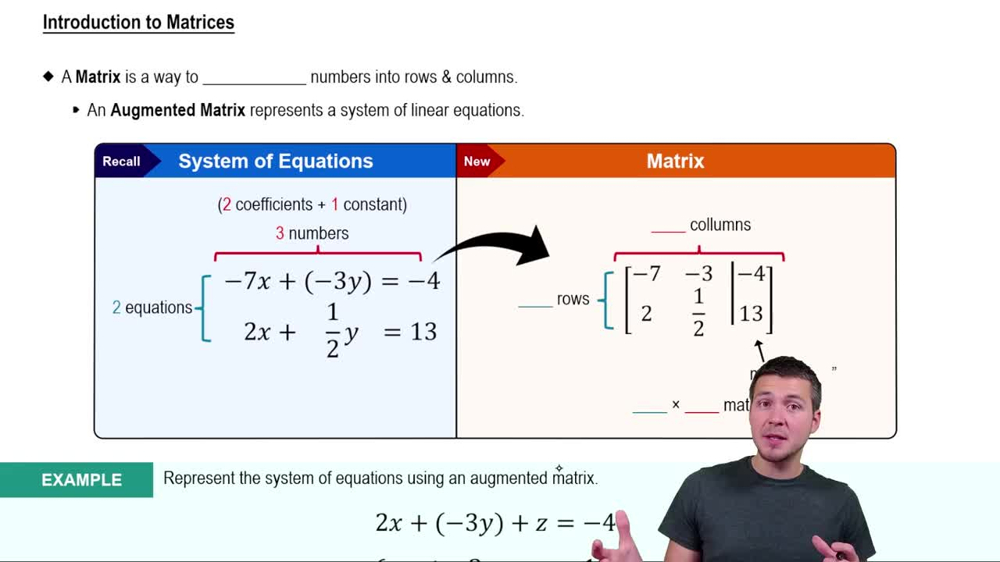
Step 1: Write the system of equations in augmented matrix form. This involves creating a matrix where each row corresponds to an equation, and the last column represents the constants on the right-hand side of the equations.
Step 2: Use Gaussian elimination to transform the augmented matrix into row-echelon form. This involves performing row operations (such as swapping rows, multiplying a row by a nonzero scalar, or adding/subtracting multiples of rows) to create zeros below the pivot elements in each column.
Step 3: Once the matrix is in row-echelon form, use back-substitution to solve for the variables. Start with the last row (which should correspond to a single variable) and substitute its value into the rows above to find the remaining variables.
Step 4: Alternatively, if using Gauss-Jordan elimination, continue performing row operations to transform the matrix into reduced row-echelon form. This form has pivot elements as 1, with zeros both above and below each pivot. Each row will directly correspond to the value of a variable.
Step 5: Interpret the final matrix to write the solution to the system of equations. If the system has no solution (inconsistent), or infinitely many solutions (dependent), state this based on the matrix form.
Verified video answer for a similar problem:
This video solution was recommended by our tutors as helpful for the problem above
Video duration:
11m
Play a video:
0 Comments
Key Concepts
Here are the essential concepts you must grasp in order to answer the question correctly.
Matrices
Matrices are rectangular arrays of numbers or variables arranged in rows and columns. They are fundamental in linear algebra and are used to represent systems of equations. Each element in a matrix can be manipulated through various operations, such as addition, multiplication, and finding inverses, which are essential for solving systems of equations.
Gaussian elimination is a method for solving systems of linear equations by transforming the system's augmented matrix into row echelon form. This involves a series of row operations to create zeros below the leading coefficients, making it easier to solve for the variables through back-substitution. It is a systematic approach that simplifies the process of finding solutions.
Back-substitution is a technique used after applying Gaussian elimination to solve for the variables in a system of equations. Once the matrix is in row echelon form, the last equation can be solved for the last variable, and this value is then substituted back into the previous equations to find the remaining variables. This step is crucial for obtaining the final solution of the system.

 11:05 minutes
 Verified step by step guidance
 4:35
4:35