Use the given row transformation to change each matrix as indicated.
Verified step by step guidance
1
Identify the given matrix as a 2x2 matrix with elements arranged as: \(\begin{bmatrix} a & b \\ c & d \end{bmatrix}\), where the first row is \((a, b)\) and the second row is \((c, d)\).
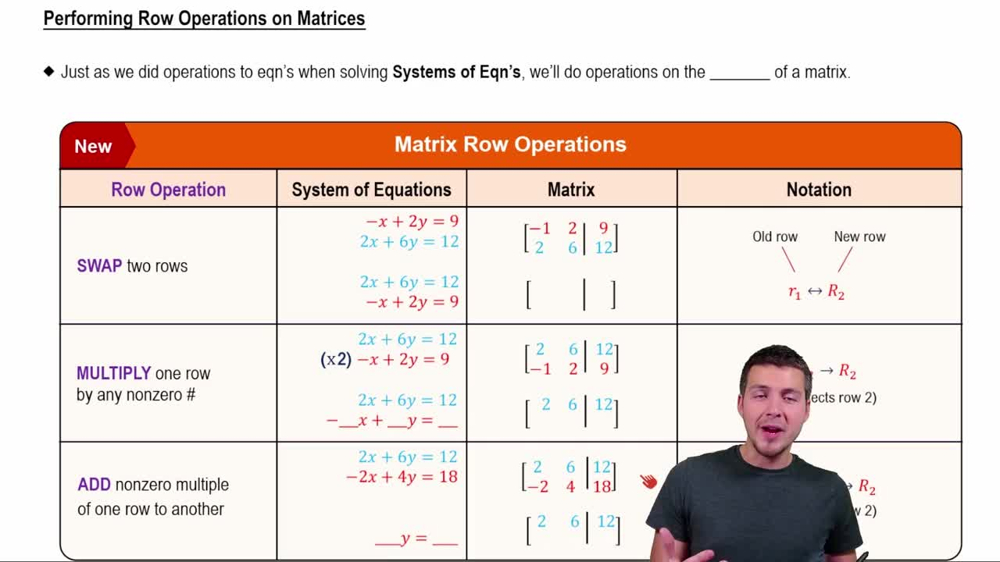
Understand the row operation: '-4 times row 1 added to row 2' means you multiply each element of the first row by -4 and then add the result to the corresponding element in the second row.
Calculate the new second row elements using the formula: \(\text{new row 2} = \text{row 2} + (-4) \times \text{row 1}\), which translates to \(\begin{bmatrix} c + (-4) \times a & d + (-4) \times b \end{bmatrix}\).
Keep the first row unchanged, so the first row remains \(\begin{bmatrix} a & b \end{bmatrix}\).
Write the resulting matrix after the row operation as \(\begin{bmatrix} a & b \\ c - 4a & d - 4b \end{bmatrix}\).
Verified video answer for a similar problem:
This video solution was recommended by our tutors as helpful for the problem above
Video duration:
2m
Play a video:
0 Comments
Key Concepts
Here are the essential concepts you must grasp in order to answer the question correctly.
Matrix Representation and Notation
A matrix is a rectangular array of numbers arranged in rows and columns. Understanding how to read and write matrices, especially 2x2 matrices, is essential for performing operations like row transformations. Each element is identified by its row and column position.
Elementary row operations include swapping rows, multiplying a row by a scalar, and adding a multiple of one row to another. These operations are used to simplify matrices or solve systems of equations. In this problem, adding -4 times row 1 to row 2 modifies the second row accordingly.
To perform a row transformation, multiply each element of the specified row by the given scalar and add the result to the corresponding element of the target row. This changes the target row while leaving others unchanged, helping to achieve matrix simplification or row echelon form.

 2:27 minutes
 Verified step by step guidance
 05:18
05:18