In Exercises 75–94, factor using the formula for the sum or difference of two cubes. x³ − 27
Verified step by step guidance
1
Identify the expression as a difference of cubes: \(x^3 - 27\) can be rewritten as \(x^3 - 3^3\).
Recall the formula for the difference of cubes: \(a^3 - b^3 = (a - b)(a^2 + ab + b^2)\).
In this expression, \(a = x\) and \(b = 3\).
Apply the formula: Substitute \(a\) and \(b\) into the formula to get \((x - 3)(x^2 + 3x + 3^2)\).
Simplify the expression: Calculate \$3^2\( to complete the factorization as \)(x - 3)(x^2 + 3x + 9)$.
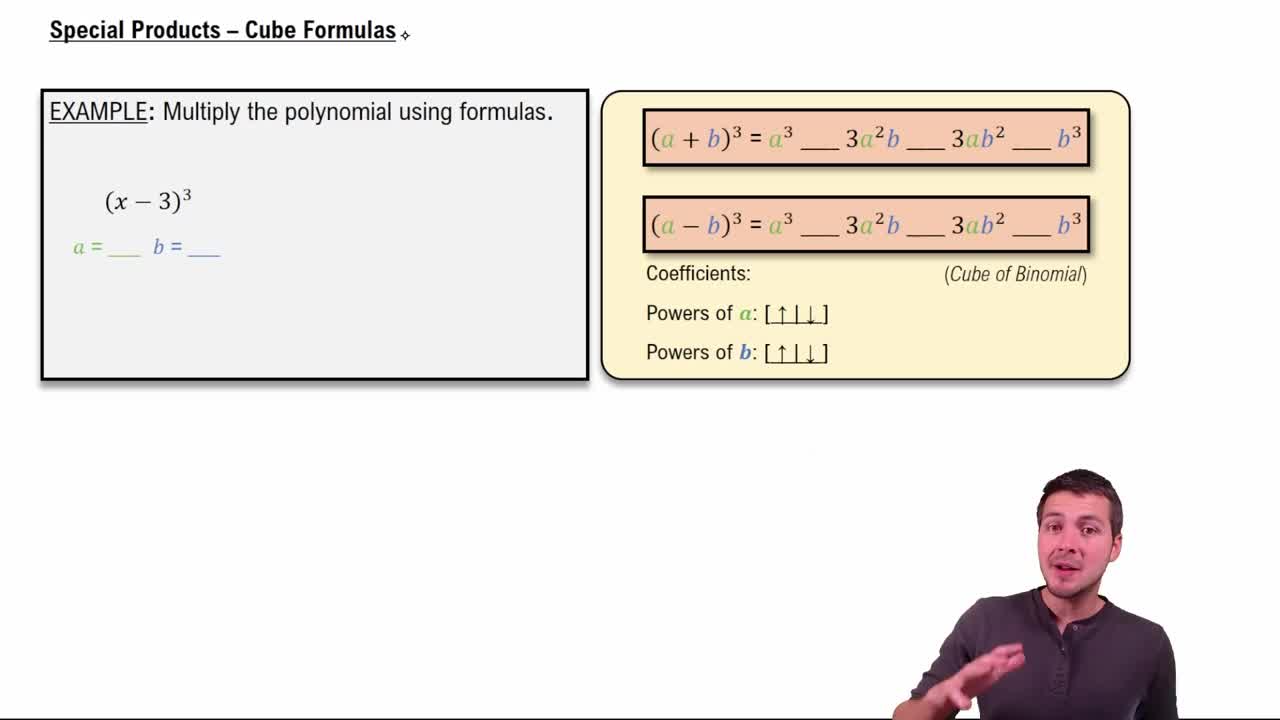
Verified video answer for a similar problem:
This video solution was recommended by our tutors as helpful for the problem above
Video duration:
3m
Play a video:
0 Comments
Key Concepts
Here are the essential concepts you must grasp in order to answer the question correctly.
Difference of Cubes
The difference of cubes refers to the algebraic expression of the form a³ - b³, which can be factored using the formula a³ - b³ = (a - b)(a² + ab + b²). In the given question, x³ - 27 can be recognized as a difference of cubes where a = x and b = 3, since 27 is 3³.
Factoring is the process of breaking down an expression into simpler components, or factors, that when multiplied together yield the original expression. Understanding how to apply specific factoring techniques, such as the difference of cubes, is essential for simplifying polynomial expressions and solving equations effectively.
Polynomial expressions are mathematical expressions that consist of variables raised to whole number exponents and their coefficients. In this case, x³ - 27 is a polynomial of degree three. Recognizing the structure of polynomial expressions is crucial for applying appropriate factoring methods and simplifying them.

 3:50 minutes
 Verified step by step guidance
 03:41
03:41