In Exercises 69–80, factor completely.x³ − y³ − x + y
Verified step by step guidance
1
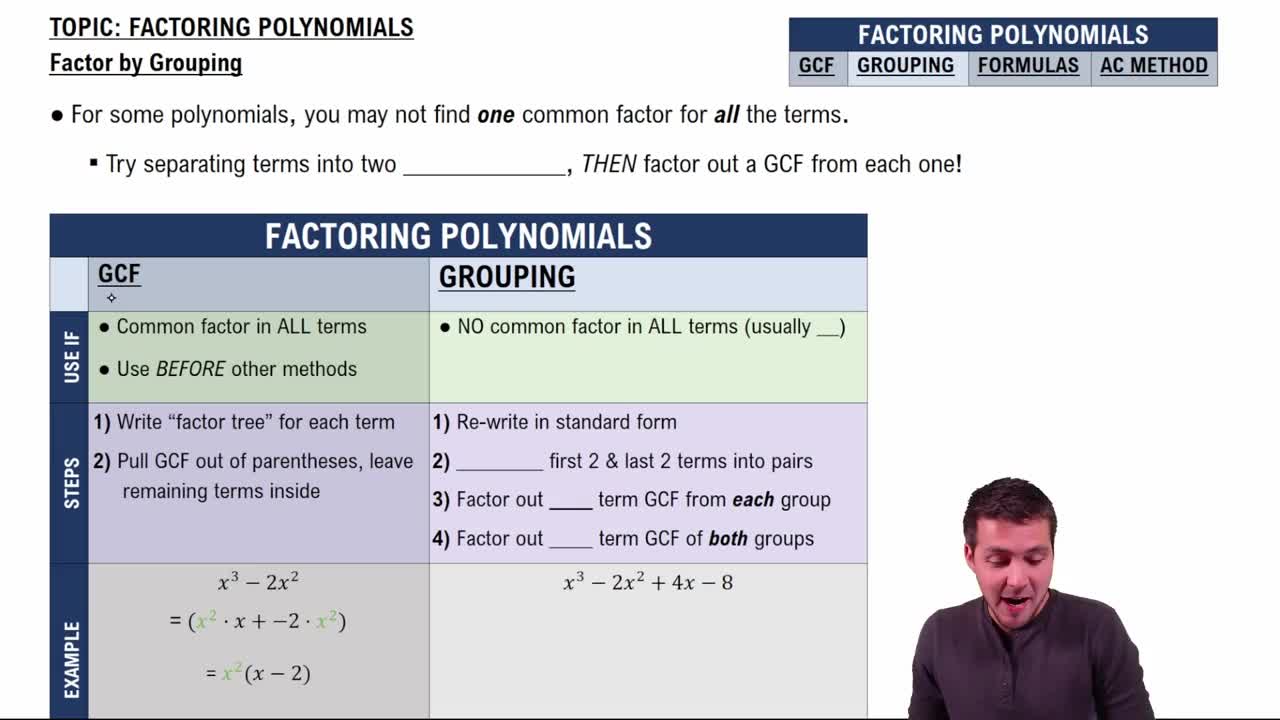
Recognize that the expression can be grouped into two parts: \(x^3 - y^3\) and \(-x + y\).
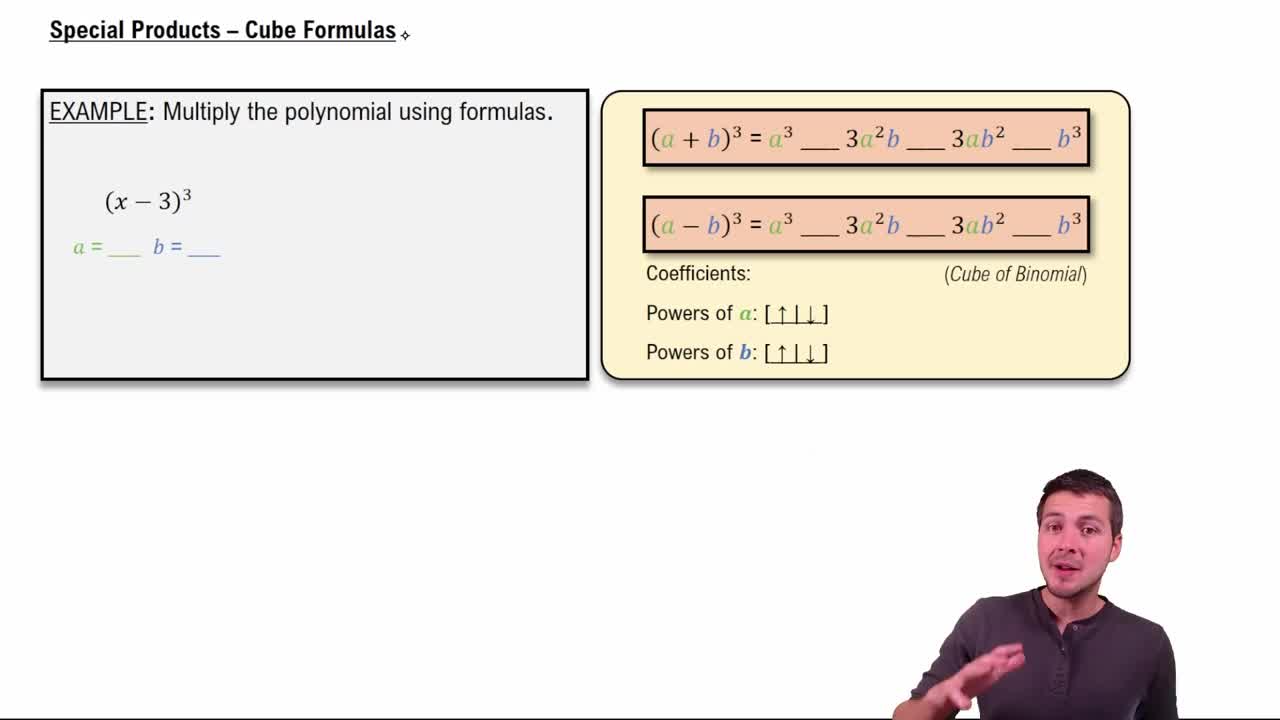
Factor \(x^3 - y^3\) using the difference of cubes formula: \(a^3 - b^3 = (a - b)(a^2 + ab + b^2)\). Here, \(a = x\) and \(b = y\).
Apply the formula to get \((x - y)(x^2 + xy + y^2)\).
Notice that \(-x + y\) can be rewritten as \(-(x - y)\).
Factor out \((x - y)\) from the entire expression: \((x - y)(x^2 + xy + y^2 - 1)\).
Verified video answer for a similar problem:
This video solution was recommended by our tutors as helpful for the problem above
Video duration:
6m
Play a video:
0 Comments
Key Concepts
Here are the essential concepts you must grasp in order to answer the question correctly.
Factoring Polynomials
Factoring polynomials involves rewriting a polynomial expression as a product of simpler polynomials. This process is essential for simplifying expressions and solving equations. In the case of the expression x³ − y³ − x + y, recognizing patterns such as the difference of cubes and grouping can aid in the factoring process.
The difference of cubes is a specific factoring pattern that applies to expressions of the form a³ - b³, which can be factored as (a - b)(a² + ab + b²). In the given expression, x³ - y³ can be identified as a difference of cubes, allowing us to apply this formula to simplify the expression further.
The grouping method is a technique used to factor polynomials by rearranging and grouping terms. This method is particularly useful when dealing with four-term polynomials, as it allows for the identification of common factors within groups. In the expression x³ − y³ − x + y, grouping the terms strategically can lead to a complete factorization.

 6:05 minutes
 Verified step by step guidance
 07:30
07:30