Use the formula for nPr to evaluate each expression. 8P5
Verified step by step guidance
1
Recall the formula for permutations: \(nP_r = \frac{n!}{(n-r)!}\), where \(n\) is the total number of items and \(r\) is the number of items to arrange.
Identify the values of \(n\) and \(r\) from the problem: here, \(n = 8\) and \(r = 5\).
Substitute these values into the formula: \(8P_5 = \frac{8!}{(8-5)!} = \frac{8!}{3!}\).
Cancel the common \$3!$ terms in numerator and denominator, leaving \(8P_5 = 8 \times 7 \times 6 \times 5 \times 4\), which you can multiply to find the final answer.
Verified video answer for a similar problem:
This video solution was recommended by our tutors as helpful for the problem above
Video duration:
2m
Play a video:
0 Comments
Key Concepts
Here are the essential concepts you must grasp in order to answer the question correctly.
Permutation (nPr)
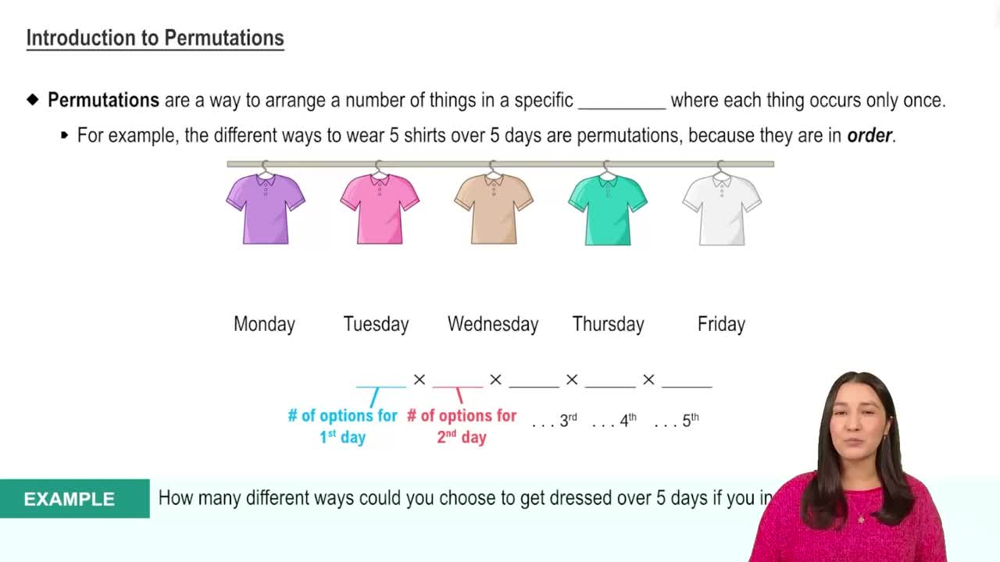
A permutation represents the number of ways to arrange a subset of items from a larger set where order matters. The notation nPr denotes the number of permutations of n items taken r at a time.
The formula for permutations is nPr = n! / (n - r)!, where n! is the factorial of n. This formula calculates the total ordered arrangements of r items selected from n distinct items.
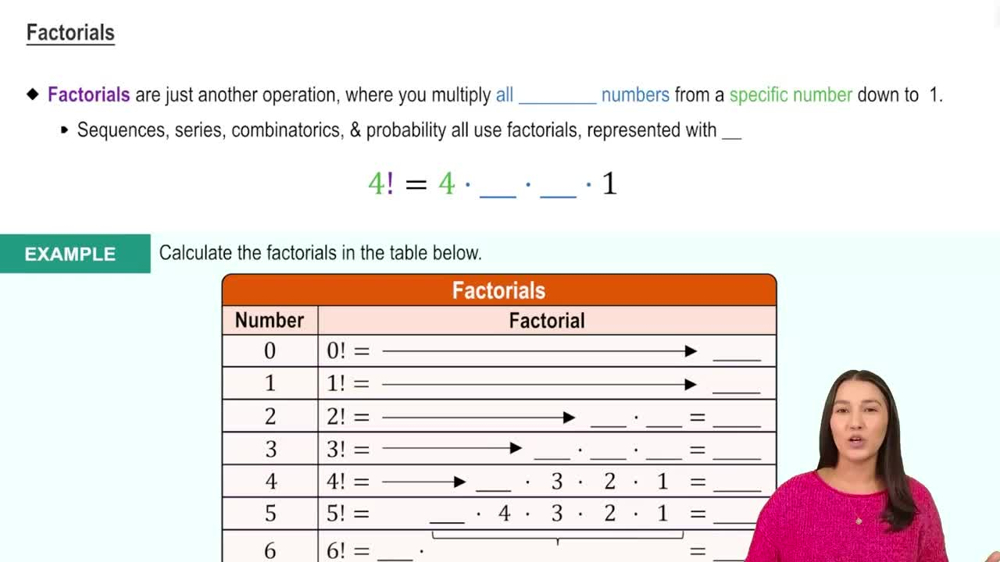
The factorial of a positive integer n, written as n!, is the product of all positive integers from 1 to n. It is essential for computing permutations and combinations in algebra.

 2:29 minutes
 Verified step by step guidance
 7:11
7:11