Use the formula for nPr to evaluate each expression. 8P0
Verified step by step guidance
1
Recall the formula for permutations: \(nP_r = \frac{n!}{(n-r)!}\), where \(n\) is the total number of items and \(r\) is the number of items chosen in order.
Identify the values of \(n\) and \(r\) from the problem: here, \(n = 8\) and \(r = 0\).
Substitute these values into the formula: \(8P_0 = \frac{8!}{(8-0)!} = \frac{8!}{8!}\).
Simplify the factorial expression: since \$8!\( divided by \)8!$ equals 1, this shows the number of ways to arrange zero items from eight.
Interpret the result: understand that choosing and arranging zero items from a set always results in exactly one way (the empty arrangement).
Verified video answer for a similar problem:
This video solution was recommended by our tutors as helpful for the problem above
Video duration:
2m
Play a video:
0 Comments
Key Concepts
Here are the essential concepts you must grasp in order to answer the question correctly.
Permutation Formula (nPr)
The permutation formula nPr calculates the number of ways to arrange r objects from a set of n distinct objects, where order matters. It is given by nPr = n! / (n - r)!, where '!' denotes factorial. This formula helps determine ordered arrangements without repetition.
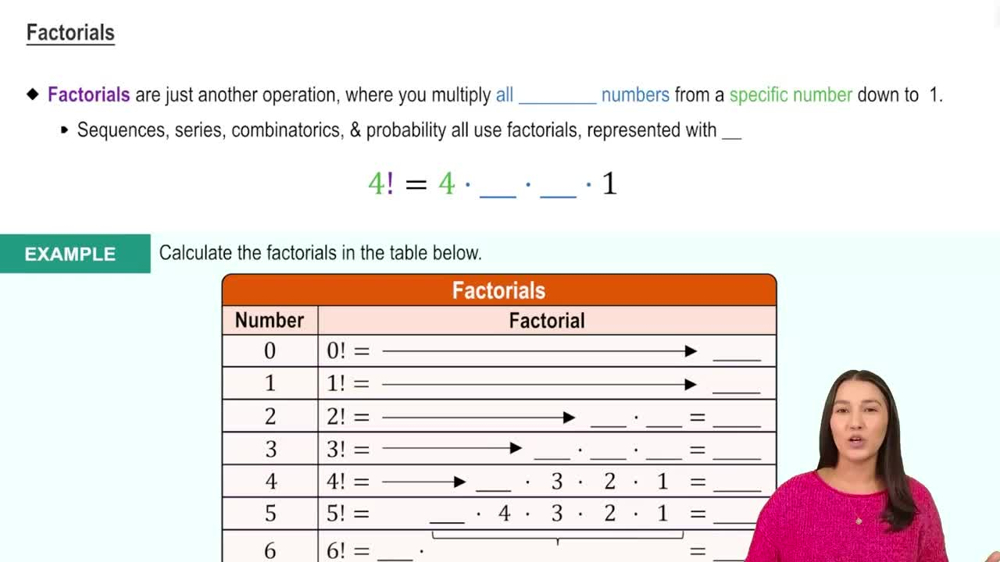
The factorial of a non-negative integer n, denoted n!, is the product of all positive integers from 1 to n. For example, 5! = 5 × 4 × 3 × 2 × 1 = 120. By definition, 0! = 1. Factorials are essential in permutations and combinations calculations.
When r = 0 in nPr, it represents the number of ways to arrange zero objects from n, which is always 1. This is because there is exactly one way to arrange nothing—the empty arrangement. Understanding this helps correctly evaluate expressions like 8P0.

 2:00 minutes
 Verified step by step guidance
 7:11
7:11