Given functions f and g, find (a) and its domain. See Examples 6 and 7.
Verified step by step guidance
1
Identify the given functions: \(f(x) = -6x + 9\) and \(g(x) = 5x + 7\).
Recall that the composition \((f \circ g)(x)\) means \(f(g(x))\), which is the function \(f\) evaluated at \(g(x)\).
Substitute \(g(x)\) into \(f(x)\): replace every \(x\) in \(f(x)\) with \(g(x)\), so write \(f(g(x)) = -6(g(x)) + 9\).
Simplify the expression by distributing and combining like terms: \(f(g(x)) = -6(5x + 7) + 9\).
Determine the domain of \((f \circ g)(x)\) by considering the domain of \(g(x)\) and the domain of \(f\) evaluated at \(g(x)\). Since both \(f\) and \(g\) are linear functions, their domains are all real numbers, so the domain of \((f \circ g)(x)\) is all real numbers.
Verified video answer for a similar problem:
This video solution was recommended by our tutors as helpful for the problem above
Video duration:
1m
Play a video:
0 Comments
Key Concepts
Here are the essential concepts you must grasp in order to answer the question correctly.
Function Composition
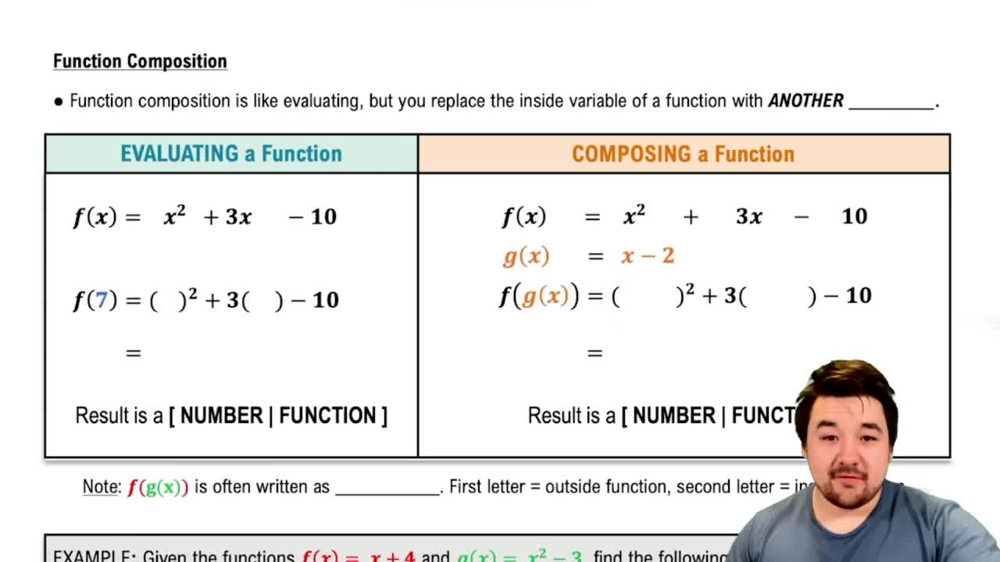
Function composition involves applying one function to the result of another, denoted as (f∘g)(x) = f(g(x)). It means you first evaluate g(x), then use that output as the input for f. Understanding this process is essential to correctly combine the two given functions.
The domain of (f∘g)(x) consists of all x-values in the domain of g for which g(x) is in the domain of f. This means you must consider restrictions from both functions to find valid inputs. Identifying these restrictions ensures the composite function is well-defined.
Both f(x) = -6x + 9 and g(x) = 5x + 7 are linear functions, which are defined for all real numbers. Knowing that linear functions have no domain restrictions simplifies finding the domain of the composite function, as the domain will typically be all real numbers unless otherwise specified.

 1:28 minutes
 Verified step by step guidance
 4:56
4:56