Factor completely, or state that the polynomial is prime.
Verified step by step guidance
1
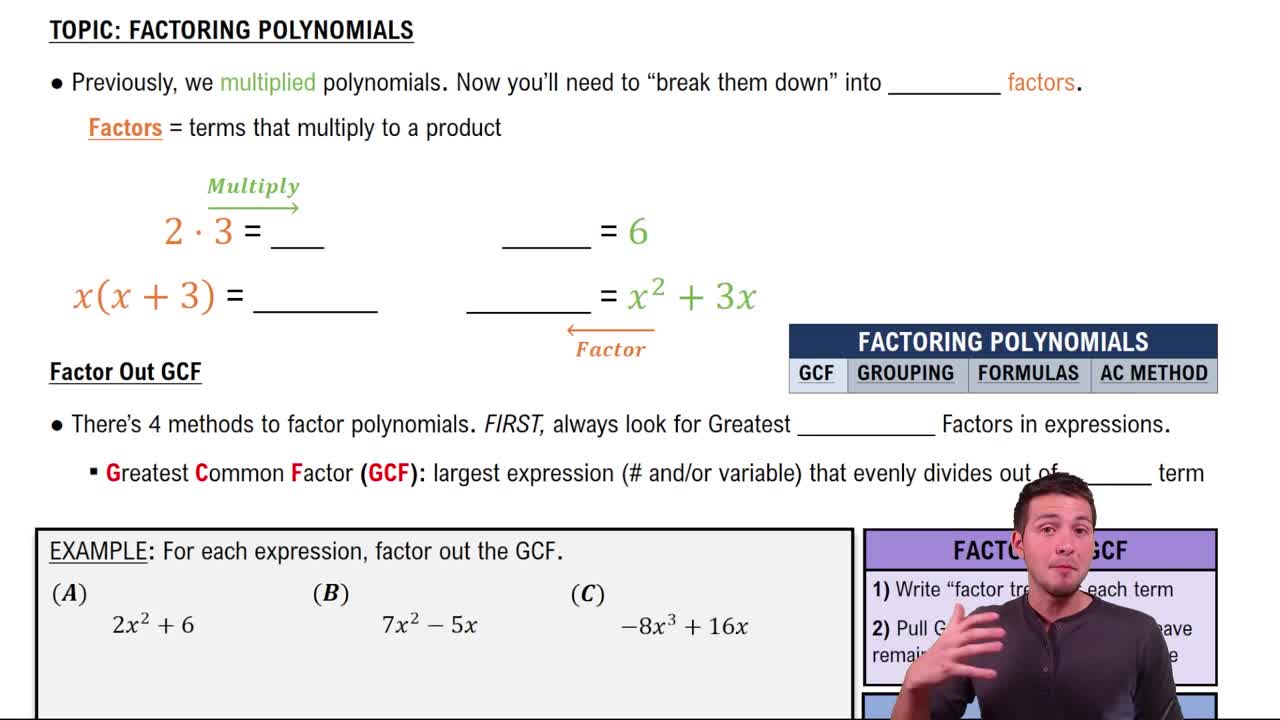
First, identify the greatest common factor (GCF) of the terms in the polynomial \$15x^3 + 3x^2\(. Look at the coefficients (15 and 3) and the variable parts (\)x^3\( and \)x^2$) separately.
The GCF of the coefficients 15 and 3 is 3. For the variable parts, the smallest power of \(x\) common to both terms is \(x^2\). So, the overall GCF is \$3x^2$.
Factor out the GCF \$3x^2\( from each term in the polynomial. This means rewriting the polynomial as \(3x^2(\text{something})\) where the 'something' is what remains after dividing each term by \)3x^2$.
Divide each term by \$3x^2\(: \(\frac{15x^3}{3x^2} = 5x\) and \(\frac{3x^2}{3x^2} = 1\). So, the expression inside the parentheses is \)5x + 1$.
Write the completely factored form as \$3x^2(5x + 1)\(. Since \)5x + 1$ cannot be factored further, this is the complete factorization.
Verified video answer for a similar problem:
This video solution was recommended by our tutors as helpful for the problem above
Video duration:
3m
Play a video:
0 Comments
Key Concepts
Here are the essential concepts you must grasp in order to answer the question correctly.
Greatest Common Factor (GCF)
The Greatest Common Factor is the largest expression that divides all terms of a polynomial without leaving a remainder. Factoring out the GCF simplifies the polynomial and is often the first step in factoring. For example, in 15x^3 + 3x^2, the GCF is 3x^2.
Factoring polynomials involves rewriting a polynomial as a product of simpler polynomials or factors. This process helps in solving equations and simplifying expressions. After factoring out the GCF, check if the remaining polynomial can be factored further.
A prime polynomial is one that cannot be factored further over the set of integers. After attempting to factor out the GCF and other methods, if no factors are found, the polynomial is considered prime. Recognizing prime polynomials prevents unnecessary factoring attempts.

 3:08 minutes
 Verified step by step guidance
 5:57
5:57