In Exercises 65–92, factor completely, or state that the polynomial is prime. x2y−16y+32−2x2
Verified step by step guidance
1
Group the terms of the polynomial into two pairs: \( (x^2y - 2x^2) \) and \( (-16y + 32) \).
Factor out the greatest common factor (GCF) from each group: \( x^2(y - 2) \) from the first group and \( -16(y - 2) \) from the second group.
Notice that \( (y - 2) \) is a common factor in both terms. Factor \( (y - 2) \) out of the entire expression: \( (y - 2)(x^2 - 16) \).
Recognize that \( x^2 - 16 \) is a difference of squares. Apply the difference of squares formula \( a^2 - b^2 = (a - b)(a + b) \) to factor \( x^2 - 16 \) as \( (x - 4)(x + 4) \).
Combine all the factors to write the completely factored form of the polynomial: \( (y - 2)(x - 4)(x + 4) \).
Verified video answer for a similar problem:
This video solution was recommended by our tutors as helpful for the problem above
Video duration:
3m
Play a video:
0 Comments
Key Concepts
Here are the essential concepts you must grasp in order to answer the question correctly.
Factoring Polynomials
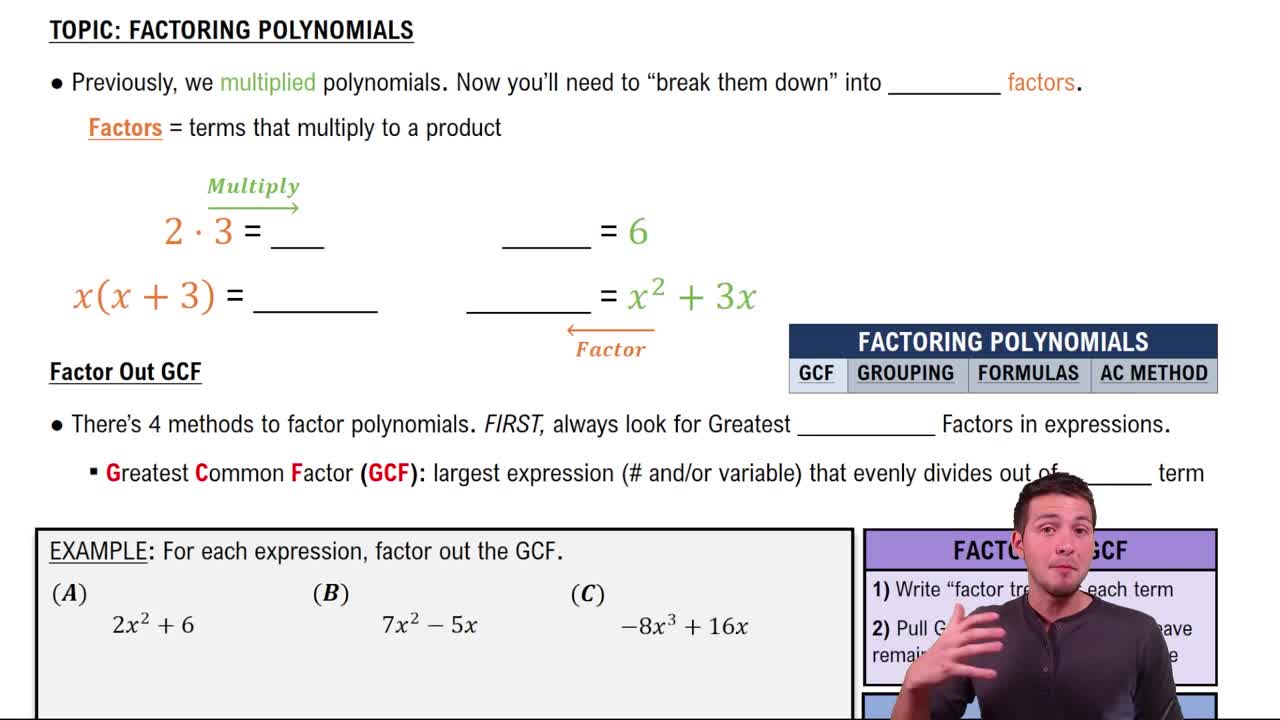
Factoring polynomials involves rewriting a polynomial expression as a product of its factors. This process is essential for simplifying expressions and solving equations. Common techniques include factoring out the greatest common factor, using the difference of squares, and applying the quadratic formula when necessary.
A polynomial is considered prime if it cannot be factored into simpler polynomials with integer coefficients. Recognizing prime polynomials is crucial in algebra, as it helps determine the limits of simplification and the methods needed for solving polynomial equations.
Combining like terms is the process of simplifying an expression by adding or subtracting terms that have the same variable raised to the same power. This step is often necessary before factoring, as it helps to organize the polynomial into a standard form, making it easier to identify potential factors.

 3:58 minutes
 Verified step by step guidance
 07:30
07:30