Find a. (fog) (x) b. (go f) (x) c. (fog) (2) d. (go f) (2). f(x) = x+4, g(x) = 2x + 1
Verified step by step guidance
1
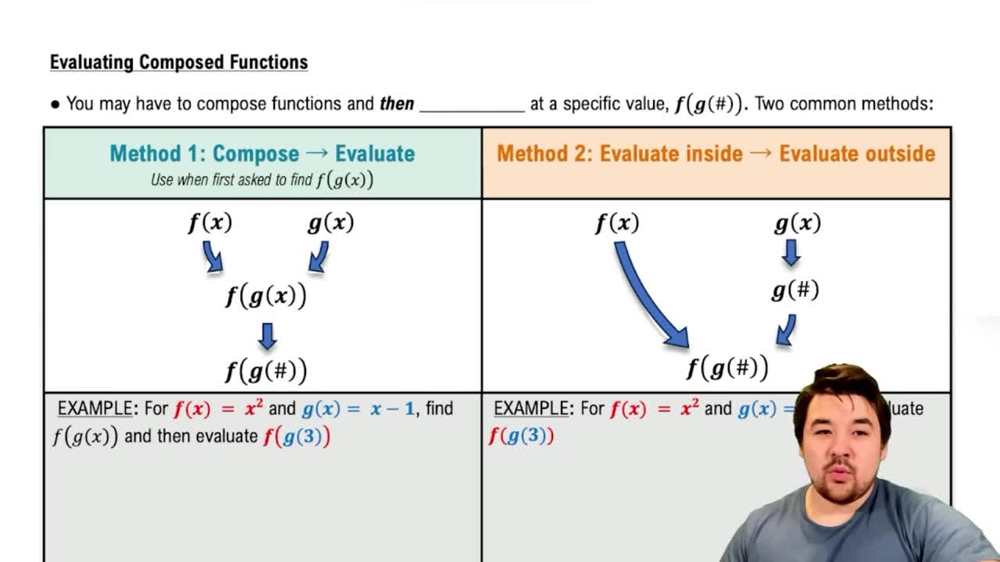
Step 1: Understand the problem. You are tasked with finding the compositions of two functions, f(x) = x + 4 and g(x) = 2x + 1. Specifically, you need to compute (f ∘ g)(x), (g ∘ f)(x), (f ∘ g)(2), and (g ∘ f)(2). The notation (f ∘ g)(x) means f(g(x)), and (g ∘ f)(x) means g(f(x)).
Step 2: Compute (f ∘ g)(x). Substitute g(x) = 2x + 1 into f(x). This means replacing x in f(x) = x + 4 with g(x). The result is f(g(x)) = (2x + 1) + 4. Simplify the expression to get the formula for (f ∘ g)(x).
Step 3: Compute (g ∘ f)(x). Substitute f(x) = x + 4 into g(x). This means replacing x in g(x) = 2x + 1 with f(x). The result is g(f(x)) = 2(x + 4) + 1. Simplify the expression to get the formula for (g ∘ f)(x).
Step 4: Compute (f ∘ g)(2). Use the formula for (f ∘ g)(x) derived in Step 2 and substitute x = 2. Simplify the expression to find the value of (f ∘ g)(2).
Step 5: Compute (g ∘ f)(2). Use the formula for (g ∘ f)(x) derived in Step 3 and substitute x = 2. Simplify the expression to find the value of (g ∘ f)(2).
Verified video answer for a similar problem:
This video solution was recommended by our tutors as helpful for the problem above
Video duration:
1m
Play a video:
0 Comments
Key Concepts
Here are the essential concepts you must grasp in order to answer the question correctly.
Function Composition
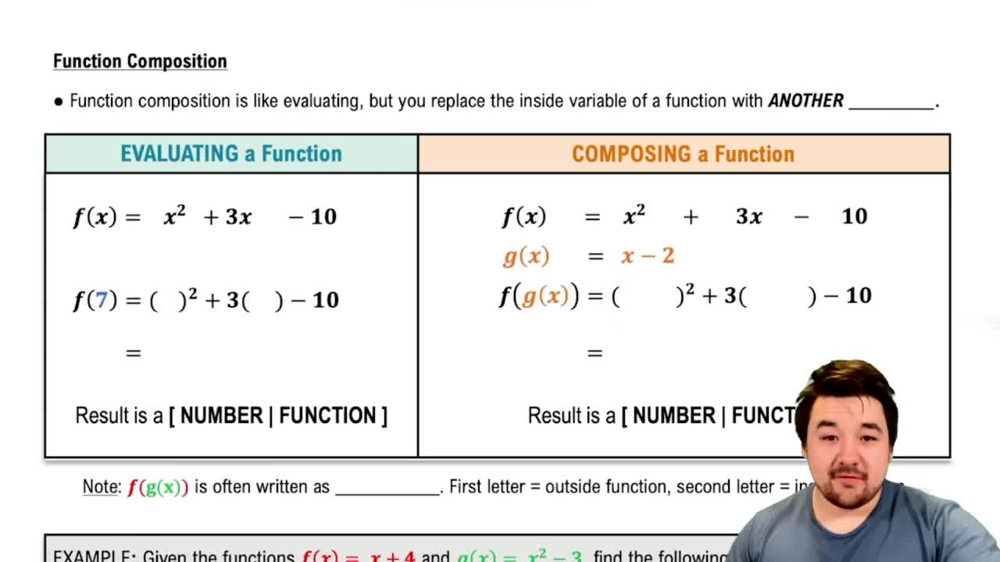
Function composition involves combining two functions to create a new function. If f(x) and g(x) are two functions, the composition (fog)(x) means applying g first and then f to the result, expressed as f(g(x)). This concept is essential for solving the given exercises, as it requires understanding how to manipulate and evaluate the functions in sequence.
Evaluating functions means substituting a specific value into a function to find its output. For example, if f(x) = x + 4, then f(2) = 2 + 4 = 6. This skill is crucial for calculating the values of (fog)(2) and (go f)(2) in the exercises, as it requires substituting values into the composed functions.
Algebraic manipulation refers to the process of rearranging and simplifying expressions using algebraic rules. This includes operations like addition, multiplication, and applying the distributive property. Mastery of algebraic manipulation is necessary for simplifying the results of the function compositions and ensuring accurate calculations in the exercises.

 1:45 minutes
 Verified step by step guidance
 4:56
4:56