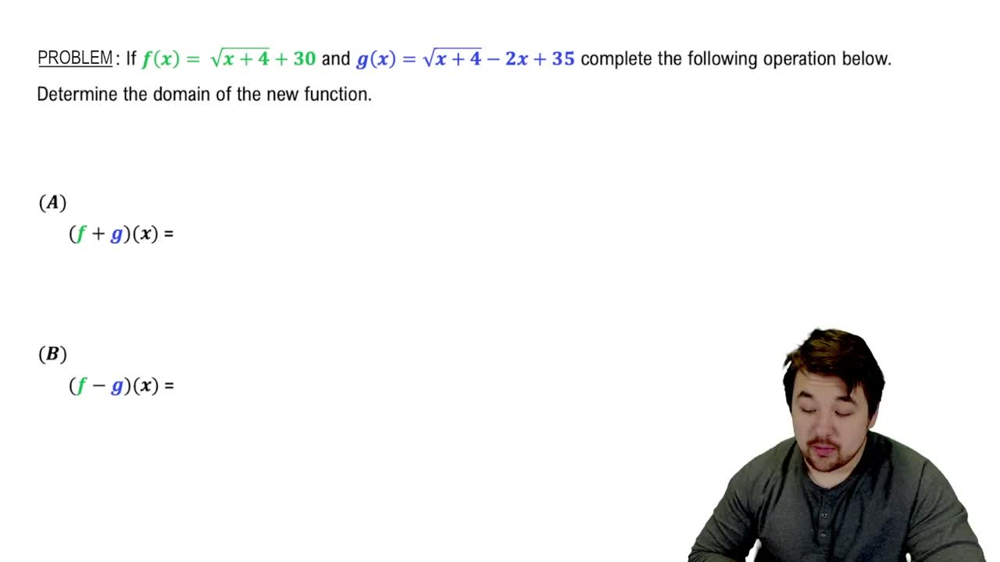
Let ƒ(x)=x2+3 and g(x)=-2x+6. Find each of the following. (ƒ+g)(3)
Verified step by step guidance
1
Understand that (ƒ+g)(x) means you add the functions ƒ(x) and g(x) together, so (ƒ+g)(x) = ƒ(x) + g(x).
Write the expressions for ƒ(x) and g(x): ƒ(x) = x^2 + 3 and g(x) = -2x + 6.
Add the two functions together: (ƒ+g)(x) = (x^2 + 3) + (-2x + 6).
Simplify the expression by combining like terms: (ƒ+g)(x) = x^2 - 2x + (3 + 6).
Evaluate the simplified expression at x = 3 by substituting 3 for x: (ƒ+g)(3) = 3^2 - 2(3) + 9.
Verified video answer for a similar problem:
This video solution was recommended by our tutors as helpful for the problem above
Video duration:
2m
Play a video:
0 Comments
Key Concepts
Here are the essential concepts you must grasp in order to answer the question correctly.
Function Notation and Evaluation
Function notation, such as ƒ(x), represents a rule that assigns each input x to an output. Evaluating a function at a specific value means substituting that value into the function's expression and simplifying to find the output.
The sum of two functions, (ƒ + g)(x), is defined by adding their outputs for the same input x. This means (ƒ + g)(x) = ƒ(x) + g(x), combining the expressions before evaluating at a given value.
To find (ƒ + g)(3), substitute x = 3 into both ƒ(x) and g(x), then add the results. Simplifying the expressions after substitution yields the final numerical value.

 2:27 minutes
 Verified step by step guidance
 4:26
4:26