Solve each equation in Exercises 47–64 by completing the square. 3x2 - 5x - 10 = 0
Verified step by step guidance
1
Rewrite the equation in standard quadratic form, isolating the constant term on one side: .
Divide through by the coefficient of (which is 3) to make the coefficient of equal to 1: .
To complete the square, take half the coefficient of (which is ), square it, and add it to both sides of the equation. Half of is , and squaring it gives . Add to both sides: .
Simplify the left-hand side into a perfect square trinomial and combine the fractions on the right-hand side. The left-hand side becomes , and the right-hand side simplifies to a single fraction.
Take the square root of both sides of the equation, remembering to include both the positive and negative roots. Then solve for by isolating it: .
Verified video answer for a similar problem:
This video solution was recommended by our tutors as helpful for the problem above
Video duration:
7m
Play a video:
0 Comments
Key Concepts
Here are the essential concepts you must grasp in order to answer the question correctly.
Completing the Square
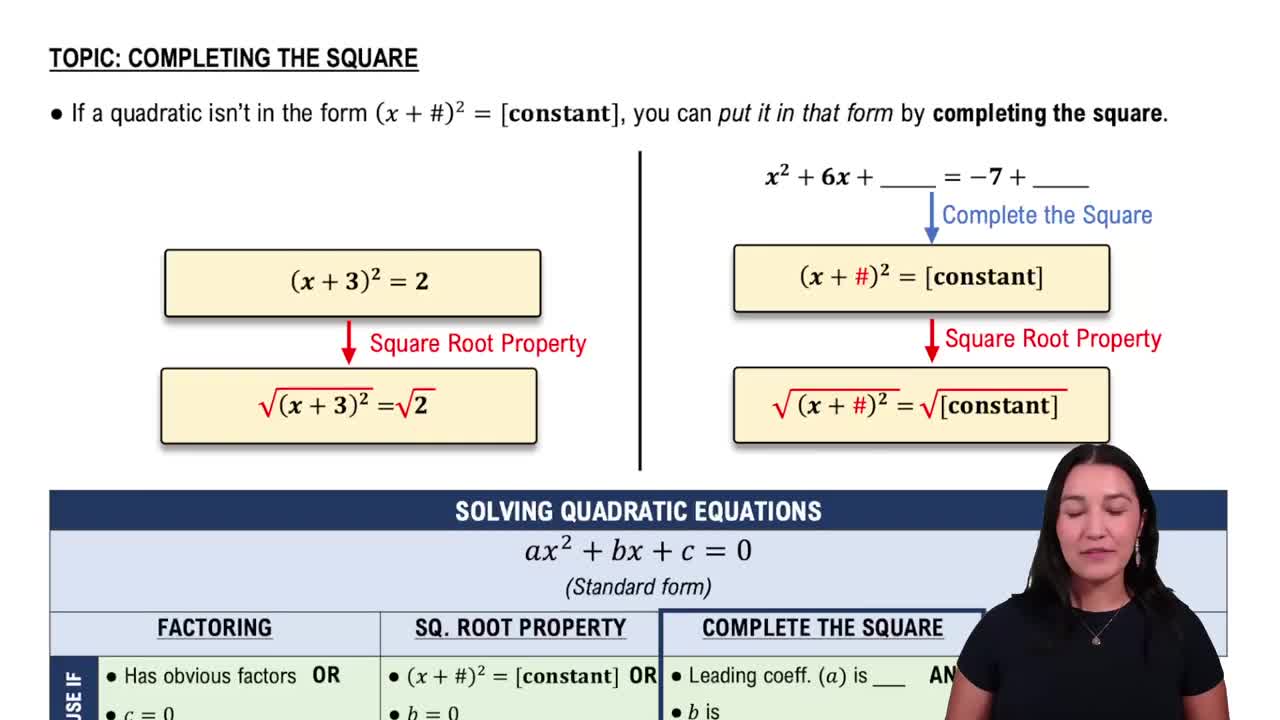
Completing the square is a method used to solve quadratic equations by transforming the equation into a perfect square trinomial. This involves rearranging the equation and adding a specific value to both sides to create a square of a binomial. This technique simplifies the process of finding the roots of the equation and is particularly useful when the quadratic formula is not preferred.
Solving Quadratic Equations by Completing the Square
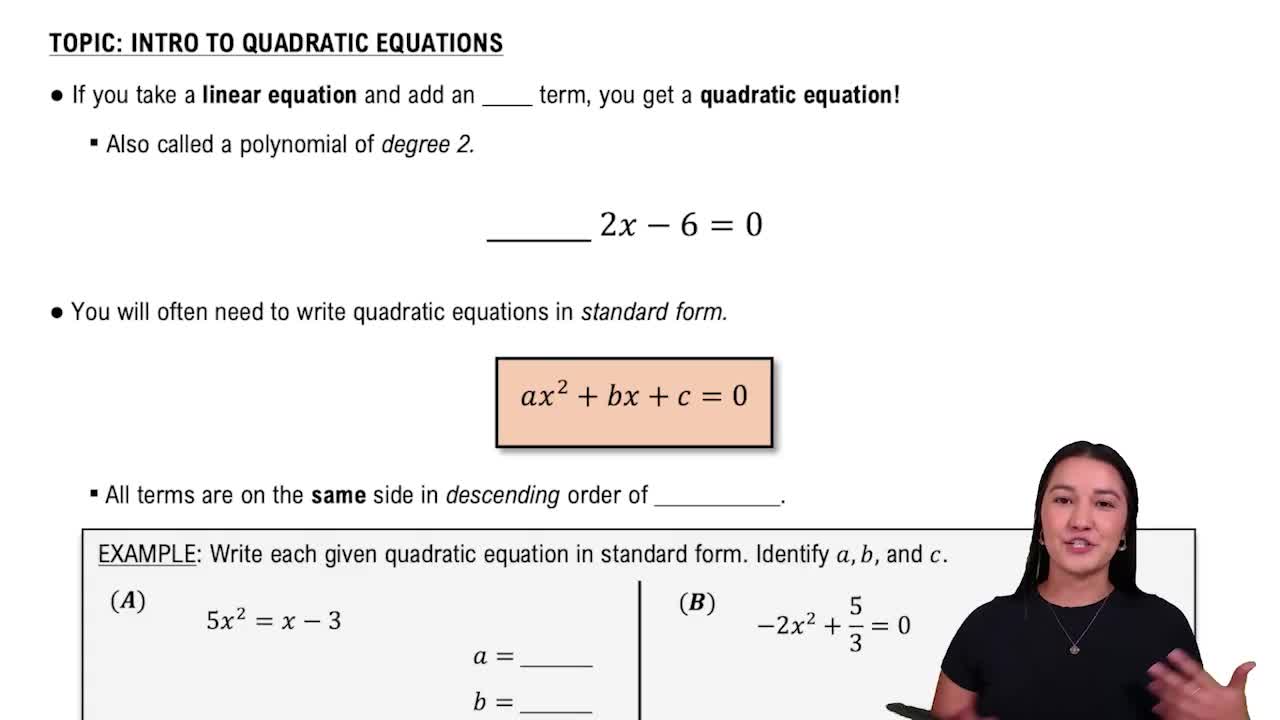
Quadratic Equations
A quadratic equation is a polynomial equation of the form ax^2 + bx + c = 0, where a, b, and c are constants, and a ≠ 0. The solutions to these equations can be found using various methods, including factoring, completing the square, or applying the quadratic formula. Understanding the standard form and properties of quadratic equations is essential for solving them effectively.
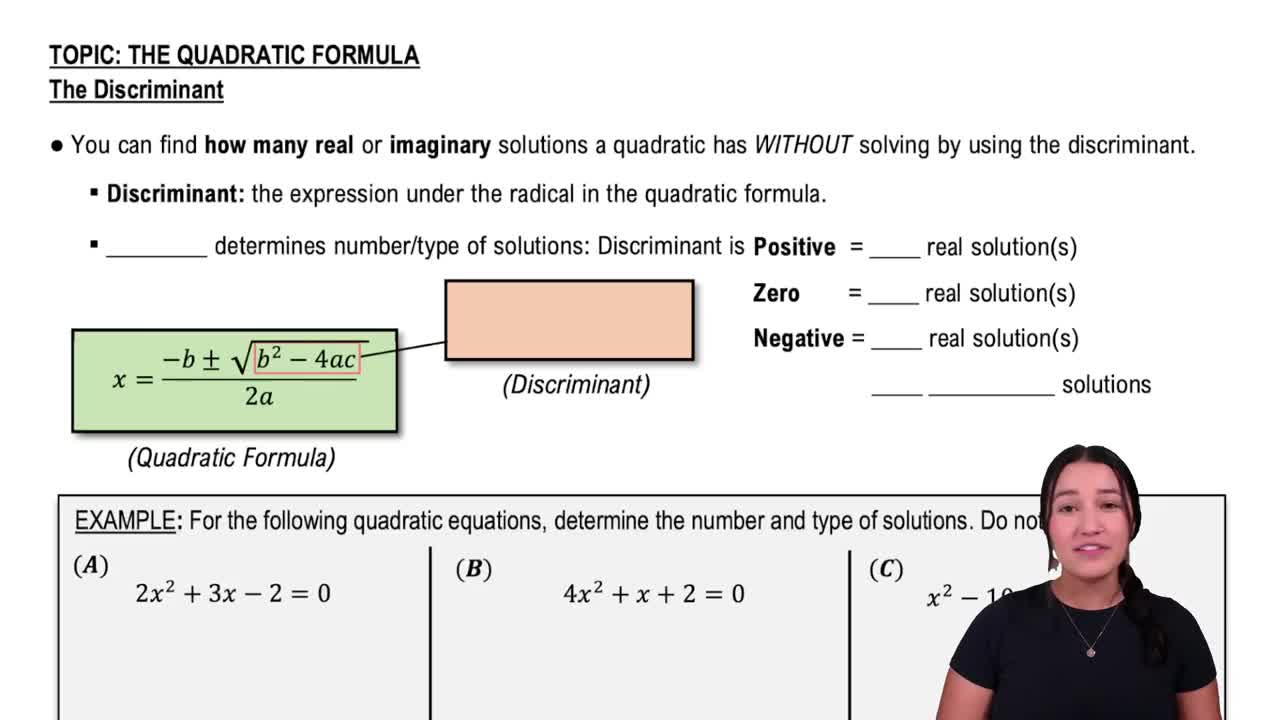
The discriminant is a component of the quadratic formula, given by the expression b^2 - 4ac. It determines the nature of the roots of a quadratic equation: if the discriminant is positive, there are two distinct real roots; if it is zero, there is one real root (a repeated root); and if it is negative, there are two complex roots. Analyzing the discriminant helps in understanding the solutions without necessarily solving the equation.

 7:58 minutes
 Verified step by step guidance
 06:24
06:24