Solve each equation. See Example 2. (4x+3)/(x+1) + 2/x = 1/(x2+x)
Verified step by step guidance
1
Identify the given equation: \(\frac{4x+3}{x+1} + \frac{2}{x} = \frac{1}{x^{2} + x}\).
Recognize that the denominator on the right side, \(x^{2} + x\), can be factored as \(x(x+1)\).
Find the least common denominator (LCD) for all terms, which is \(x(x+1)\).
Multiply every term in the equation by the LCD \(x(x+1)\) to eliminate the denominators.
After clearing denominators, simplify the resulting equation and solve the resulting polynomial equation for \(x\).
Verified video answer for a similar problem:
This video solution was recommended by our tutors as helpful for the problem above
Video duration:
6m
Play a video:
0 Comments
Key Concepts
Here are the essential concepts you must grasp in order to answer the question correctly.
Rational Expressions
Rational expressions are fractions where the numerator and denominator are polynomials. Understanding how to manipulate these expressions, including simplifying and finding common denominators, is essential for solving equations involving rational terms.
The least common denominator is the smallest expression that all denominators in a rational equation can divide into evenly. Identifying the LCD allows you to combine or clear fractions by multiplying through, simplifying the equation to a polynomial form.
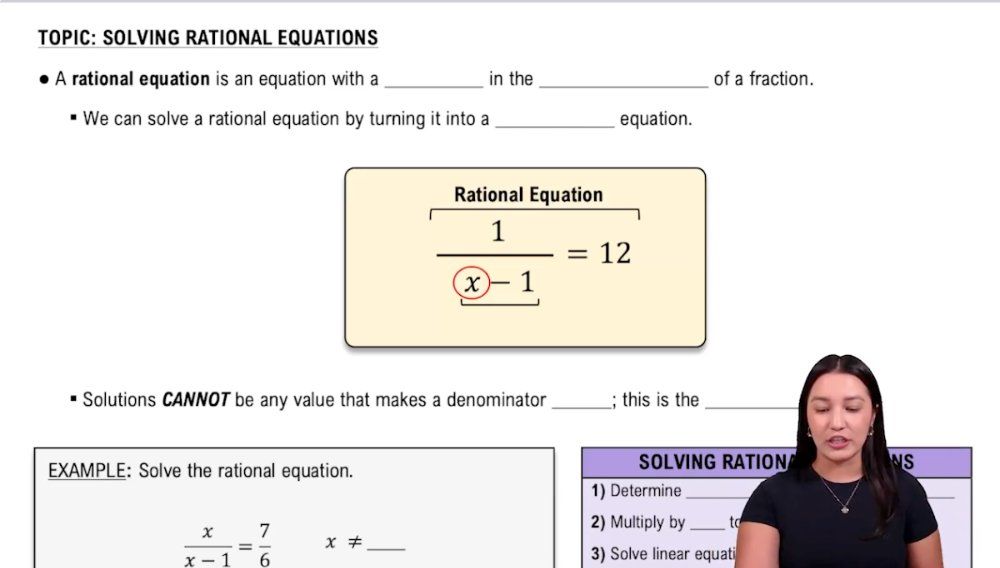
Solving rational equations involves eliminating denominators by multiplying both sides by the LCD, then solving the resulting polynomial equation. It's important to check for extraneous solutions that make any denominator zero, as these are not valid.

 6:18 minutes
 Verified step by step guidance
 02:58
02:58