Identify the given equation: \(\frac{x}{x-1} - \frac{1}{x+1} = \frac{2}{x^{2} - 1}\).
Recognize that the denominator on the right side, \(x^{2} - 1\), can be factored using the difference of squares: \(x^{2} - 1 = (x-1)(x+1)\).
Find the least common denominator (LCD) for all terms, which is \((x-1)(x+1)\), and multiply every term in the equation by this LCD to eliminate the denominators.
After multiplying, simplify each term by canceling the common factors in the numerators and denominators, resulting in a polynomial equation without fractions.
Solve the resulting polynomial equation for \(x\), and check for any restrictions by ensuring that the values of \(x\) do not make any denominator in the original equation equal to zero.
Verified video answer for a similar problem:
This video solution was recommended by our tutors as helpful for the problem above
Video duration:
6m
Play a video:
0 Comments
Key Concepts
Here are the essential concepts you must grasp in order to answer the question correctly.
Rational Expressions and Their Domains
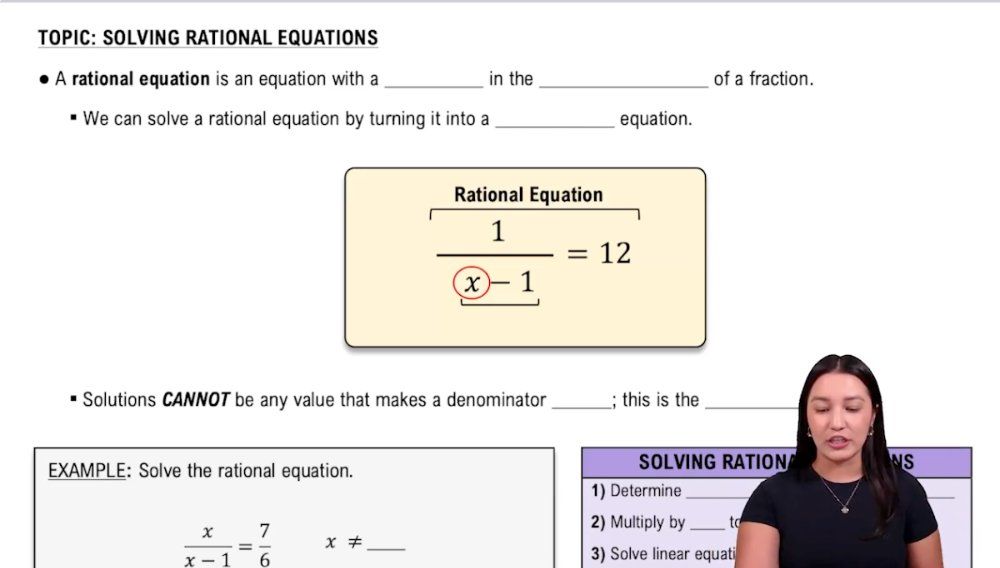
Rational expressions are fractions where the numerator and denominator are polynomials. Understanding their domains is crucial because values that make the denominator zero are excluded. For example, in the equation, x cannot be 1 or -1 since these values make denominators zero, causing undefined expressions.
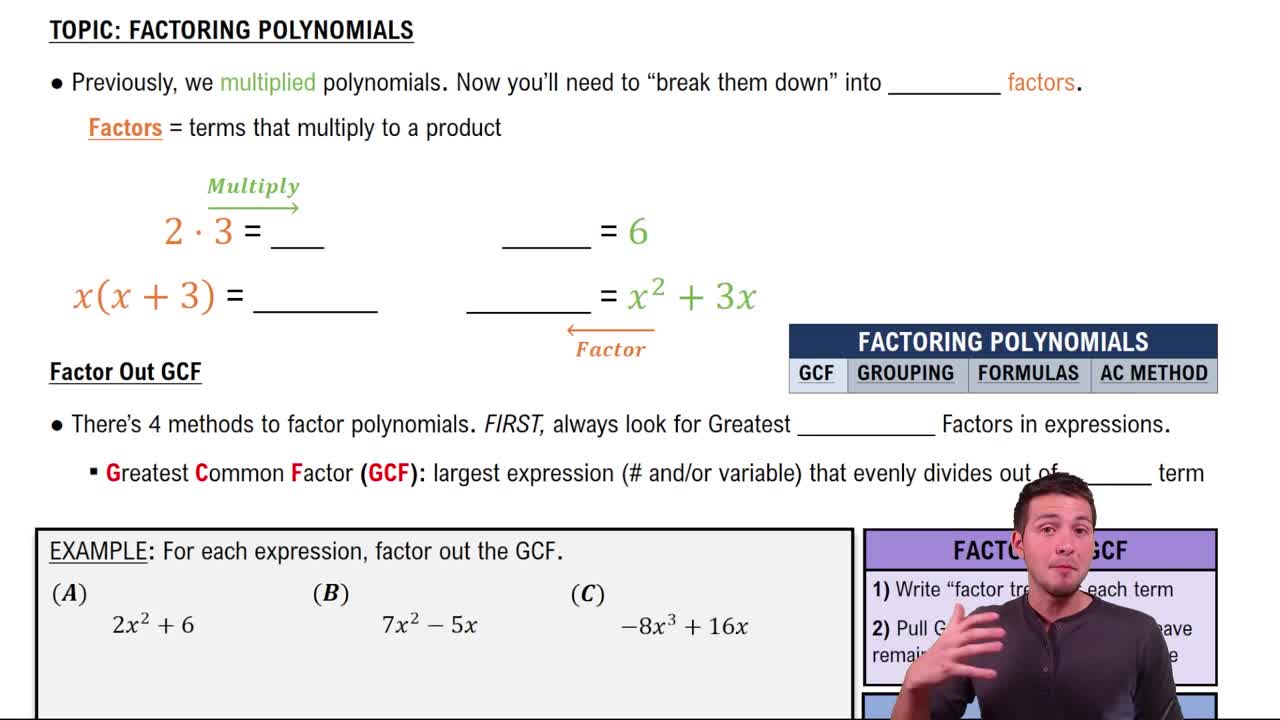
Factoring polynomials involves rewriting expressions as products of simpler polynomials. Recognizing that x² - 1 factors as (x - 1)(x + 1) helps simplify the equation and combine terms effectively. This step is essential for finding a common denominator and solving the equation.
Solving rational equations involves finding values of the variable that satisfy the equation without making any denominator zero. This typically requires multiplying both sides by the least common denominator (LCD) to eliminate fractions, simplifying the resulting equation, and checking for extraneous solutions.

 6:19 minutes
 Verified step by step guidance
 02:58
02:58