Given functions f and g, find (b)(g∘ƒ)(x) and its domain. See Examples 6 and 7.
Verified step by step guidance
1
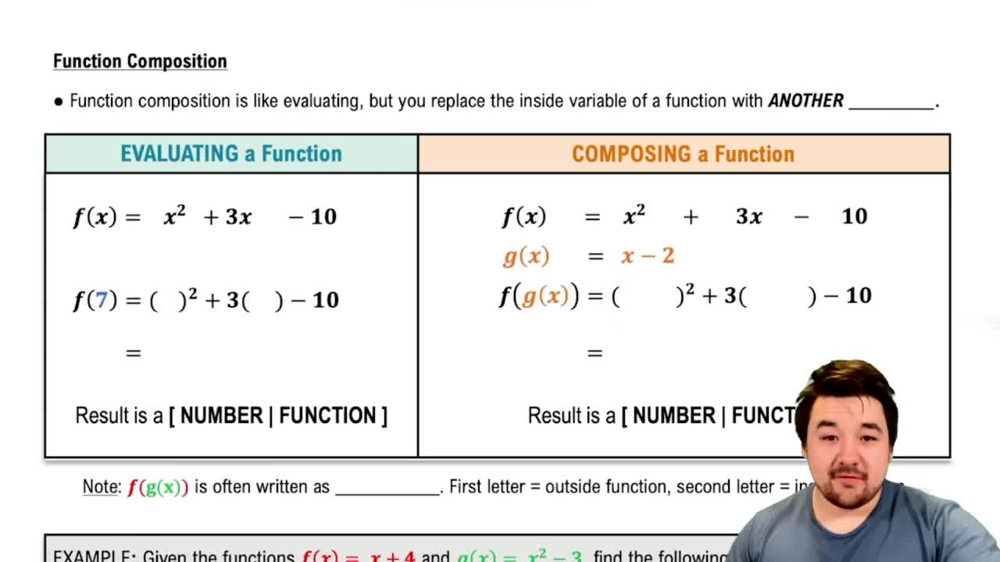
Step 1: Understand the composition of functions. For (ƒ∘g)(x), this means ƒ(g(x)), which is the function ƒ applied to the output of g(x). Similarly, for (g∘ƒ)(x), this means g(ƒ(x)).
Step 2: Find (ƒ∘g)(x) by substituting g(x) into ƒ. Since ƒ(x) = \(\sqrt{x+2}\), replace x with g(x) = -\(\frac{1}{x}\) to get (ƒ∘g)(x) = \(\sqrt{-\frac{1}{x}\) + 2}.
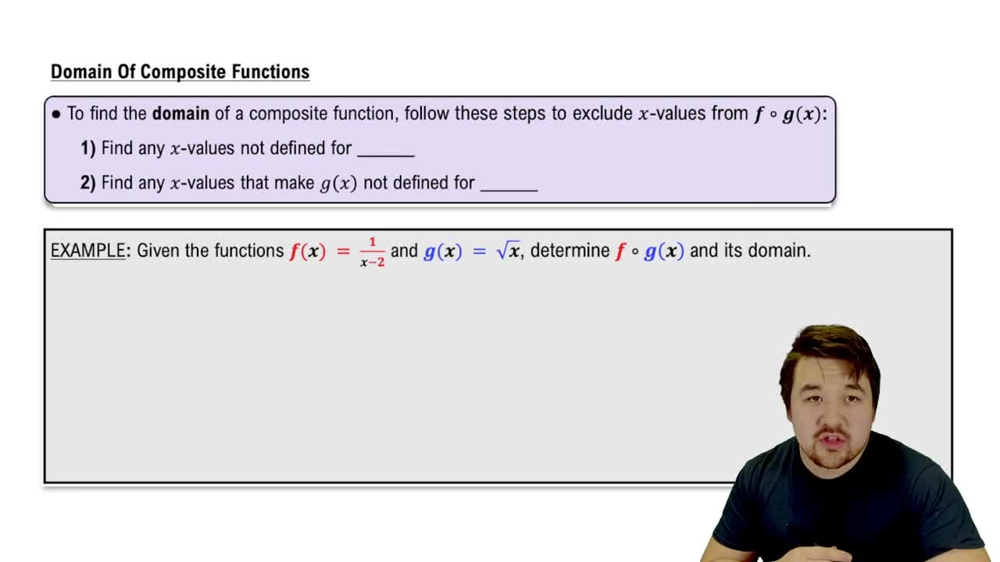
Step 3: Determine the domain of (ƒ∘g)(x). The expression inside the square root must be greater than or equal to zero: \(\left\)(-\(\frac{1}{x}\) + 2\(\right\)) \(\geq\) 0. Also, consider the domain restrictions of g(x), which excludes x = 0 because of division by zero.
Step 4: Find (g∘ƒ)(x) by substituting ƒ(x) into g. Since g(x) = -\(\frac{1}{x}\), replace x with ƒ(x) = \(\sqrt{x+2}\) to get (g∘ƒ)(x) = -\(\frac{1}{\sqrt{x+2}\)}.
Step 5: Determine the domain of (g∘ƒ)(x). The denominator \(\sqrt{x+2}\) cannot be zero, so x + 2 > 0, which means x > -2. Also, since the square root is in the denominator, x = -2 is excluded to avoid division by zero.
Verified video answer for a similar problem:
This video solution was recommended by our tutors as helpful for the problem above
Video duration:
5m
Play a video:
0 Comments
Key Concepts
Here are the essential concepts you must grasp in order to answer the question correctly.
Function Composition
Function composition involves applying one function to the result of another, denoted as (f∘g)(x) = f(g(x)). It requires substituting the entire output of g(x) into f(x), creating a new function that combines both operations.
The domain is the set of all input values for which a function is defined. When composing functions, the domain of the composite function depends on the domain of the inner function and the domain restrictions of the outer function after substitution.
The square root function requires the radicand to be non-negative, limiting inputs to values where x+2 ≥ 0. Rational functions like g(x) = -1/x are undefined at x = 0, so these restrictions must be considered when determining the domain of compositions.

 5:44 minutes
 Verified step by step guidance
 4:56
4:56