Factor completely, or state that the polynomial is prime. 16x^2-40x+25
Verified step by step guidance
1
Identify the structure of the polynomial. The given polynomial, 16x^2 - 40x + 25, is a quadratic trinomial in the form ax^2 + bx + c, where a = 16, b = -40, and c = 25.
Check if the trinomial is a perfect square trinomial. A perfect square trinomial takes the form (px + q)^2 = p^2x^2 + 2pqx + q^2. Compare the coefficients of the given polynomial to see if it matches this form.
Take the square root of the first term (16x^2) and the last term (25). The square root of 16x^2 is 4x, and the square root of 25 is 5.
Verify if the middle term (-40x) matches 2pq, where p = 4x and q = 5. Calculate 2pq: 2 * 4x * 5 = 40x. Since the middle term is -40x, this matches if we include a negative sign, so the trinomial can be factored as (4x - 5)^2.
Write the factored form of the polynomial: (4x - 5)(4x - 5), or equivalently, (4x - 5)^2. Since it factors completely, the polynomial is not prime.
Verified video answer for a similar problem:
This video solution was recommended by our tutors as helpful for the problem above
Video duration:
6m
Play a video:
0 Comments
Key Concepts
Here are the essential concepts you must grasp in order to answer the question correctly.
Factoring Polynomials
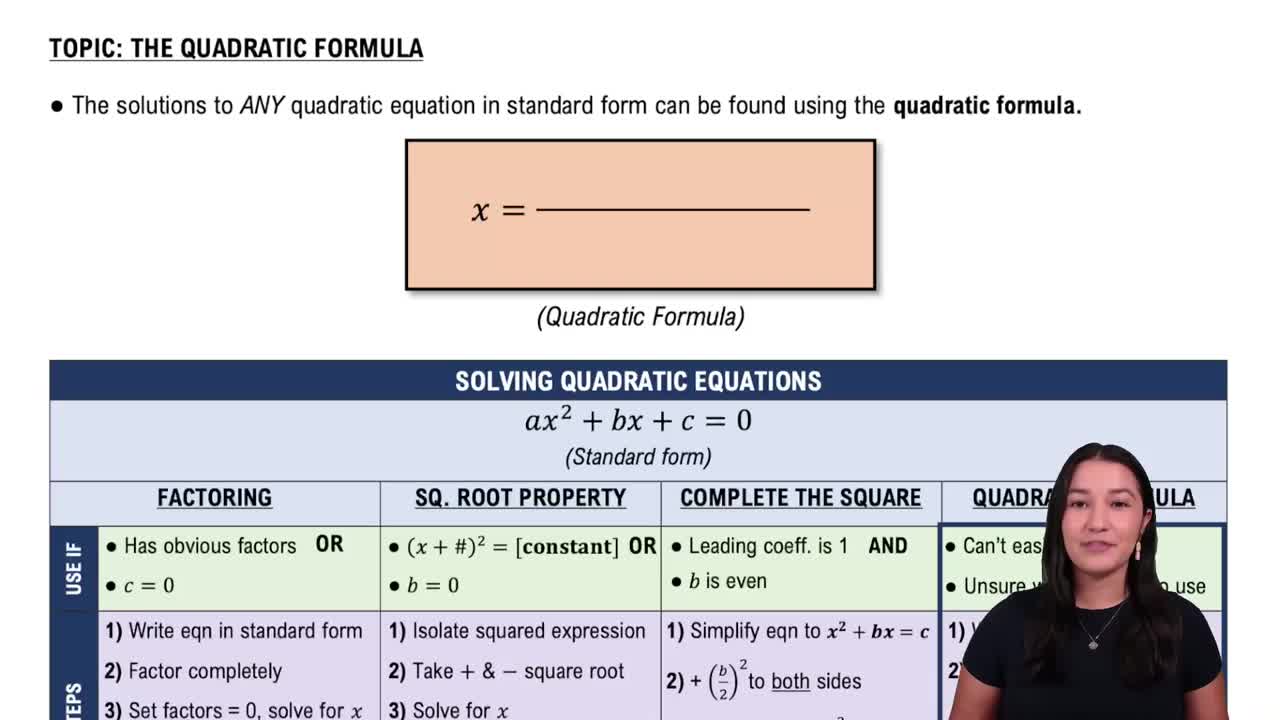
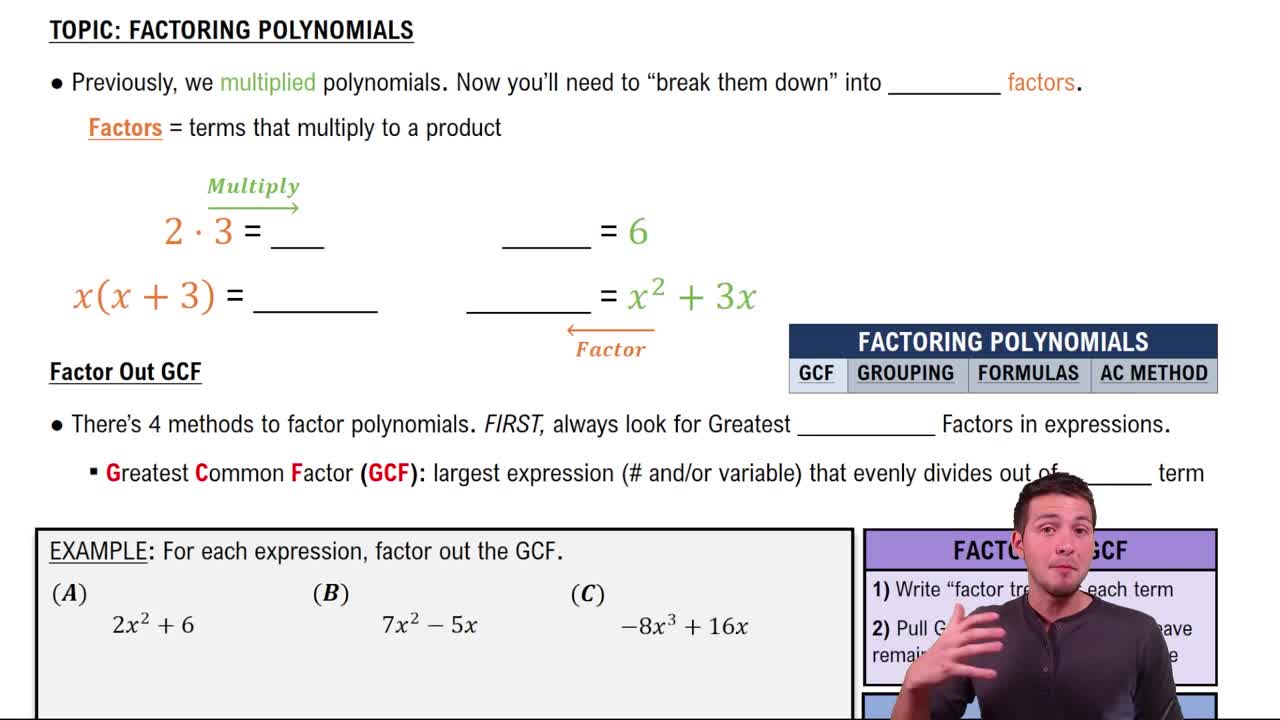
Factoring polynomials involves rewriting a polynomial expression as a product of simpler polynomials. This process is essential for solving equations and simplifying expressions. Common methods include factoring out the greatest common factor, using the difference of squares, and applying the quadratic formula for quadratic polynomials.
A quadratic polynomial is a polynomial of degree two, typically expressed in the form ax^2 + bx + c. The coefficients a, b, and c are real numbers, with 'a' not equal to zero. Understanding the structure of quadratic polynomials is crucial for applying various factoring techniques and recognizing their properties, such as the vertex and axis of symmetry.
Solving Quadratic Equations Using The Quadratic Formula
Prime Polynomials
A prime polynomial is a polynomial that cannot be factored into the product of two non-constant polynomials with real coefficients. Identifying whether a polynomial is prime is important in algebra, as it determines the methods available for solving equations. If a polynomial cannot be factored, it indicates that its roots may be irrational or complex.

 6:24 minutes
 Verified step by step guidance
 07:30
07:30