In Exercises 1–10, factor out the greatest common factor. x2(2x+5)+17(2x+5)
Verified step by step guidance
1
Identify the common factor in the terms of the expression. Notice that both terms, \(x^2(2x+5)\) and \(17(2x+5)\), share the binomial \((2x+5)\) as a common factor.
Factor out the common binomial \((2x+5)\) from the expression. This means rewriting the expression as \((2x+5)(\text{something})\).
Determine what remains in each term after factoring out \((2x+5)\). From the first term \(x^2(2x+5)\), \(x^2\) remains. From the second term \(17(2x+5)\), \(17\) remains.
Combine the remaining terms into a single binomial. After factoring out \((2x+5)\), the expression becomes \((2x+5)(x^2 + 17)\).
Verify your result by distributing \((2x+5)\) back into \((x^2 + 17)\) to ensure it matches the original expression.
Verified video answer for a similar problem:
This video solution was recommended by our tutors as helpful for the problem above
Video duration:
1m
Play a video:
0 Comments
Key Concepts
Here are the essential concepts you must grasp in order to answer the question correctly.
Greatest Common Factor (GCF)
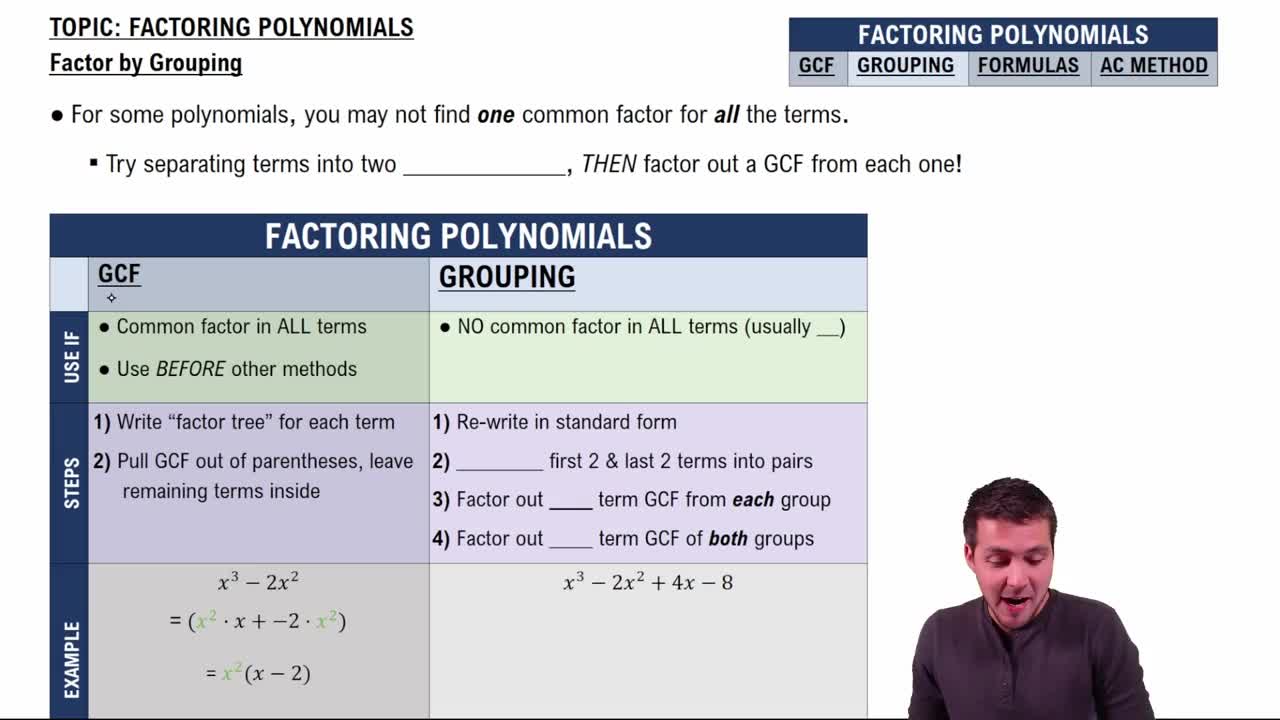
The Greatest Common Factor is the largest expression that divides two or more terms without leaving a remainder. In algebra, identifying the GCF is crucial for simplifying expressions and factoring polynomials. For example, in the expression x^2(2x+5) + 17(2x+5), the GCF is (2x+5), as it is common to both terms.
Factoring is the process of breaking down an expression into simpler components, or factors, that when multiplied together yield the original expression. This is essential in algebra for simplifying equations and solving for variables. In the given expression, factoring out the GCF allows us to rewrite it in a more manageable form.
Polynomial expressions are mathematical expressions that consist of variables raised to whole number exponents and their coefficients. They can be added, subtracted, multiplied, and factored. Understanding how to manipulate polynomial expressions is fundamental in algebra, as it forms the basis for solving equations and analyzing functions.

 1:51 minutes
 Verified step by step guidance
 5:57
5:57