For each polynomial function, use the remainder theorem to find ƒ(k). ƒ(x) = x2 + 4; k = 2i
Verified step by step guidance
1
Recall the Remainder Theorem, which states that the remainder when a polynomial ƒ(x) is divided by (x - k) is equal to ƒ(k). So, to find ƒ(k), we simply substitute k into the polynomial ƒ(x).
Given the polynomial function ƒ(x) = x^2 + 4, and k = 2i, substitute x with 2i in the polynomial: ƒ(2i) = (2i)^2 + 4.
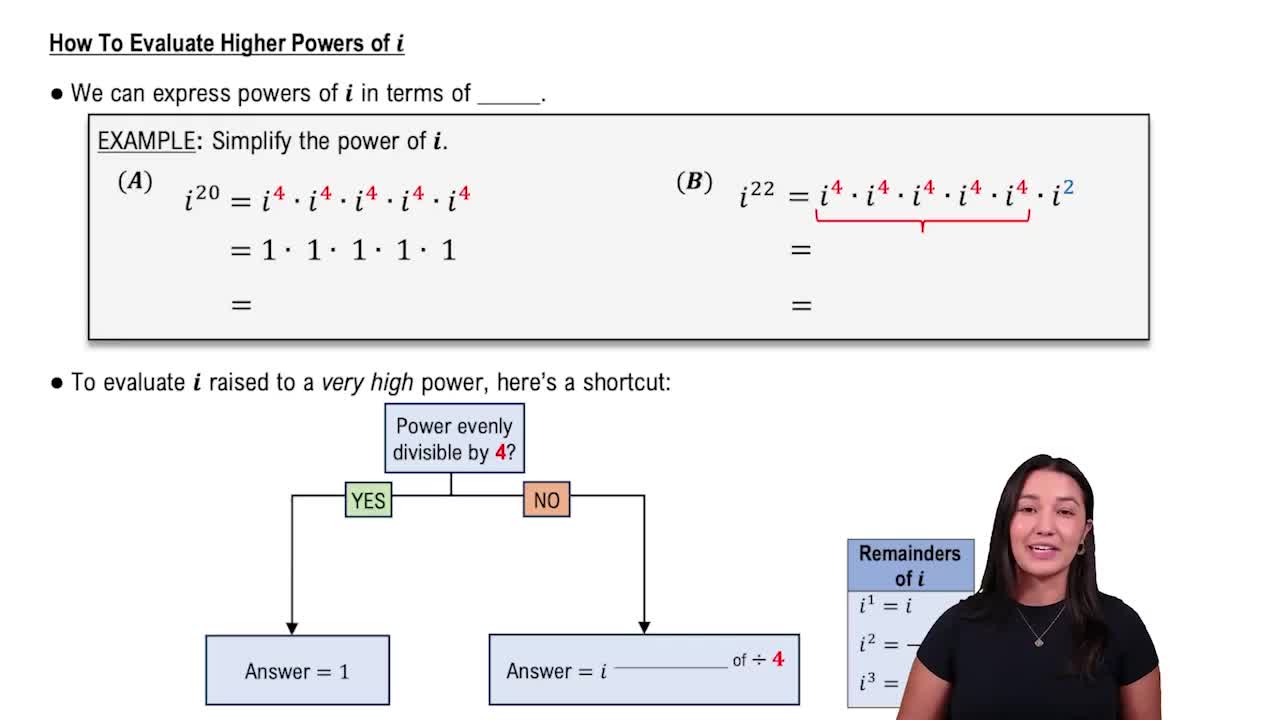
Calculate the square of 2i: (2i)^2 = 2^2 * i^2 = 4 * i^2.
Recall that i is the imaginary unit where i^2 = -1, so replace i^2 with -1 in the expression: 4 * (-1) = -4.
Now, add the constant term: ƒ(2i) = -4 + 4. This expression represents the value of ƒ(k) using the Remainder Theorem.
Verified video answer for a similar problem:
This video solution was recommended by our tutors as helpful for the problem above
Video duration:
2m
Play a video:
0 Comments
Key Concepts
Here are the essential concepts you must grasp in order to answer the question correctly.
Polynomial Functions
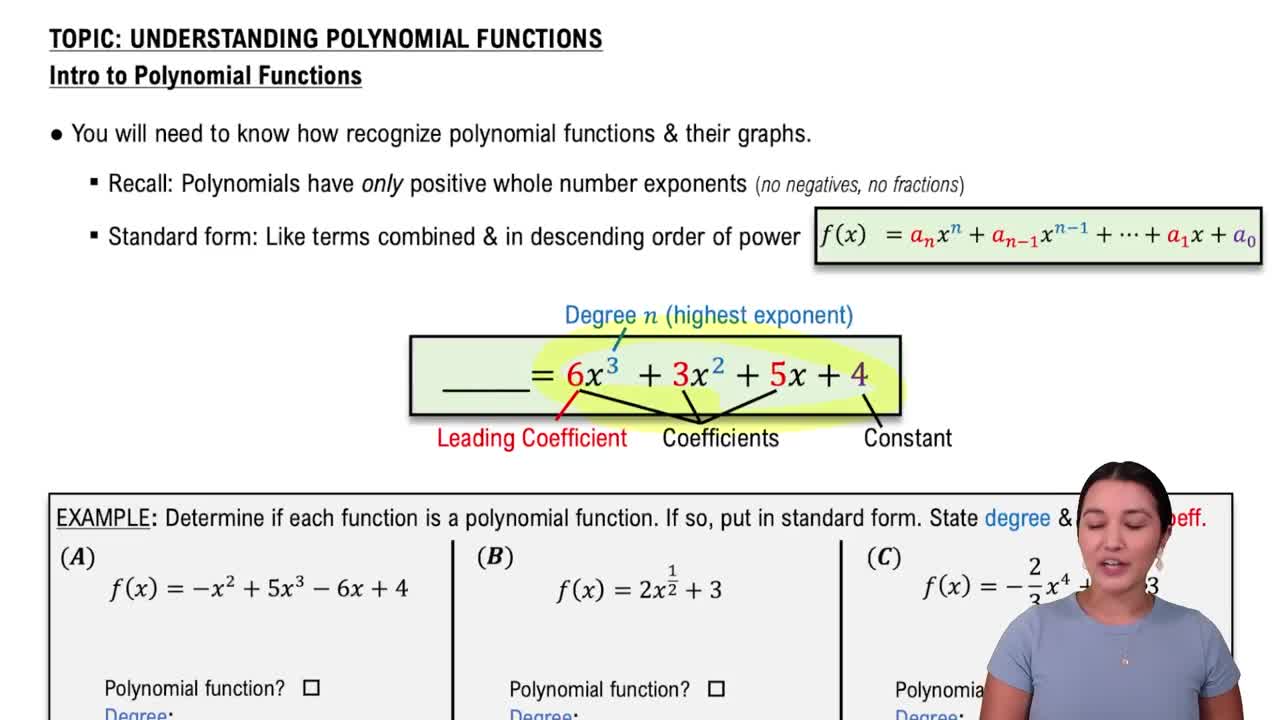
A polynomial function is an expression consisting of variables and coefficients combined using addition, subtraction, multiplication, and non-negative integer exponents. Understanding the structure of polynomial functions helps in evaluating them at specific values, including complex numbers.
The Remainder Theorem states that when a polynomial ƒ(x) is divided by (x - k), the remainder is equal to ƒ(k). This allows us to find the value of the polynomial at k by simply evaluating ƒ(k), without performing full polynomial division.
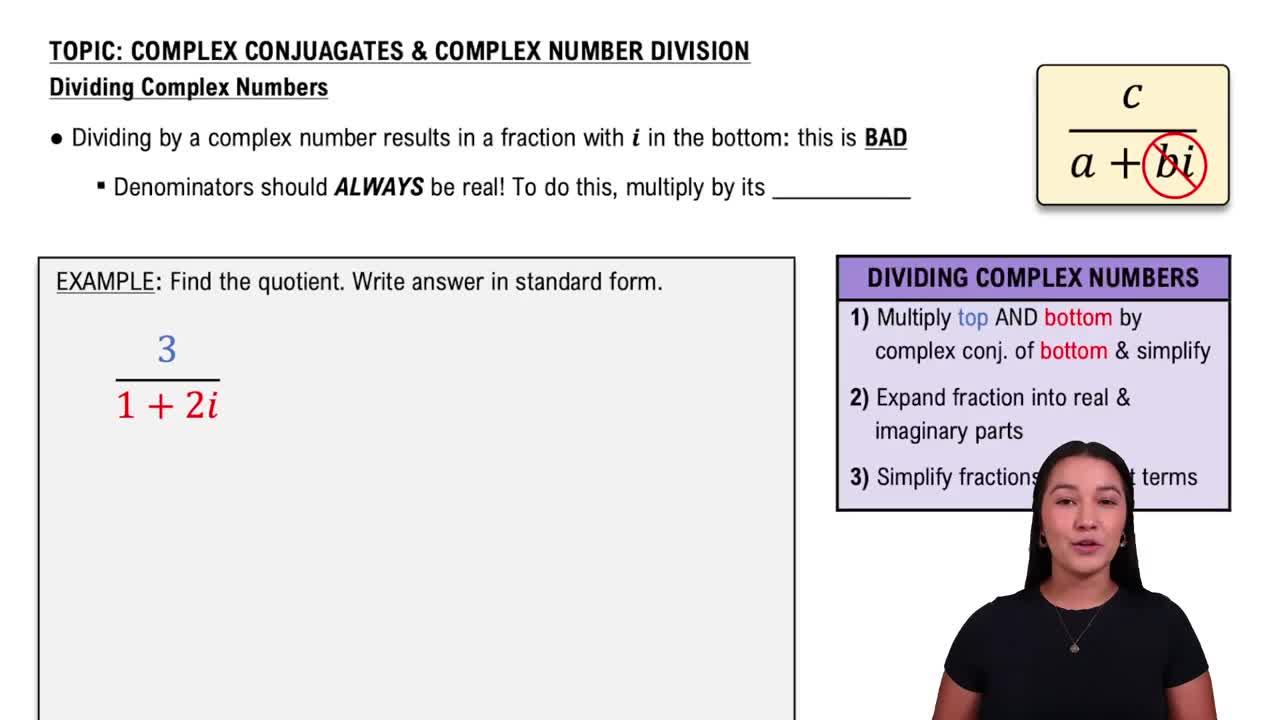
Complex numbers include a real part and an imaginary part, expressed as a + bi, where i is the imaginary unit with i² = -1. Evaluating polynomials at complex values requires substituting and simplifying using the properties of i.

 2:26 minutes
 Verified step by step guidance
 06:04
06:04