In Exercises 69–82, factor completely.12x²y – 46xy² + 14y³
Verified step by step guidance
1
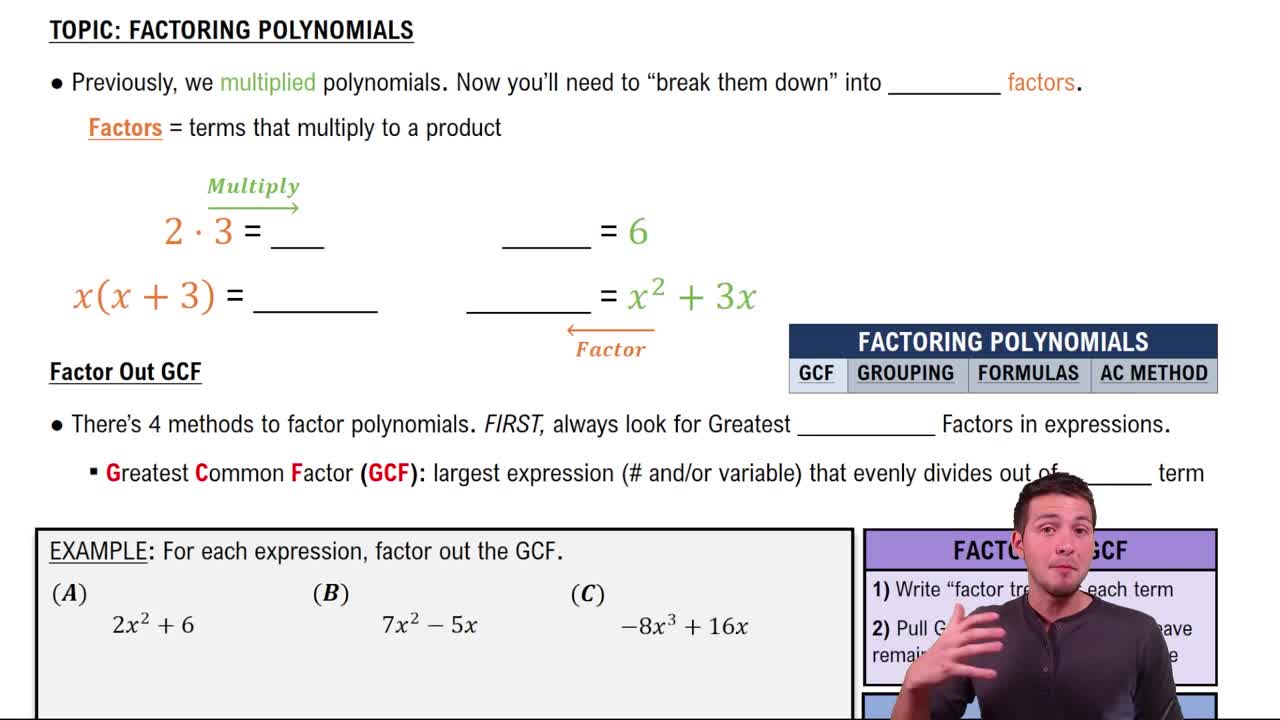
Step 1: Identify the greatest common factor (GCF) of all the terms in the expression. In this case, the GCF is 2y.
Step 2: Factor out the GCF from each term in the expression. This gives us: 2y(6x^2 - 23xy + 7y^2).
Step 3: Focus on the trinomial inside the parentheses: 6x^2 - 23xy + 7y^2. Look for two numbers that multiply to the product of the first and last coefficients (6 * 7 = 42) and add to the middle coefficient (-23).
Step 4: The numbers that satisfy these conditions are -21 and -2. Rewrite the middle term using these numbers: 6x^2 - 21xy - 2xy + 7y^2.
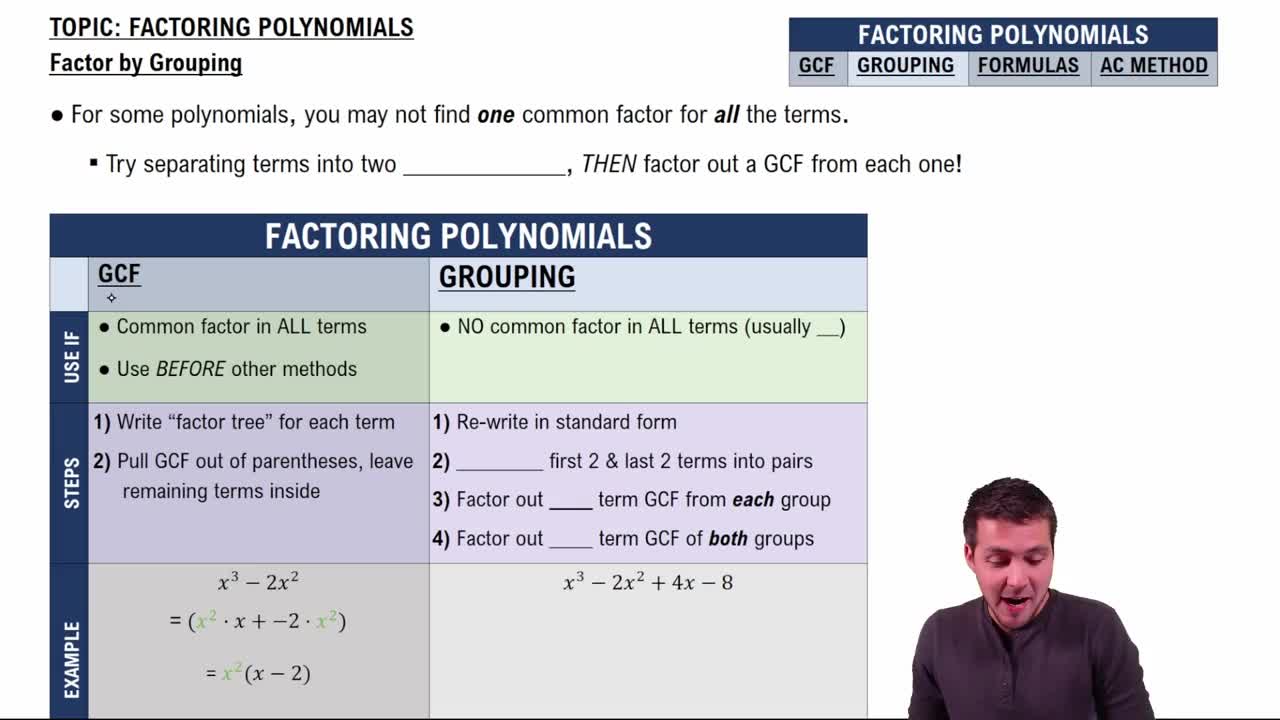
Step 5: Group the terms into pairs and factor by grouping: (6x^2 - 21xy) + (-2xy + 7y^2). Factor out the common factors in each group: 3x(2x - 7y) - y(2x - 7y). Notice the common binomial factor (2x - 7y), and factor it out: (3x - y)(2x - 7y).
Verified video answer for a similar problem:
This video solution was recommended by our tutors as helpful for the problem above
Video duration:
4m
Play a video:
0 Comments
Key Concepts
Here are the essential concepts you must grasp in order to answer the question correctly.
Factoring Polynomials
Factoring polynomials involves rewriting a polynomial expression as a product of its factors. This process is essential for simplifying expressions and solving equations. Common methods include factoring out the greatest common factor (GCF), using special products like the difference of squares, and applying techniques such as grouping.
The greatest common factor (GCF) is the largest factor that divides all terms in a polynomial. Identifying the GCF is the first step in factoring, as it allows for simplification of the polynomial. For the expression 12x²y – 46xy² + 14y³, finding the GCF helps in breaking down the polynomial into simpler components.
The grouping method is a technique used to factor polynomials with four or more terms. It involves rearranging the terms into groups, factoring out the GCF from each group, and then factoring out the common binomial factor. This method is particularly useful when the polynomial does not easily lend itself to other factoring techniques.

 4:15 minutes
 Verified step by step guidance
 07:30
07:30