In Exercises 65–92, factor completely, or state that the polynomial is prime. 20y4−45y2
Verified step by step guidance
1
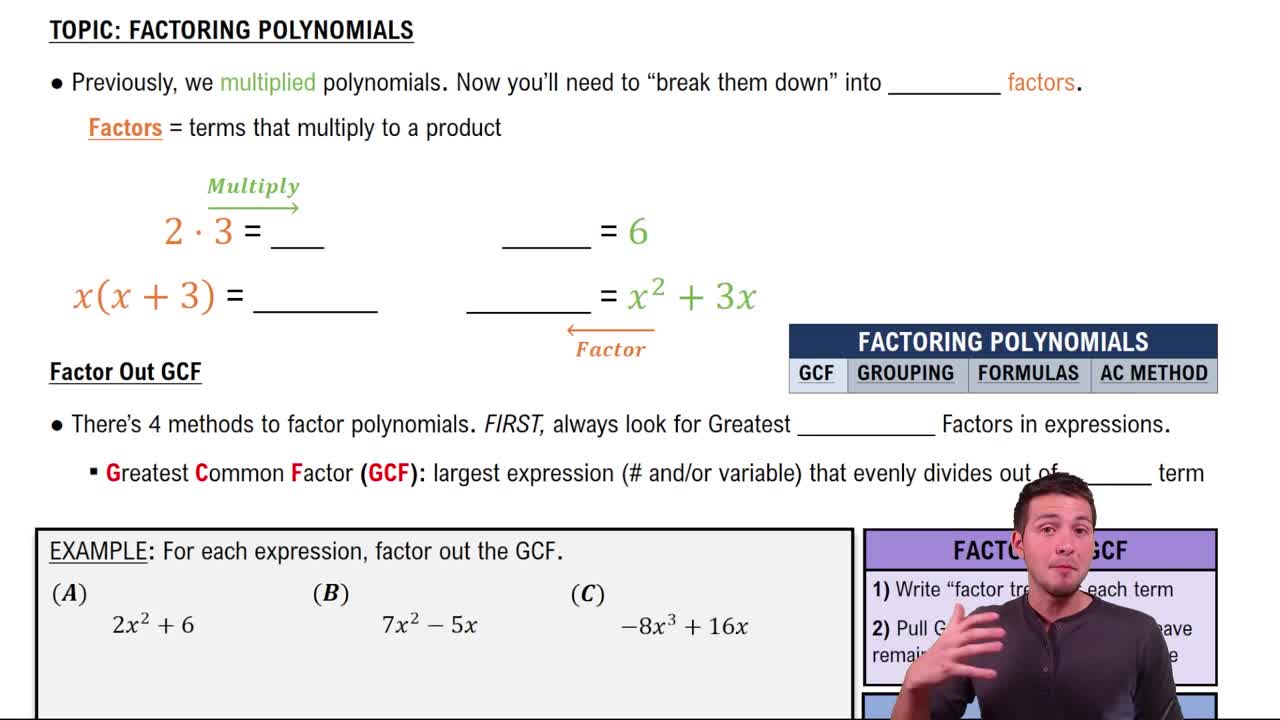
Identify the greatest common factor (GCF) of the terms in the polynomial. The terms are 20y⁴ and -45y². The GCF of the coefficients 20 and -45 is 5, and the smallest power of y common to both terms is y². Therefore, the GCF is 5y².
Factor out the GCF (5y²) from the polynomial. This gives: 5y²(4y² - 9).
Observe the remaining factor, 4y² - 9. Notice that it is a difference of squares because 4y² = (2y)² and 9 = 3².
Apply the difference of squares formula, a² - b² = (a - b)(a + b), to factor 4y² - 9. Here, a = 2y and b = 3, so 4y² - 9 factors into (2y - 3)(2y + 3).
Combine all the factors to write the completely factored form of the polynomial: 5y²(2y - 3)(2y + 3).
Verified video answer for a similar problem:
This video solution was recommended by our tutors as helpful for the problem above
Video duration:
3m
Play a video:
0 Comments
Key Concepts
Here are the essential concepts you must grasp in order to answer the question correctly.
Factoring Polynomials
Factoring polynomials involves breaking down a polynomial expression into simpler components, or factors, that when multiplied together yield the original polynomial. This process often includes identifying common factors, applying special factoring techniques like difference of squares, and recognizing patterns such as perfect squares or cubes.
The Greatest Common Factor (GCF) is the largest factor that divides two or more numbers or terms without leaving a remainder. In polynomial expressions, finding the GCF is a crucial first step in factoring, as it simplifies the polynomial and makes it easier to identify other factors.
A prime polynomial is a polynomial that cannot be factored into simpler polynomials with real coefficients. Recognizing a polynomial as prime is essential when factoring, as it indicates that the polynomial does not have any factors other than itself and one, thus concluding the factoring process.

 3:58 minutes
 Verified step by step guidance
 07:30
07:30