Use the various properties of exponential and logarithmic functions to evaluate the expressions in parts (a)–(c). Given ƒ(x) = log2 x, find ƒ(27)
Table of contents
- 0. Review of Algebra4h 18m
- 1. Equations & Inequalities3h 18m
- 2. Graphs of Equations1h 43m
- 3. Functions2h 17m
- 4. Polynomial Functions1h 44m
- 5. Rational Functions1h 23m
- 6. Exponential & Logarithmic Functions2h 28m
- 7. Systems of Equations & Matrices4h 5m
- 8. Conic Sections2h 23m
- 9. Sequences, Series, & Induction1h 22m
- 10. Combinatorics & Probability1h 45m
6. Exponential & Logarithmic Functions
Properties of Logarithms
Problem 100
Textbook Question
Determine whether each equation is true or false. Where possible, show work to support your conclusion. If the statement is false, make the necessary change(s) to produce a true statement. log6 [4(x + 1)] = log6 (4) + log6 (x + 1)
Verified step by step guidance1
Recall the logarithm property that states: \(\log_b (MN) = \log_b (M) + \log_b (N)\), where \(b\) is the base of the logarithm, and \(M\) and \(N\) are positive numbers.
Identify the terms inside the logarithm on the left side: \$4(x + 1)\( can be seen as the product of \)4\( and \)(x + 1)$.
Apply the logarithm property to the left side: \(\log_6 [4(x + 1)]\) should equal \(\log_6 (4) + \log_6 (x + 1)\) if the property holds.
Since the right side of the equation is exactly \(\log_6 (4) + \log_6 (x + 1)\), the original equation matches the logarithm product rule.
Conclude that the equation is true for all \(x\) where \$4(x + 1) > 0\(, which means \)x > -1$ to keep the logarithms defined.
Verified video answer for a similar problem:This video solution was recommended by our tutors as helpful for the problem above
Video duration:
1mPlay a video:
Key Concepts
Here are the essential concepts you must grasp in order to answer the question correctly.
Properties of Logarithms
Logarithms have specific properties that simplify expressions, such as the product rule: log_b(MN) = log_b(M) + log_b(N). This property allows the logarithm of a product to be expressed as the sum of logarithms, which is essential for verifying or manipulating logarithmic equations.
Recommended video:
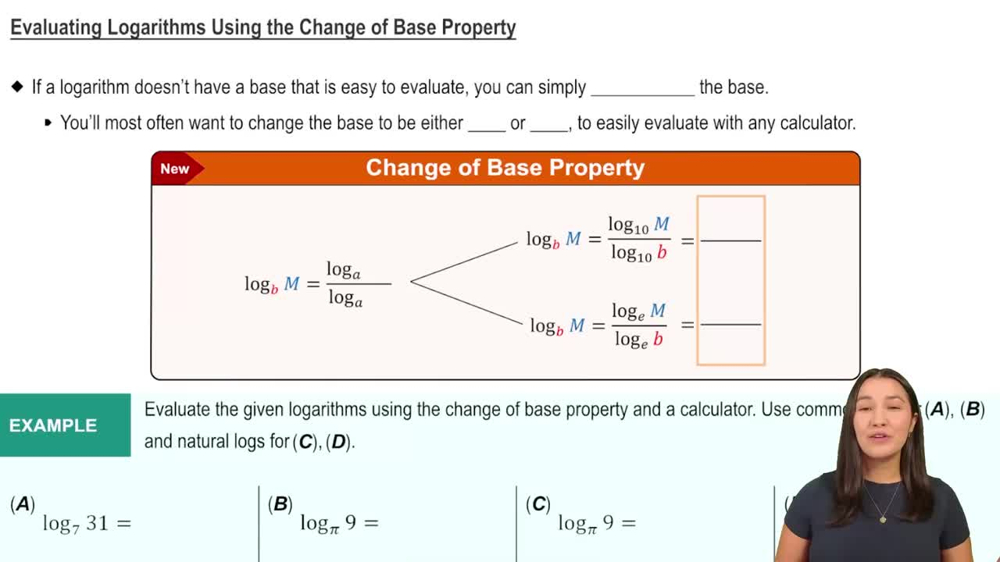
Change of Base Property
Domain of Logarithmic Functions
The domain of a logarithmic function log_b(A) requires that the argument A be positive (A > 0). Understanding this is crucial to determine if expressions like log6(4(x + 1)) and log6(x + 1) are defined, which affects the validity of the equation.
Recommended video:
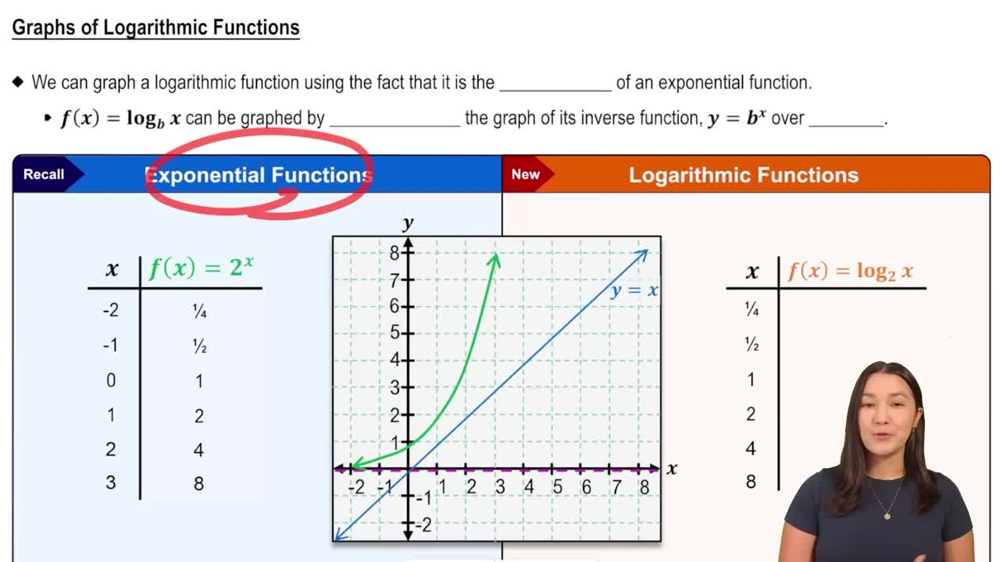
Graphs of Logarithmic Functions
Equation Verification and Transformation
To verify if a logarithmic equation is true, one must apply logarithmic properties correctly and check for equivalence. If false, adjusting the equation by applying correct properties or rewriting terms ensures the statement becomes true, reinforcing understanding of algebraic manipulation.
Recommended video:
Intro to Transformations
Watch next
Master Product, Quotient, and Power Rules of Logs with a bite sized video explanation from Patrick
Start learningRelated Videos
Related Practice
Textbook Question
614
views