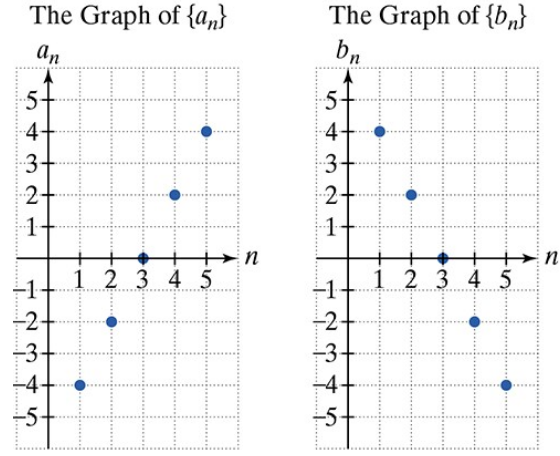
In Exercises 61–68, use the graphs of and to find each indicated sum.
Verified step by step guidance
1
Identify the values of the sequences \(a_n\) and \(b_n\) for \(n = 4\) and \(n = 5\) from the graphs. For \(a_n\), locate the points at \(n=4\) and \(n=5\) on the first graph and note their corresponding \(a_n\) values. For \(b_n\), do the same on the second graph.
Write down the values explicitly: \(a_4\), \(a_5\), \(b_4\), and \(b_5\).
Calculate the ratio \(\frac{a_i}{b_i}\) for each \(i = 4, 5\). This means dividing the \(a_i\) value by the corresponding \(b_i\) value for each index.
Square each ratio to get \(\left(\frac{a_i}{b_i}\right)^2\) for \(i = 4, 5\).
Sum the squared ratios for \(i = 4\) and \(i = 5\) to find \(\sum_{i=4}^5 \left(\frac{a_i}{b_i}\right)^2\).
Verified video answer for a similar problem:
This video solution was recommended by our tutors as helpful for the problem above
Video duration:
6m
Play a video:
0 Comments
Key Concepts
Here are the essential concepts you must grasp in order to answer the question correctly.
Sequences and Terms
A sequence is an ordered list of numbers where each number is called a term, denoted as a_n or b_n. Understanding how to identify and interpret terms from a graph is essential, as each point corresponds to a term's value at a specific index n.
Summation notation, represented by the Greek letter Σ, is used to denote the sum of a sequence of terms. The expression Σ from i=4 to 5 means adding terms starting at i=4 up to i=5, which requires evaluating each term and then summing the results.
This involves performing arithmetic operations on sequence terms, such as division and exponentiation. In this problem, each term a_i is divided by b_i, then squared, and finally summed. Understanding how to manipulate and combine sequence values is crucial.