In Exercises 61–68, use the graphs of and to find each indicated sum.
Verified step by step guidance
1
Step 1: Identify the values of the sequence \( a_n \) for \( n = 1 \) to \( 5 \) from the first graph. Read the y-values of the points at \( n = 1, 2, 3, 4, 5 \).
Step 2: Square each of the values found for \( a_n \) to get \( a_i^2 \) for \( i = 1 \) to \( 5 \).
Step 3: Sum the squared values of \( a_i \) from \( i = 1 \) to \( 5 \) to find \( \sum_{i=1}^5 a_i^2 \).
Step 4: Identify the values of the sequence \( b_n \) for \( n = 3 \) to \( 5 \) from the second graph. Read the y-values of the points at \( n = 3, 4, 5 \).
Step 5: Square each of the values found for \( b_n \) to get \( b_i^2 \) for \( i = 3 \) to \( 5 \), then sum these squared values to find \( \sum_{i=3}^5 b_i^2 \). Finally, subtract this sum from the sum of \( a_i^2 \) values to get the expression \( \sum_{i=1}^5 a_i^2 - \sum_{i=3}^5 b_i^2 \).
Verified video answer for a similar problem:
This video solution was recommended by our tutors as helpful for the problem above
Video duration:
6m
Play a video:
0 Comments
Key Concepts
Here are the essential concepts you must grasp in order to answer the question correctly.
Sequences and Terms
A sequence is an ordered list of numbers, where each number is called a term. Terms are usually denoted as a_n or b_n, where n indicates the position in the sequence. Understanding how to identify and extract specific terms from a graph or formula is essential for evaluating sums involving sequences.
Summation notation uses the Greek letter sigma (Σ) to represent the sum of a sequence of terms. The expression Σ from i=m to n of a_i means adding all terms a_i starting at i=m and ending at i=n. This notation simplifies writing long sums and is crucial for interpreting and calculating sums in algebra.
When a sum involves squares of sequence terms, such as Σ a_i^2, each term a_i must be squared before summing. This requires correctly identifying each term's value from the graph, squaring it, and then adding all squared values. This concept is important for problems involving sums of powers of sequence terms.

 6:41 minutes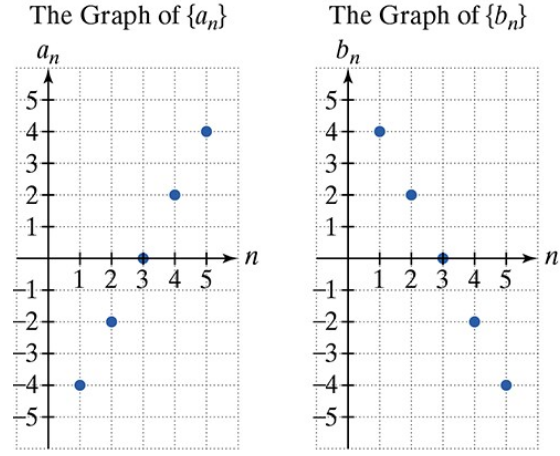
 Verified step by step guidance
 8:22
8:22